This study experimentally tested whether a stressor characterized by social-evaluative threat (SET), a context in which the self can be judged negatively by others, would elicit increases in proinflammatory cytokine activity and alter the regulation of this response. This hypothesis was derived in part from research on immunological responses to social threat in nonhuman animals. Healthy female participants were assigned to perform a speech and a math task in the presence or absence of an evaluative audience (SET or non-SET, respectively). As hypothesized, stimulated production of the proinflammatory cytokine tumor necrosis factor-α (TNF-α) increased from baseline to poststressor in the SET condition, but was unchanged in the non-SET condition. Further, the increases in TNF-α production correlated with participants' cognitive appraisals of being evaluated. Additionally, the ability of glucocorticoids to shut down the inflammatory response was decreased in the SET condition. These findings underscore the importance of social evaluation as a threat capable of eliciting proinflammatory cytokine activity and altering its regulation.
Wednesday, October 21, 2009
Social threat activates our body's inflammatory chemistry
This work from Dickerson et al. is both fascinating and frightening. It provides a more detailed glimpse of how social threat can transmute into self-destructive body chemistry.
Genetic influences increase between early and middle childhood.
From Davis et al.:
The generalist genes hypothesis implies that general cognitive ability (g) is an essential target for understanding how genetic polymorphisms influence the development of the human brain. Using 8,791 twin pairs from the Twins Early Development Study, we examine genetic stability and change in the etiology of g assessed by diverse measures during the critical transition from early to middle childhood. The heritability of a latent g factor in early childhood is 23%, whereas shared environment accounts for 74% of the variance. In contrast, in middle childhood, heritability of a latent g factor is 62%, and shared environment accounts for 33%. Despite increasing importance of genetic influences and declining influence of shared environment, similar genetic and shared environmental factors affect g from early to middle childhood, as indicated by a cross-age genetic correlation of .57 and a shared environmental correlation of .65. These findings set constraints on how genetic and environmental variation affects the developing brain.
Tuesday, October 20, 2009
Cognitive enhancement may come at a cost.
Johan Leher has contributed a fascinating article to Nature News (PDF here) that discusses the 30 or more strains of mice that have been genetically altered to have enhanced memory and problem solving capabilities, and more generally addresses the issue of cognitive enhancement in humans. Many of the mouse mutants have enhanced long term potentiation (LTP) at synapses (a few nerve transmissions between nerve cells enhance further transmissions). LTP is a fundamental feature of learning and memory, and it appears that by increasing its plasticity it is possible to increase cognitive capacity.
The downside of enhancing memory, at least in some unusual humans who have extraordinary memory abilities, is that they appear to be locked in details, unable to understand metaphors or generalize. Martha Farah notes that some human experiments with amphetamines show a trade-off between enhanced attention and performance on creative tasks. "The brain may have made a compromise in that having a more accurate memory interferes with the ability to generalize...You may need a little noise in order to be able to think abstractly, to get beyond the concrete and literal." A further issue is non-cognitive side effects, which have been demonstrated in mice, such as enhanced sensitivity to pain.
The downside of enhancing memory, at least in some unusual humans who have extraordinary memory abilities, is that they appear to be locked in details, unable to understand metaphors or generalize. Martha Farah notes that some human experiments with amphetamines show a trade-off between enhanced attention and performance on creative tasks. "The brain may have made a compromise in that having a more accurate memory interferes with the ability to generalize...You may need a little noise in order to be able to think abstractly, to get beyond the concrete and literal." A further issue is non-cognitive side effects, which have been demonstrated in mice, such as enhanced sensitivity to pain.
The Teddy Bear Effect
An interesting article from Livingston and Pearce, "The Teddy-Bear Effect: Does Having a Baby Face Benefit Black Chief Executive Officers?" The abstract:
Prior research suggests that having a baby face is negatively correlated with success among White males in high positions of leadership. However, we explored the positive role of such "babyfaceness" in the success of high-ranking Black executives. Two studies revealed that Black chief executive officers (CEOs) were significantly more baby-faced than White CEOs. Black CEOs were also judged as being warmer than White CEOs, even though ordinary Blacks were rated categorically as being less warm than ordinary Whites. In addition, baby-faced Black CEOs tended to lead more prestigious corporations and earned higher salaries than mature-faced Black CEOs; these patterns did not emerge for White CEOs. Taken together, these findings suggest that babyfaceness is a disarming mechanism that facilitates the success of Black leaders by attenuating stereotypical perceptions that Blacks are threatening. Theoretical and practical implications for research on race, gender, and leadership are discussed.
Monday, October 19, 2009
Perpetual revelations
Ross Douthat reviews a book, "The Case for God" by Karen Armstrong, that tries to land somewhere between the militant atheists and the religious fundamentalists. Armstrong makes a case for an approach to religion:
...which emphasizes the pursuit of an unknowable Deity, rather than the quest for theological correctness ... compatible with a liberal, scientific, technologically advanced society. She argues that it’s actually truer to the ancient traditions of Judaism, Islam and (especially) Christianity than is much of what currently passes for “conservative” religion. And the neglect of these traditions, she suggests, is “one of the reasons why so many Western people find the concept of God so troublesome today.”
Both modern believers and modern atheists, Armstrong contends, have come to understand religion primarily as a set of propositions to be assented to, or a catalog of specific facts about the nature of God, the world and human life. But this approach to piety would be foreign to many premodern religious thinkers, including the greatest minds of the Christian past, from the early Fathers of the Church to medieval eminences like Thomas Aquinas.
These and other thinkers, she writes, understood faith primarily as a practice, rather than as a system — not as “something that people thought but something they did.” Their God was not a being to be defined or a proposition to be tested, but an ultimate reality to be approached through myth, ritual and “apophatic” theology, which practices “a deliberate and principled reticence about God and/or the sacred” and emphasizes what we can’t know about the divine. And their religion was a set of skills, rather than a list of unalterable teachings — a “knack,” as the Taoists have it, for navigating the mysteries of human existence.
Taking it lying down...
Many cognitive neuroscience measurements are made on subjects who are supine, as for example in an MRI scanner. Given that body postures can affect behaviors (as when slumped postures lead to more 'helpless' behaviors, or erect posture with chest protruding enhances confident behavior) Harmon-Jones and Peterson compared the brain responses of subjects to anger-inducing insults while in either an upright or reclined position . It is know that left prefrontal cortex is more activated than the right prefrontal cortex during the experience of anger, particularly anger associated with approach motivational inclinations. They found, consistent with an embodied motivation prediction, that a insult delivered to subjects in an upright condition produced greater relative left lateral frontal activity than insults in a reclined condition - which produced about the same relative left lateral frontal activity as the neutral-upright condition.
Friday, October 16, 2009
Rational Irrationality
 John Cassidy, in an interesting article in The New Yorker, discusses the inner logic of an economy like ours, in which behavior that is perfectly reasonable on the individual level produces calamity when aggregated in the marketplace. During both rises and falls in the markets, very small perturbations can be magnified by interlocking feedback loops that cause the economy to balloon into either a bubble or a crash.
Calvin Trillin, in a humorous but dead-on piece, has a much more simple model for the meltdown. Wall Street used to be run by the bottom third of the college class, the people who took gut general education courses (such as the Geology course referred to as "Rocks for Jocks"), and they weren't smart enough to invent all these fancy derivative investment vehicles. Then the upper third of the class that used to become teachers, doctors, or lawyers decided they needed to make more money. Mathematicians and physicists poured in to investment houses and invented all the complicated and sophisticated schemes that brought down the system.
Temperature and social proximity
An interesting bit from IJzerman and Semin, who examine the effect of warmth on social proximity:
"Holding warm feelings toward someone" and "giving someone the cold shoulder" indicate different levels of social proximity. In this article, we show effects of temperature that go beyond these metaphors people live by. In three experiments, warmer conditions, compared with colder conditions, induced (a) greater social proximity, (b) use of more concrete language, and (c) a more relational focus. Different temperature conditions were created by either handing participants warm or cold beverages (Experiment 1) or placing them in comfortable warm or cold ambient conditions (Experiments 2 and 3). These studies corroborate recent findings in the field of grounded cognition revealing that concrete experiences ground abstract concepts with which they are coexperienced. Our studies show a systemic interdependence among language, perception, and social proximity: Environmentally induced conditions shape not only language use, but also the perception and construal of social relationships.
Thursday, October 15, 2009
Texting, surfing, studying...
I've done a number of posts on the evils of multitasking (for example here and here, or enter multitasking in the search box in the left column of this blog), and thus was struck by a number of salient points in an article by Perri Klass. Here are some clips:
...A recent and much-discussed study showed decreased productivity in adults who were multitasking...you don’t really multitask, you just think you do; the brain can’t process two high-level cognitive things. What you are actually doing...is oscillating between the two...So are teenagers any better at oscillating?...It may be that multitasking is more of a problem for us old brains...parents are digital immigrants...children are digital natives...they really have come of age with these technologies.One possibility is that performing a task while allowing distractions lengthens the amount of time that can be spent on the task, more than compensating for a decrease in efficiency.
The literature looking at media and its impact on attentional skills is just in its infancy...We don’t really know what they pay attention to, what they don’t. We don’t know how it impacts their school performance, whether it impacts their school performance.
Bright-sided
 Patricia Cohen offers a review of Barbara Ehrenreich's new book “Bright-sided: How the Relentless Promotion of Positive Thinking Has Undermined America,” which takes on the happiness movement, in particular its more extreme proponents. The book, despite its title, it is not a curmudgeonly rant. Ehrenreich found in 2000 that she had breast cancer. The book chronicles:
...her stay in a world that she became intimately familiar with: the smiley-faced, pink-ribboned, positive-thinking culture that surrounds breast cancer patients...The unrelenting message was “that you had to be cheerful and accepting and that you would not recover unless you were...It’s a clever blame-the-victim sort of thing.”
Then the financial crisis hit. “Wham,” she said. “It was so clear to me that it was connected.” The relentlessly optimistic forecasts about subprime mortgages and endless increases in real estate values were the product of the positive-thinking culture. One of the fundamental tenets of the literature, Ms. Ehrenreich said, is to surround yourself with other positive thinkers and “get rid of negative people...
We’ve been weeding out anybody capable of rational thinking, of realism.”
In “Bright-sided,” she traces the roots of the nation’s blithe sunniness to a reaction against Calvinist gloom and the limits of medical science in the first half of the 19th century. Starting with Phineas Parkhurst Quimby, perhaps one of the first American New Age faith healers, she draws a line to Mary Baker Eddy, the founder of Christian Science; the psychologist William James; Ralph Waldo Emerson; Norman Vincent Peale, who published “The Power of Positive Thinking” in 1952; and the toothy television minister Joel Osteen, who preaches the gospel of prosperity...To Ms. Ehrenreich, the reliance on one’s personal disposition shifts attention from the larger social, political and economic forces behind poverty, unemployment and poor health care. “It can’t all be fixed by assertiveness training...All that shiny optimism, she said, was “like sitting in a warm bubble bath for too long.”
Wednesday, October 14, 2009
The illusion of sex
Here is a figure from a neat article (PDF here) by Richard Russell illustrating how facial contrast and cosmetics can alter the perceived sex of an androgynous face.

The Illusion of Sex. The face on the left appears male, while the face on the right appears female. Both images were produced by making slight alterations to the same original image. The eyes and lips were unaltered, and hence equally dark in both images. The remainder of the image was darkened to produce the left image, and lightened to produce the right image. The eyes and lips may appear darker in the right image than in the left image, but are notöit is an example of simultaneous contrast.

The Illusion of Sex. The face on the left appears male, while the face on the right appears female. Both images were produced by making slight alterations to the same original image. The eyes and lips were unaltered, and hence equally dark in both images. The remainder of the image was darkened to produce the left image, and lightened to produce the right image. The eyes and lips may appear darker in the right image than in the left image, but are notöit is an example of simultaneous contrast.
The neuropsychology of religion - neural correlates of belief
Sam Harris (the guy who wrote "The End of Faith" and "Letters to a Christian Nation"), along with a group of collaborators, has made fMRI measurements on fifteen committed Christians and fifteen nonbelievers as they evaluated the truth and falsity of religious and nonreligious propositions. Religious thinking is more associated with brain regions that govern emotion, self-representation, and cognitive conflict, while thinking about ordinary facts is more reliant upon memory retrieval networks.
Tuesday, October 13, 2009
Facial width-to-height ratio predicts aggression
Carré et al. find that observers can make accurate judgments of propensity for aggression in men from faces displaying neutral expressions, even when exposure to the faces is limited to 39 ms. Individual participants reliably judged men with larger facial width to height ratios as more aggressive. Here is their abstract and a figure from the paper showing the width and height determination:

Facial width-to-height ratio is a sexually dimorphic metric that is independent of body size and may have been shaped by sexual selection. We recently showed that this metric is correlated with behavioral aggression in men. In Study 1, observers estimated the propensity for aggression of men photographed displaying neutral facial expressions and for whom a behavioral measure of aggression was obtained. The estimates were correlated strongly with the facial width-to-height ratio of the stimulus faces and with the actual aggression of the men. These results were replicated in Study 2, in which the exposure to each stimulus face was shortened to 39 ms. Participants' estimates of aggression for each stimulus face were highly correlated between Study 2 (39-ms exposure) and Study 1 (2,000-ms exposure). These findings suggest that the facial width-to-height ratio may be a cue used to predict propensity for aggression in others.

Predicting our choice between risky and safe options..
This recent work from Schultz, Dolan and collaborators suggests brain imaging might be able to predict risky versus safe behaviors in a given choice context:
Decision making under risk is central to human behavior. Economic decision theory suggests that value, risk, and risk aversion influence choice behavior. Although previous studies identified neural correlates of decision parameters, the contribution of these correlates to actual choices is unknown. In two different experiments, participants chose between risky and safe options. We identified discrete blood oxygen level-dependent (BOLD) correlates of value and risk in the ventral striatum and anterior cingulate, respectively. Notably, increasing inferior frontal gyrus activity to low risk and safe options correlated with higher risk aversion. Importantly, the combination of these BOLD responses effectively decoded the behavioral choice. Striatal value and cingulate risk responses increased the probability of a risky choice, whereas inferior frontal gyrus responses showed the inverse relationship. These findings suggest that the BOLD correlates of decision factors are appropriate for an ideal observer to detect behavioral choices. More generally, these biological data contribute to the validity of the theoretical decision parameters for actual decisions under risk.
Monday, October 12, 2009
Personalized genetics and medicine
An article by Pauline C. Ng, Sarah S. Murray, Samuel Levy and J. Craig Venter finds differences in results from two direct to consumer genetics testing companies. Their summary:
* For seven diseases, 50% or less of the predictions of two companies agreed across five individualsAlso Lahn and Ebenstein argue that the discovery of genetic diversity among groups of people as well as among individuals should be embraced, not feared. Their summary:
* Companies should communicate high risks better and test for drug response markers
* Community should study markers in all ethnicities and look at behaviour after tests
* Promoting biological sameness in humans is illogical, even dangerous
* To ignore the possibility of group diversity is to do poor science and poor medicine
* A robust moral position is one that embraces this diversity as among humanity's great assets
Gene therapy restores vision to color-blind monkeys
An Editor's summary in the Oct. 8 Nature describes a remarkable finding, and Shapley discusses the work described in the paper by Mancuso et al. :
It is often assumed that critical periods exist for the development of vision and other neural capabilities and that they end prior to adolescence. For example, it might be expected that gene therapy in adults with congenital vision disorders would be impossible. But experiments in adult spider monkeys who are normally red–green colour blind show that it is possible to add a third photopigment (human opsin) into some of their retinal cells by gene therapy. The monkeys acquire a new dimension of colour vision as a result. Not only does this suggest a possible therapy for a common congenital visual defect in humans (clinical trials are now under way), but also it demonstrates the extreme neuroplasticity of visual processing and points to possible routes by which trichromatic vision evolved.
Friday, October 09, 2009
How nonsense sharpens our intellect
Benedict Carey points to an article in Psychological Science that I scanned past without realizing its interest. Proulx and Heine show that a threat to our sense of coherence or meaning in one area (such as reading an absurd short story by Kafka) enhances our ability to unconsciously detect patterns within letter strings (an artificial grammar task). Encountering incoherence apparently primes our brains to detect patterns they might otherwise miss. The idea is that the brain evolved to predict, and it does so by identifying patterns. The process is enhanced by a threat to meaning. (It is also important to evaluate the possibility that nervousness, not a search for meaning, leads to heightened vigilance.)
Mummy Recipe Hard to Follow
 Another gem from the Random Samples section of the Oct. 2 Science Magazine:
Frank Rühli wants to know just how the Egyptians did it. So he is trying to mummify human legs.
Rühli, a physician and head of the Swiss Mummy Project at the University of Zurich, and his collaborators severed the legs from a female donor body. One, the "control leg," was kept in an oven at 40°C and low humidity to replicate "natural mummification" in the Egyptian desert. The other leg, as described in ancient Egyptian records, was put on a pine board and covered with natron, a blend of four sodium compounds that pulls moisture out of the tissue. The researchers left it at 23°C to see what natron would do in the Swiss environment.
Other researchers have tried mummifying human remains. But the Swiss group is using advanced imaging technology, biopsies, and tests of DNA degradation for moment-by-moment analysis of the mummification process.
So far, the researchers have found that mummification in Zurich takes longer than expected: After 3 months, scans showed that the natron leg still had pockets of humidity, Rühli says. They have also discovered that storing an untreated leg in the heat doesn't work well. The control leg failed to dry out and started to decompose after a week. Rühli plans to repeat the experiment, this time encasing the control leg in hot sand.
Thursday, October 08, 2009
Where our brain computes value.
From Chib et al.:
To make economic choices between goods, the brain needs to compute representations of their values. A great deal of research has been performed to determine the neural correlates of value representations in the human brain. However, it is still unknown whether there exists a region of the brain that commonly encodes decision values for different types of goods, or if, in contrast, the values of different types of goods are represented in distinct brain regions. We addressed this question by scanning subjects with functional magnetic resonance imaging while they made real purchasing decisions among different categories of goods (food, nonfood consumables, and monetary gambles). We found activity in a key brain region previously implicated in encoding goal-values: the ventromedial prefrontal cortex (vmPFC) was correlated with the subjects' value for each category of good. Moreover, we found a single area in vmPFC to be correlated with the subjects' valuations for all categories of goods. Our results provide evidence that the brain encodes a "common currency" that allows for a shared valuation for different categories of goods.
Shrinking the Shrinks
From the Random Samples section of the Oct. 2 Science Magazine (I was not successful in spotting the report mentioned on the APS website):
Many training programs for clinical psychologists in the United States should be scrapped, an organization of psychologists says. In a report to be released this month, the Association for Psychological Science (APS) calls for more scientific rigor in psychotherapy. "Clinical psychology resembles medicine at a point in its history when practitioners were operating in a largely prescientific manner," it says. Therapists' "lack of adequate science training ... leads them to value personal clinical experience over research evidence." The report lambastes the American Psychological Association (APA)—which comprises mainly clinical psychologists—for lax accreditation standards and proposes a new mechanism for certifying Ph.D. training programs.
Psychologist Scott Lilienfeld of Emory University in Atlanta praises the report, saying, "Far too many practitioners are administering unsubstantiated or untested intervention." But he worries that its proposals would freeze out Psy.D. programs, nonresearch degrees begun in the 1970s, which now turn out about half of the nation's clinical psychologists.
Jeffrey Zeig, a clinical psychologist and director of the Milton H. Erikson Foundation in Phoenix, says psychotherapy is much too diverse to be constrained by APS definitions. "There are more than 1,000,000 therapists in the U.S., and only a fraction" have Ph.D.s, says Zeig, who predicts the report "will have as much effect as a breeze has on a leaf."
But report co-author Timothy Baker of the University of Wisconsin School of Medicine and Public Health in Madison predicts that it "will ultimately reshape clinical psychology just as the [1910] Flexner Report reshaped medicine," leading to the closure of almost half the nation's medical schools.
The high price of being a gay couple.
My partner and I live in Madison, Wisconsin. The state legislature recently passed a bill granting domestic partnerships a small fraction of the benefits that go with conventional marriage (like being able to visit your ill partner in the hospital, or by default have health care or legal power of attorney if one partner is incapacitated.) This bill is being challenged in court by the same right wing religious nuts who backed the successful drive to add a state constitutional amendment banning gay marriage. I've become acutely aware of some of the financial downside of being a gay couple over the past 20 years of my current partnership, having been in a conventional marriage for 21 years before that. Now some hard numbers on just how unfair the situation is have been generated by Bernard and Lieber in the New York Times. The lifetime penalty for being in a same-sex couple can range between ~$30,000 and ~$200,000, depending on the circumstance.
Wednesday, October 07, 2009
How our brain's hard wiring is hooked by texting, twitter, email, googling...
 As a companion to the previous post on distinguishing 'wanting' and 'liking' I would like to point you to an engaging article in Slate by Emily Yoffe (thanks to my son Jon for pointing it out to me). She discusses the work from researchers like Jaak Panksepp and Kent Berridge (the subjects of several mindblog posts over the past few years) that suggests the biological basis of our addiction to email, google, twitter, texting, etc.
The juice that fuels the seeking system is the neurotransmitter dopamine. The dopamine circuits "promote states of eagerness and directed purpose," Panksepp writes. It's a state humans love to be in. So good does it feel that we seek out activities, or substances, that keep this system aroused—cocaine and amphetamines, drugs of stimulation, are particularly effective at stirring it.
Ever find yourself sitting down at the computer just for a second to find out what other movie you saw that actress in, only to look up and realize the search has led to an hour of Googling? Thank dopamine. Our internal sense of time is believed to be controlled by the dopamine system. People with hyperactivity disorder have a shortage of dopamine in their brains, which a recent study suggests may be at the root of the problem. For them even small stretches of time seem to drag. An article by Nicholas Carr in the Atlantic last year, "Is Google Making Us Stupid?" speculates that our constant Internet scrolling is remodeling our brains to make it nearly impossible for us to give sustained attention to a long piece of writing. Like the lab rats, we keep hitting "enter" to get our next fix.
Wanting is Berridge's equivalent for Panksepp's seeking system. It is the liking system that Berridge believes is the brain's reward center. When we experience pleasure, it is our own opioid system, rather than our dopamine system, that is being stimulated. This is why the opiate drugs induce a kind of blissful stupor so different from the animating effect of cocaine and amphetamines. Wanting and liking are complementary. The former catalyzes us to action; the latter brings us to a satisfied pause. Seeking needs to be turned off, if even for a little while, so that the system does not run in an endless loop. When we get the object of our desire (be it a Twinkie or a sexual partner), we engage in consummatory acts that Panksepp says reduce arousal in the brain and temporarily, at least, inhibit our urge to seek.
But our brains are designed to more easily be stimulated than satisfied. "The brain seems to be more stingy with mechanisms for pleasure than for desire," Berridge has said. This makes evolutionary sense. Creatures that lack motivation, that find it easy to slip into oblivious rapture, are likely to lead short (if happy) lives. So nature imbued us with an unquenchable drive to discover, to explore. Stanford University neuroscientist Brian Knutson has been putting people in MRI scanners and looking inside their brains as they play an investing game. He has consistently found that the pictures inside our skulls show that the possibility of a payoff is much more stimulating than actually getting one.
Actually all our electronic communication devices—e-mail, Facebook feeds, texts, Twitter—are feeding the same drive as our searches. Since we're restless, easily bored creatures, our gadgets give us in abundance qualities the seeking/wanting system finds particularly exciting. Novelty is one. Panksepp says the dopamine system is activated by finding something unexpected or by the anticipation of something new. If the rewards come unpredictably—as e-mail, texts, updates do—we get even more carried away. No wonder we call it a "CrackBerry."
"Wanting" what was never "liked"
Work from Berridge and collaborators shows in rat experiments that pathways in the ventral pallidum that fire when a cue to a previously liked stimulus (such as sucrose) is presented - but do not fire with a cue of the previously "disliked" taste of intense salt - can suddenly become activated if the salt cue is encountered in a never-before-experienced state of physiological salt depletion. This means that dynamic recomputation of cue-triggered "wanting" signals can occur in real time at the moment of cue re-encounter by combining a previously learned Pavlovian associations with novel physiological information about a current state of specific appetite.
Tuesday, October 06, 2009
Long live quest gets respect? The 120 Club.
Nicholas Wade notes a recent meeting on aging at Harvard Medical School (Some of the participants belong to the "120 Club," whose members propose to live until they are 120). His article focuses on work of David Sinclair and Sirtris Pharmaceuticals .
...In mice, sirtuin activators are effective against lung and colon cancer, melanoma, lymphoma, Type 2 diabetes, cardiovascular disease and Alzheimer’s disease...SRT-501, the company’s special formulation of resveratrol, is being tested against two cancers, multiple myeloma and colon cancer that has spread to the liver. A chemical mimic of resveratrol, known as SRT-2104, is in a Phase 2 trial for Type 2 diabetes, and in a Phase 1 trial in elderly patients. (Phase 1 trials test for safety, Phase 2 for efficacy.)...unpublished tests in mice showed that another chemical mimic, SRT-1720, increased both health and lifespan; after two years, twice as many mice taking the drug were alive compared with the undosed animals. Resveratrol itself has not been shown to increase lifespan in normal mice, although it does so in obese mice, laboratory roundworms and flies.
Brain organization of our defensive fear system.
Mobbs et al. show that higher forebrain areas are involved in early-threat responses, including the assignment and control of fear, whereas imminent danger results in fast more "hard-wired" defensive reactions mediated by our midbrain.
Monday, October 05, 2009
Seeing our body reduces pain
An interesting report from Longo et al. :
Given previous reports of strong interactions between vision and somatic senses, we investigated whether vision of the body modulates pain perception. Participants looked into a mirror aligned with their body midline at either the reflection of their own left hand (creating the illusion that they were looking directly at their own right hand) or the reflection of a neutral object. We induced pain using an infrared laser and recorded nociceptive laser-evoked potentials (LEPs). We also collected subjective ratings of pain intensity and unpleasantness. Vision of the body produced clear analgesic effects on both subjective ratings of pain and the N2/P2 complex of LEPs. Similar results were found during direct vision of the hand, without the mirror. Furthermore, these effects were specific to vision of one's own hand and were absent when viewing another person's hand. These results demonstrate a novel analgesic effect of non-informative vision of the body.
When errors are rewarding
de Bruijn et al. show a clear distinction between error and reward processing in our brains:
For social beings like humans, detecting one's own and others' errors is essential for efficient goal-directed behavior. Although one's own errors are always negative events, errors from other persons may be negative or positive depending on the social context. We used neuroimaging to disentangle brain activations related to error and reward processing, by manipulating the social context (cooperation or competition). Activation in posterior medial frontal cortex (pMFC) was increased for all errors, independent of who made the error or the reward outcome. Conversely, activity in striatum was modulated by reward, independent of whether the action was erroneous or not. The results demonstrate a clear distinction between error and reward processing in the human brain. Importantly, the current study indicates that error detection in pMFC is independent of reward and generalizes beyond our own actions, highlighting its role in optimizing performance in both individual and joint action.
The anxious temperament.
There is an engaging article by Henig in yesterday's New York Times Magazine: "Understanding the anxious mind." It focuses on the famous work of Jerome Kagan at Harvard; who, along with others, has shown that some of us are born with a predisposition to be timid and anxious.
Friday, October 02, 2009
Memory consolidation - a shift from hippocampal to neocortical sites
Work from Takashima et al. confirms the idea that the retrieval network for memories shifts away from using the hippocampus as the memories grow older and are consolidated in the neocortex. They use MRI measurement to observe this shift:
The standard model of system-level consolidation posits that the hippocampus is part of a retrieval network for recent memories. According to this theory, the memories are gradually transferred to neocortical circuits with consolidation, where the connections within this circuit grow stronger and reorganized so that redundant and/or contextual details may be lost. Thus, remote memories are based on neocortical networks and can be retrieved independently of the hippocampus. To test this model, we measured regional brain activity and connectivity during retrieval with functional magnetic resonance imaging. Subjects were trained on two sets of face–location association and were tested with two different delays, 15 min and 24 h including a whole night of sleep. We hypothesized that memory traces of the locations associated with specific faces will be linked through the hippocampus for the retrieval of recently learned association, but with consolidation, the activity and the functional connectivity between the neocortical areas will increase. We show that posterior hippocampal activity related to high-confidence retrieval decreased and neocortical activity increased with consolidation. Moreover, the connectivity between the hippocampus and the neocortical regions decreased and in turn, cortico-cortical connectivity between the representational areas increased. The results provide mechanistic support for a two-level process of the declarative memory system, involving initial representation of new associations in a network including the hippocampus and subsequent consolidation into a predominantly neocortical network.
Mindblog backlog...
Another compilation of items that are potentially interesting to some MindBlog readers:
Two Blogs of interest: Body in Mind (self explanatory) and Phenomics (on more intelligent description of personality dysfunction based on underlying genetic heterogeneity, and how the the Diagnostic and Statistical Manual of Mental Disorders actually impedes research and understanding.)
The robot that breaks and reassembles itself.
Why we need God. From Robert Wright, author of “The Moral Animal,” “Nonzero” and, most recently, “The Evolution of God.”
Eyes Wide Shut - perceived emotionality of music, eye closure, and the amygdala.
Brain pathology in athletes appears at an unusually young age.
Numbers in the Blind's “Eye.” Both blind and sighted people represent numbers through a spatial code, but with different electrophysiological correlates corresponding to cognitive versus sensory processing.
Gates Puts Feynman Lectures Online. These famous lectures can show you that there really is joy in physics. I was overwhelmed when I first saw some of them in my college days.
Knowledge rewards. It turns out that the size of coming rewards is signalled by the same dopamine neurons that signal primitive rewards like sex and food. Two monkeys were trained to glance at one of two targets on a computer screen in order to receive a drink reward, which was randomly large or small. When one target included information about reward size the monkeys preferred to go for that target, rather than be surprised by a randomly sized reward. Neurons in the brain's 'reward' circuitry fired when the monkeys learned information about the future, suggesting that the act of prediction may be intrinsically rewarding.
Yet another theory on why we sleep ...suggestion that sleep evolved to optimize animals’ use of time, keeping them safe and hidden when the hunting, fishing or scavenging was scarce and perhaps risky. In that view, differences in sleep quality, up to and including periods of insomnia, need not be seen as problems but as adaptations to the demands of the environment.
Two Blogs of interest: Body in Mind (self explanatory) and Phenomics (on more intelligent description of personality dysfunction based on underlying genetic heterogeneity, and how the the Diagnostic and Statistical Manual of Mental Disorders actually impedes research and understanding.)
The robot that breaks and reassembles itself.
Why we need God. From Robert Wright, author of “The Moral Animal,” “Nonzero” and, most recently, “The Evolution of God.”
Eyes Wide Shut - perceived emotionality of music, eye closure, and the amygdala.
Brain pathology in athletes appears at an unusually young age.
Numbers in the Blind's “Eye.” Both blind and sighted people represent numbers through a spatial code, but with different electrophysiological correlates corresponding to cognitive versus sensory processing.
Gates Puts Feynman Lectures Online. These famous lectures can show you that there really is joy in physics. I was overwhelmed when I first saw some of them in my college days.
Knowledge rewards. It turns out that the size of coming rewards is signalled by the same dopamine neurons that signal primitive rewards like sex and food. Two monkeys were trained to glance at one of two targets on a computer screen in order to receive a drink reward, which was randomly large or small. When one target included information about reward size the monkeys preferred to go for that target, rather than be surprised by a randomly sized reward. Neurons in the brain's 'reward' circuitry fired when the monkeys learned information about the future, suggesting that the act of prediction may be intrinsically rewarding.
Yet another theory on why we sleep ...suggestion that sleep evolved to optimize animals’ use of time, keeping them safe and hidden when the hunting, fishing or scavenging was scarce and perhaps risky. In that view, differences in sleep quality, up to and including periods of insomnia, need not be seen as problems but as adaptations to the demands of the environment.
Thursday, October 01, 2009
How our brain remembers the consequences of our actions
A fundamental building block in shaping our behavior is the relationship between a sensory event, a chosen action and its consequences. Histed et al. now point to how the brain stores this information by showing that neurons in the monkey prefrontal cortex and basal ganglia display persistent activity that is related to the outcomes of previous actions. Seo and Lee review this work in Nature, noting in the figure the sort of stimulus, action, outcome sequence that is in question :

Basically, the data suggest that the prefrontal cortex and basal ganglia might be essential brain areas for storing information about action–outcome associations

Basically, the data suggest that the prefrontal cortex and basal ganglia might be essential brain areas for storing information about action–outcome associations
Mindblindness in Asperger's syndrome
Recent work by Senju et al. is summarized in Science:
Placement of Asperger syndrome within the family of autism spectrum disorders (ASD) has always been a bit uneasy; although people with Asperger syndrome do exhibit the core impairments in social interaction and communication that are characteristic of ASD, they nevertheless perform well on tests that are thought to assess the ability to mentalize or to possess Theory of Mind skills. One of the classic tests of mentalizing ability is the false-belief task, in which subjects must be able to represent their own beliefs (true) and another's beliefs, which are false because they have not been given complete information, such as not having seen the transfer of a piece of candy from one drawer to another. People with Asperger syndrome succeed at the verbal form of the false-belief task, yet Senju et al. show that this is owing entirely to their having learned how to cope with an existing and still demonstrable deficit in an implicit version of the false-belief task. That is, the core impairment is present, but conscious and explicit learning allows them to compensate.Here is the Senju et al. abstract:
Adults with Asperger syndrome can understand mental states such as desires and beliefs (mentalizing) when explicitly prompted to do so, despite having impairments in social communication. We directly tested the hypothesis that such individuals nevertheless fail to mentalize spontaneously. To this end, we used an eye-tracking task that has revealed the spontaneous ability to mentalize in typically developing infants. We showed that, like infants, neurotypical adults’ (n = 17 participants) eye movements anticipated an actor’s behavior on the basis of her false belief. This was not the case for individuals with Asperger syndrome (n = 19). Thus, these individuals do not attribute mental states spontaneously, but they may be able to do so in explicit tasks through compensatory learning.
Wednesday, September 30, 2009
Green Porno.
 In the 25 Sept. issue of Science Magazine, the Gonzo Scientist points us to these humorous performances on the Sundance channel (worth checking out) by Isabella Rossellini. She offers a series of brief video performances, between 1 and 2 minutes long, in which she dresses in elaborate animal costumes to paint a miniportrait of several organisms, describing key features of their physiology and behavior - in particular their reproductive biology.
A new chemical fix for chronic depression??
Maybe, for mice. With the results possibly relevant to us. There is evidence, obtained from both post-mortem human brains and from animal experiments, that persistent depression may involve long term chemical changes in gene-protein complexes called chromatin. Covington et al find that chronic social defeat stress in mice causes a transient decrease, followed by a persistent increase, in levels of acetylated histone H3 (a chromatin protein) in the nucleus accumbens, an important limbic brain region. They then find that infusion into this region of inhibitors of the enzyme that removes acetate groups lessens behavioral symptoms of depression and also reverses the effects of chronic defeat stress on global patterns of gene expression in the nucleus accumbens.
Out of Africa
The Sept. 22 issue of P.N.A.S. has a special section of articles on human evolution. The abstract of Ian Tattersall's introductory to this section has a nice summary:
Our species, Homo sapiens, is highly autapomorphic (uniquely derived) among hominids in the structure of its skull and postcranial skeleton. It is also sharply distinguished from other organisms by its unique symbolic mode of cognition. The fossil and archaeological records combine to show fairly clearly that our physical and cognitive attributes both first appeared in Africa, but at different times. Essentially modern bony conformation was established in that continent by the 200–150 Ka range (a dating in good agreement with dates for the origin of H. sapiens derived from modern molecular diversity). The event concerned was apparently short-term because it is essentially unanticipated in the fossil record. In contrast, the first convincing stirrings of symbolic behavior are not currently detectable until (possibly well) after 100 Ka. The radical reorganization of gene expression that underwrote the distinctive physical appearance of H. sapiens was probably also responsible for the neural substrate that permits symbolic cognition. This exaptively acquired potential lay unexploited until it was “discovered” via a cultural stimulus, plausibly the invention of language. Modern humans appear to have definitively exited Africa to populate the rest of the globe only after both their physical and cognitive peculiarities had been acquired within that continent.
Tuesday, September 29, 2009
Nutrition and Violence
In the Sept. 25 issue of Science John Bohannon describes work of Oxford's Bernard Gesch and others studying prison populations for evidence of links between nutrition and violent behavior. Two previous studies have shown that prisoners given nutritional supplements committed ~35% fewer violent incidences than those given a placebo, and a more ambitious study of over 1,000 prisoners in three U.K. prisons started this spring. The article offers a summary table which I pass on here:


How would you control eight legs?
It's a problem, if you are an octopus, because you have the challenge of controlling eight appendages that can assume an almost limitless number of positions. Zulio et al. (the paper has a neat video) show that the octopus brain takes a very different tack from our own. Instead of having a specific body part controlled by a specific area of the the brain (as in our brains), the control of complex, coordinated movements is consolidated into specific areas of the nervous system. They placed 35 electrodes to micro-stimulate higher motor centers (in the basal lobes)in free moving animals. Low-voltage stimulation of different areas evokes simple responses, such as a change in skin colour or small eyelid movements. Higher voltages elicit more complex responses, such as inking and jet-propelled swimming. Discrete and complex components have no central topographical organization but are distributed over wide regions. They found no stimulation site where movements of a single arm or body part could be elicited.
The Mind and LIfe Institute
Here is the link to download the Autumn 2009 Newsletter of the Mind and Life Institute. It describes the Mind and Life Education and Research Network, a multidisciplinary intellectual forum dedicated to investigating issues at the intersection of mind, brain, education and contemplative practice.
Monday, September 28, 2009
Size matters...
I work out every day in the university gym, where in the shower room it is obvious that the large more macho males subtly (or not so subtly) check out the 'packages' of their shower mates. Here's the payoff in another species, illustrated by Kahn et al.'s study showing that female mate preference in mosquitofish is influenced by size of male genitalia. The tested female preference for males that had had their genitalia considerably reduced in size by surgery compared with those with only a minor reduction (see figure). They found that females spent, on average, around one-and-a-half times longer associating with the better-endowed males. This preference was, however, only expressed when females chose between two large males; for small males, there was no effect of genital size on female association time.
 Representative G. holbrooki showing the difference between wild-type (not used in trials) and treatment male gonopodia. (a) Wild-type; (b) minor reduction; (c) major reduction. Scale bar 1 mm.
 Representative G. holbrooki showing the difference between wild-type (not used in trials) and treatment male gonopodia. (a) Wild-type; (b) minor reduction; (c) major reduction. Scale bar 1 mm.
Watch those shots of booze!
I've always been curious about the attraction that shots of sugar and alcohol (peppermint schnaps, etc.) have for adolescent drinkers. Now we have a possible animal model for this behavior: Rats fed tasty 'jelly shots' containing alcohol during adolescence became bigger risk-takers than teetotaller rats when presented with a lever game designed by Bernstein et. al. When the adult rats were faced with a choice between pressing a lever for a guaranteed two sugar pills or a lever that could give them either nothing or four sugar pills, the individuals exposed to alcohol in adolescence tended to gamble more often. This effect on behavior could still be seen three months after the alcohol was discontinued. The results indicate that the risk-taking behavior is caused by the alcohol. Here is the abstract of the work:
Individuals who abused alcohol at an early age show decision-making impairments. However, the question of whether maladaptive choice constitutes a predisposing factor to, or a consequence resulting from, alcohol exposure remains open. To examine whether a causal link exists between voluntary alcohol consumption during adolescence and adult decision making the present studies used a rodent model. High levels of voluntary alcohol intake were promoted by providing adolescent rats with access to alcohol in a palatable gel matrix under nondeprivation conditions. A probability-discounting instrumental response task offered a choice between large but uncertain rewards and small but certain rewards to assess risk-based choice in adulthood either 3 weeks or 3 months following alcohol exposure. While control animals' performance on this task closely conformed to a predictive model of risk-neutral value matching, rats that consumed high levels of alcohol during adolescence violated this model, demonstrating greater risk preference. Evidence of significant risk bias was still present when choice was assessed 3 months following discontinuation of alcohol access. These findings provide evidence that adolescent alcohol exposure may lead to altered decision making during adulthood and this model offers a promising approach to the investigation of the neurobiological underpinnings of this link.
Friday, September 25, 2009
Acting against our real self interest to preserve our self image
Here is a fascinating bit of game playing from Yamagishi et al. :
In a series of experiments, we demonstrate that certain players of an economic game reject unfair offers even when this behavior increases rather than decreases inequity. A substantial proportion (30–40%, compared with 60–70% in the standard ultimatum game) of those who responded rejected unfair offers even when rejection reduced only their own earnings to 0, while not affecting the earnings of the person who proposed the unfair split (in an impunity game). Furthermore, even when the responders were not able to communicate their anger to the proposers by rejecting unfair offers in a private impunity game, a similar rate of rejection was observed. The rejection of unfair offers that increases inequity cannot be explained by the social preference for inequity aversion or reciprocity; however, it does provide support for the model of emotion as a commitment device. In this view, emotions such as anger or moral disgust lead people to disregard the immediate consequences of their behavior, committing them to behave consistently to preserve integrity and maintain a reputation over time as someone who is reliably committed to this behavior.
Mindblog backlog...
Here is my second offering of links to a few bits of work that I find interesting, but that are so far down my list of potential blog postings that they are unlikely to make it into a regular post, and might be of interest to some MindBlog readers.
Cognitive fitness of cost-efficient brain functional networks
Cognitive fitness of cost-efficient brain functional networks
Superior task performance was positively correlated with global cost efficiency of the β-band network (15-30 Hz) and specifically with cost efficiency of nodes in left lateral parietal and frontal areas. These results are consistent with biophysical models highlighting the importance of β-band oscillations for long-distance functional connections in brain networks and with pathophysiological models of schizophrenia as a dysconnection syndrome. More generally, they echo the saying that “less is more”: The information processing performance of a network can be enhanced by a sparse or low-cost configuration with disproportionately high efficiency.Do we really need vision? How blind people "see" the actions of others.
Our mirror neuron system develops in the absence of sight.A 35,000 year old flute.
Fragments of ancient flutes reveal that music was well established in Europe by about 40,000 years ago.Keeping in Touch with One's Self: Multisensory Mechanisms of Self-Consciousness
More from the laboratory that brought you the full body illusion.Two related papers:
Neural Substrates of Mounting Temporal Expectation
Ready…Go: Amplitude of the fMRI Signal Encodes Expectation of Cue Arrival Time
Thursday, September 24, 2009
A new positive psychology website
You might want to check out the launch of a new self help website happiness.com. It has the support of gurus in the happiness field such as Martin Seligman, and offers its own particular set of happiness exercises and plans. It's hard to find fault with the simple exercises and suggestions offered; and indeed, whenever I take the attention space to spend some time doing common exercises in the field, like feeling or expressing gratitude or kindness, savoring small joys, forgiving, avoiding over thinking and social comparison, etc. it lightens me up considerably. However, one of the features of these sites that kind of gets to me is their Pollyanna aura, with the apparent goal of being 100% happy 100% of the time - of making 'sad' just go away....it seems to me that the spice of life is having robust highs and lows. I enjoy my lighter moments and I also savor my basically curmudgeonly nature.
Observing the brain pathway that lowers anxiety
Kim and Whalen publish an interesting study in the Journal of Neuroscience using diffusion tensor imaging to show that the structural integrity, or strength, of a pathway between the prefrontal cortex and the amygdala correlates with lower trait anxiety in individual subjects (the idea being that this pathway allows prefrontal cortex to inhibit amygdala reactivity to anxiety provoking stimuli). The abstract:
Here, we used diffusion tensor imaging (DTI) and showed that the strength of an axonal pathway identified between the amygdala and prefrontal cortex predicted individual differences in trait anxiety. A functional magnetic resonance imaging (fMRI) functional localizer that has been shown to produce reliable amygdala activation was collected in 20 psychiatrically healthy subjects. Voxelwise regression analyses using this fMRI amygdala reactivity as a regressor were performed on fractional anisotropy images derived from DTI. This analysis identified a white matter pathway between the amygdala and ventromedial prefrontal cortex. Individual differences in the structural integrity of this putative amygdala–prefrontal pathway were inversely correlated with trait anxiety levels (i.e., higher pathway strength predicted lower anxiety). More generally, this study illustrates a strategy for combining fMRI and DTI to identify individual differences in structural pathways that predict behavioral outcomes.
A unique area for tool use in human versus monkey brains
Peeters et al. observe an activation in the left inferior parietal lobule when humans observe tool use, absent in monkeys doing the same observation, which they suggest is related to our capacity to understand the causal relationship between tools and the result of their use.
Though other species of primates also use tools, humans appear unique in their capacity to understand the causal relationship between tools and the result of their use. In a comparative fMRI study, we scanned a large cohort of human volunteers and untrained monkeys, as well as two monkeys trained to use tools, while they observed hand actions and actions performed using simple tools. In both species, the observation of an action, regardless of how performed, activated occipitotemporal, intraparietal, and ventral premotor cortex, bilaterally. In humans, the observation of actions done with simple tools yielded an additional, specific activation of a rostral sector of the left inferior parietal lobule (IPL). This latter site was considered human-specific, as it was not observed in monkey IPL for any of the tool videos presented, even after monkeys had become proficient in using a rake or pliers through extensive training. In conclusion, while the observation of a grasping hand activated similar regions in humans and monkeys, an additional specific sector of IPL devoted to tool use has evolved in Homo sapiens, although tool-specific neurons might reside in the monkey grasping regions. These results shed new light on the changes of the hominid brain during evolution.
Wednesday, September 23, 2009
More on Brain Boosters
Gary Stix has written a review article for the Oct. 2009 issue of the Scientific American titled "Turbocharging the Brain", a topic that has been the subject of several previous mindblog posts. Here are two simple summary figures on effects and risks (click on figure to enlarge):

and on potential new drugs:


and on potential new drugs:

Bird brains get even more clever.
New Caledonian crows, already known for clever tool-making in the wild and in the lab, are now shown to be able of using three tools in the correct order to bag a treat. Such sequential tool use has never been observed in any other untrained nonhuman animal. In the wild, the crows (Corvus moneduloides) regularly fashion barbs and hooks from leaves and twigs to extract grubs from holes and crevices. In the new experiments, each of seven crows was given a test tube stuffed with a tasty piece of meat that could be pried out only with a particular stick. To get at the meat, the birds had to do three things in the right order: pick up a short stick, available on the cage floor, and use it to pull a longer stick out of a second test tube; use that stick to extract an even longer stick from a third test tube; and then use this longest stick to get the prize. Four crows were successful. It seems unlikely that they were selecting sticks at random, because they usually swapped sticks for longer ones.
Tuesday, September 22, 2009
Societal trend of media multitasking is changing our cognitive control
Lin reviews some interesting work of Ophir et al. showing:
...that heavy media multitaskers (HMMs) performed worse on task switching than light media multitaskers (LMMs), likely because of HMMs' reduced ability to filter out interference from irrelevant stimuli and representations in memory. Their findings are surprising in that, intuitively, HMMs should be better at task switching (i.e., multitasking) because they frequently switch between tasks, a habit or expertise (if so) that should have helped them to be better multitaskers (task switchers). However, the findings are also not surprising in that...HMMs tend to be breadth-biased in their behaviors and are inclined to pay attention to a larger scope of information instead of focusing on a particular piece of information. Such a behavior or habit has conditioned them to be less selective when it comes to filtering information and tasks in front of them. In other words, HMMs may have developed a habit of treating all of the information in front of them with equal (or almost equal) amounts of attention instead of focusing their attention steadily on a particular task. As a result, they performed worse than LMMs did when they were asked to focus attention on selective pieces.
Mood elevating endorphine release greater with social than with solitary exercise
The Research Highlights section of the Sept. 17 issue of Nature points to work by Cohen et al.:
Coordinated social activity, such as dancing or team sports, stimulates the brain to release high levels of mood-elevating endorphins that are believed to have a role in social bonding. But how can this be distinguished from the normal release of endorphins during exercise?...Emma Cohen of the University of Oxford, UK, and her colleagues looked at rowers training alone or with teammates on stationary rowing machines. Because measuring endorphins directly would require a spinal tap, the researchers instead used pain tolerance to gauge endorphin release after workouts. They found that rowers had greater increases in pain threshold after operating as a crew than when going solo.Cohen et al. suggest that enhanced endorphin release from synchronized activity may explain the sense of euphoria experienced in social activities like laughter, music-making, and dancing that are involved in social bonding in humans (and possibly other vertebrates.)
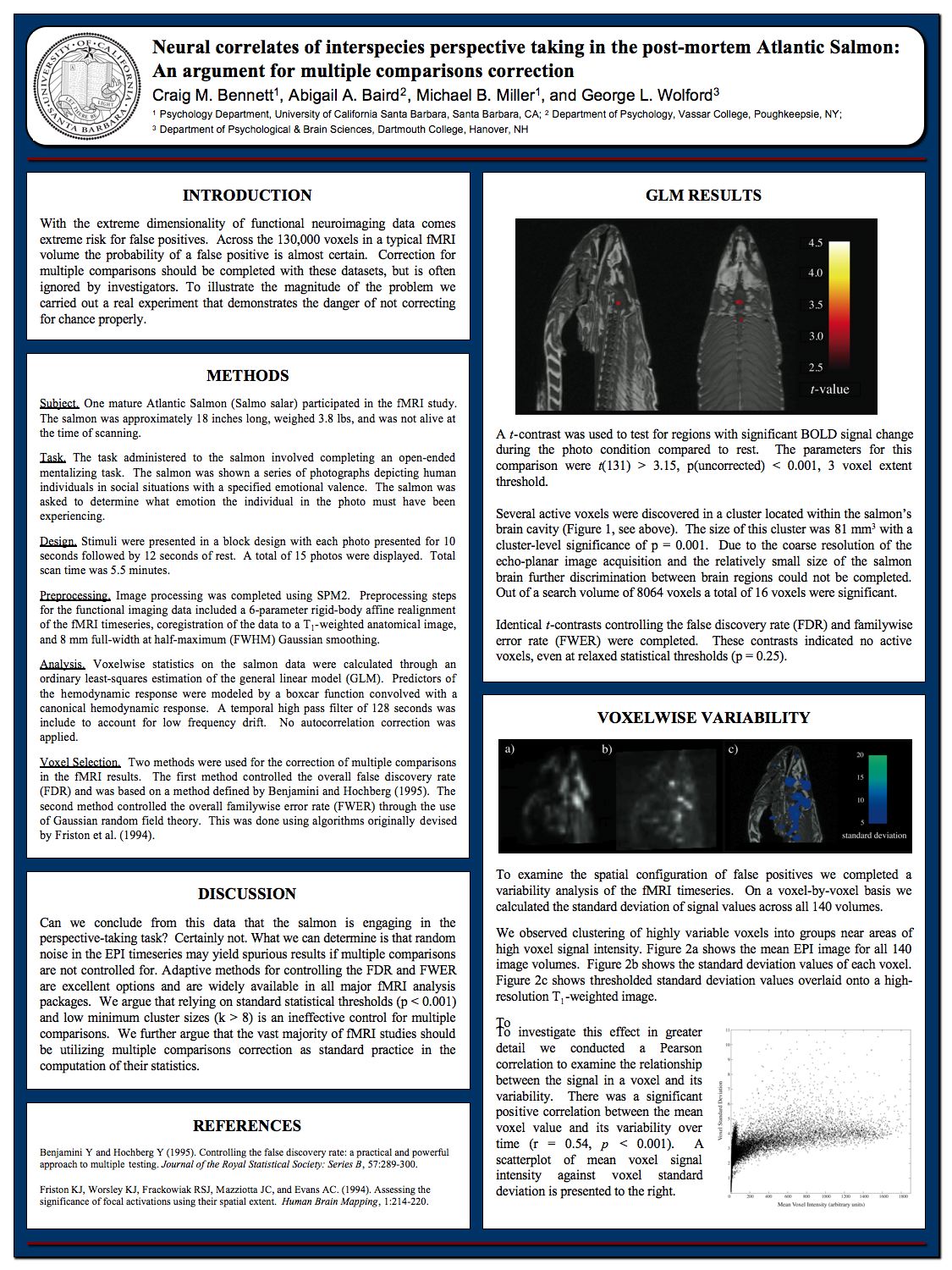
MRI of emotions in a dead fish...
Even though this gem is making the rounds of the blogosphere it is worth pointing to again here. (This reminds me of my grandmother's answer to my "what do the people do here?" question as we were driving through small Texas towns. Her reply: "They take in each other's laundry." )
Bennett et. al. present a hilarious yet serious abstract showing different brain MRI responses as a dead salmon views pictures of people with different emotional expressions. It is a demonstration of the "multiple comparisons problem" - the fact that if you do a lot of different statistical tests, some of them will, just by chance, give interesting results. A multiple comparisons corrections can be applied, but many fMRI publications still report "uncorrected" results.
Bennett et. al. present a hilarious yet serious abstract showing different brain MRI responses as a dead salmon views pictures of people with different emotional expressions. It is a demonstration of the "multiple comparisons problem" - the fact that if you do a lot of different statistical tests, some of them will, just by chance, give interesting results. A multiple comparisons corrections can be applied, but many fMRI publications still report "uncorrected" results.
Subscribe to:
Posts (Atom)