Monday, June 08, 2009

MindBlog is taking a vacation

For the next 10 days I will be in Amsterdam and Munich on vacation with my daughter Sarah. I think I will suspend blog posting for about two weeks. I have been doing regular weekday postings continuously since February of 2006, and I'm curious to see what life is like in their absence!

Friday, June 05, 2009

The genetics of musical aptitude

Ukkola et al. attempt to understand the neurobiological basis of music in human evolution and communication, motivated by the idea that a main function of music is human social communication. They find a correlation between variations in groups of genes associated with social bonding and cognitive functions and musical aptitude and creativity. They suggest that the neurobiology of music perception and production is likely to be related to the pathways affecting intrinsic attachment behavior. (By the way, in the same issue of PLoS ONE, Israel et al. correlate variations the vasopressin 1a receptor gene (AVPR1a) also monitored by Ukkola et al. with prosocial behavior in several game tasks).

Language influence on color perception.

Here is an interesting bit of work that shows that our brain's language regions can exert a top down influence on early color processing in the visual cortex. The experiments show that colors from different linguistic categories presented to the right visual field (which projects to the left linguistic cortex) caused much stronger activation of visual areas 2 and 3 than stimuli presented to the left visual field (which projects to the right hemisphere). Here is the abstract:
The effect of language on the categorical perception of color is stronger for stimuli in the right visual field (RVF) than in the left visual field, but the neural correlates of the behavioral RVF advantage are unknown. Here we present brain activation maps revealing how language is differentially engaged in the discrimination of colored stimuli presented in either visual hemifield. In a rapid, event-related functional MRI study, we measured subjects' brain activity while they performed a visual search task. Compared with colors from the same lexical category, discrimination of colors from different linguistic categories provoked stronger and faster responses in the left hemisphere language regions, particularly when the colors were presented in the RVF. In addition, activation of visual areas 2/3, responsible for color perception, was much stronger for RVF stimuli from different linguistic categories than for stimuli from the same linguistic category. Notably, the enhanced activity of visual areas 2/3 coincided with the enhanced activity of the left posterior temporoparietal language region, suggesting that this language region may serve as a top-down control source that modulates the activation of the visual cortex. These findings shed light on the brain mechanisms that underlie the hemifield- dependent effect of language on visual perception.

Thursday, June 04, 2009

Cognitive Illusions

My son Jon pointed me to this engaging TED talk on cognitive illusions by Dan Ariely.

Genes to cognition

Here is an educational site you might enjoy checking out, supported by the Cold Spring Harbor Laboratory.

Wednesday, June 03, 2009

Attention training and attention state training

Tang and Posner (PDF here) examine two different approaches that have been shown to improve attention and self-regulation: computer based exercises in children and adults (attention training, AT); and exposure to nature, mindfulness and integrative body-mind training (IBMT, or attention state training, AST). Here is their summary of the characteristics of these two approaches:

AT
• Trains executive attention networks
• Requires directed attention and effortful control
• Targets non-autonomic control systems
• Produces mental fatigue easily
• Training transfers to other cognitive abilities

AST
• Produces changes of body-mind state
• Requires effortful control (early stage) and effortless exercise (later)
• Involves the autonomic system
• Aims at achieving a relaxed and balanced state
• Training transfers to cognition, emotion and social behaviors

Activation of the anterior cingulate cortex appears to be central with both approaches, with AT involving involving changes in anterior cingulate and lateral prefrontal areas, perhaps mainly through increased connectivity between the two. AST involves increased interaction between anterior cingulate cortex and the autonomic nervous system. Increase in activity in the ACC in AST is similar to what is found in AT during task performance and could account for the improved executive attention with both methods.

It is worth noting that both aerobic exercise (A.F. Kramer and K.I. Erickson, Capitalizing on cortical plasticity: influence of physical activity on cognition and brain function, Trends Cogn. Sci. 11 (2007), pp. 342–348) and music education (E.G. Schellenberg, Music and cognitive abilities, Psychol. Sci. 14 (2004), pp. 317–320.) have also been shown to enhance cognitive processes

Lucid old age.

Want to live past 90 without dementia? Check out this article by Benedict Carey describing a retirement community in Los Angeles.

Tuesday, June 02, 2009

Empathy Marketing 101

I pass on this interesting review on "neuromarketing" that Gary Ohlson has just emailed to me.

Stress pathways that impair prefrontal cortex.

Arnsten offers a focus article (one among several) in Nature Reviews Neuroscience that describes how stress impairs the top-down cognitive control functions of the prefrontal cortex, and enhances bottom-up amygdala-limbic emotional influences. I'm passing on the abstract and a summary figure with its text that might be useful for teaching:
The prefrontal cortex (PFC) — the most evolved brain region — subserves our highest-order cognitive abilities. However, it is also the brain region that is most sensitive to the detrimental effects of stress exposure. Even quite mild acute uncontrollable stress can cause a rapid and dramatic loss of prefrontal cognitive abilities, and more prolonged stress exposure causes architectural changes in prefrontal dendrites. Recent research has begun to reveal the intracellular signalling pathways that mediate the effects of stress on the PFC. This research has provided clues as to why genetic or environmental insults that disinhibit stress signalling pathways can lead to symptoms of profound prefrontal cortical dysfunction in mental illness.


The prefrontal cortex (PFC) has extensive connections with other cortical and subcortical regions that are organized in a topographical manner, such that regions that regulate emotion are situated ventrally and medially (green area in part a of the figure) and regions that regulate thought and action are situated more dorsally and laterally (blue and blue–green areas in part a). The dorsolateral PFC (DLPFC) has extensive connections with sensory and motor cortices and is key for regulating attention, thought and action1. In humans, the right inferior PFC (rIPFC) seems to be specialized for inhibiting inappropriate motor responses. By contrast, the ventromedial PFC (VMPFC) has extensive connections with subcortical structures (such as the amygdala, the nucleus accumbens and the hypothalamus) that generate emotional responses and habits and is thus able to regulate emotional responses. Finally, the dorsomedial PFC (DMPFC) has been associated with error monitoring9 and, in human functional MRI studies, reality testing. These PFC regions extensively interconnect to regulate higher-order decision making and to plan and organize for the future. Under non-stress conditions (see part a of the figure), the extensive connections of the PFC orchestrate the brain's activity for intelligent regulation of behaviour, thought and emotion. The PFCalso has direct and indirect connections to monoamine cell bodies in the brainstem, such as the locus coeruleus (LC) (where noradrenaline projections arise) and the substantia nigra (SN) and ventral tegmental area (VTA) (where the major dopamine projections originate), and thus can regulate its own catecholamine inputs. Optimal levels of catecholamine release in turn enhance PFC regulation, thus creating a 'delicious cycle'. Under conditions of psychological stress (see part b of the figure) the amygdala activates stress pathways in the hypothalamus and brainstem, which evokes high levels of noradrenaline (NA) and dopamine (DA) release. This impairs PFC regulation but strengthens amygdala function, thus setting up a 'vicious cycle'. For example, high levels of catecholamines, such as occur during stress, strengthen fear conditioning mediated by the amygdala. By contrast, stress impairs higher-order PFC abilities such as working memory and attention regulation. Thus, attention regulation switches from thoughtful 'top-down' control by the PFC that is based on what is most relevant to the task at hand to 'bottom-up' control by the sensory cortices, whereby the salience of the stimulus (for example, whether it is brightly coloured, loud or moving) captures our attention5. The amygdala also biases us towards habitual motor responding rather than flexible, spatial navigation. Thus, during stress, orchestration of the brain's response patterns switches from slow, thoughtful PFC regulation to the reflexive and rapid emotional responses of the amygdala and related subcortical structures.

Parietal brain neurons tuned to fractions

Interesting work from Jacob and Nieder:
Although the concept of whole numbers is intuitive and well suited for counting and ordering, it is with the invention of fractions that the number system gained precision and flexibility. Absolute magnitude is encoded by single neurons that discharge maximally to specific numbers. However, it is unknown how the ratio of two numbers is represented, whether by processing numerator and denominator in separation, or by extending the analog magnitude code to relative quantity. Using functional MRI adaptation, we now show that populations of neurons in human fronto-parietal cortex are tuned to preferred fractions, generalizing across the format of presentation. After blood oxygen level-dependent signal adaptation to constant fractions, signal recovery to deviant fractions was modulated parametrically as a function of numerical distance between the deviant and adaptation fraction. The distance effect was invariant to changes in notation from number to word fractions and strongest in the anterior intraparietal sulcus, a key region for the processing of whole numbers. These findings demonstrate that the human brain uses the same analog magnitude code to represent both absolute and relative quantity. Our results have implications for mathematical education, which may be tailored to better harness our ability to access automatically a composite quantitative measure.

Monday, June 01, 2009

More Chopin, the Polonaise No. 1

Here is a further piece I have recorded recently on my Steinway B at Twin Valley.

Liberals and Conservatives feel differently

Kristoff reviews evidence that our political stances start with flash moral intuitions that our brains then find evidence to support. For liberals, morality derives mostly from fairness and prevention of harm. For conservatives, morality places relatively more emphasis on upholding authority and loyalty — and revulsion at disgust.
Psychologists have developed a “disgust scale” based on how queasy people would be in 27 situations, such as stepping barefoot on an earthworm or smelling urine in a tunnel. Conservatives systematically register more disgust than liberals. (To see how you weigh factors in moral decisions, take the tests at http://yourmorals.org/.)...One experiment involved hypnotizing subjects to expect a flash of disgust at the word “take.” They were then told about Dan, a student council president who “tries to take topics that appeal to both professors and students.” The research subjects felt disgust but couldn’t find any good reason for it. So, in some cases, they concocted their own reasons, such as: “Dan is a popularity-seeking snob.”

Friday, May 29, 2009

Hugs

Given the unhealthy phobia about physical contact in this country, in addition to litigious paranoia about sexual harassment or improper touching, I was really heartened to read this account of a new trend among teenagers in high school of giving hugs on greeting: male-female, female-female, even male-male (given sanction by recent 'Bromance' movies). Some prune faced administrators have banned it, but I think it reflects that kids are more inclined to nuture each other, perhaps as an antidote to comparative aridity of a world of Facebook 'friends.' (By the way, I wrote this brief post on reading the NYTimes article yesterday morning, then set it to be actually posted next Monday. Then I see the bloody story featured on the NBC Evening News yesterday evening, interviews with experts and all that, and so I guess I have to stay with the news cycle and post while its fresh!).

The coming superbrain?

John Markoff offers a timely essay - given the recent release of the movie "Terminator Salvation" - on the future of artificial intelligence. There seems to be little doubt that we will eventually be able to design machines that have the emergent property, like ourselves, of being aware of their own internal states. Metzinger suggests that this will happen once the neural underpinnings of his "Ego Tunnel" are made more clear.

Thursday, May 28, 2009

Your own brain gym.

Passing on this link emailed to me this morning: Build Your Own Brain Gym: 100 Tools, Exercises, and Games. The blog on this website (which, curiously, is a health care administration career site) contains a veritable orgy of self-help links.

Subcortical enhancement of musical intervals in musicians

From Lee et al:
By measuring the auditory brainstem response to two musical intervals, the major sixth (E3 and G2) and the minor seventh (E3 and F#2), we found that musicians have a more specialized sensory system for processing behaviorally relevant aspects of sound. Musicians had heightened responses to the harmonics of the upper tone (E), as well as certain combination tones (sum tones) generated by nonlinear processing in the auditory system. In music, the upper note is typically carried by the upper voice, and the enhancement of the upper tone likely reflects musicians' extensive experience attending to the upper voice. Neural phase locking to the temporal periodicity of the amplitude-modulated envelope, which underlies the perception of musical harmony, was also more precise in musicians than nonmusicians. Neural enhancements were strongly correlated with years of musical training, and our findings, therefore, underscore the role that long-term experience with music plays in shaping auditory sensory encoding.

The amusic brain

Peretz et al. find that people with congenital amusia (~4% of the population unable to distinguish different tones) have the essential neural circuitry to perceive fine-grained pitch differences, but limited awareness of this ability and the lack of responsiveness to semitone changes that violate musical keys. Apparently the neural pitch representation cannot make contact with musical pitch knowledge along the auditory-frontal neural pathway.
Like language, music engagement is universal, complex and present early in life. However, ~4% of the general population experiences a lifelong deficit in music perception that cannot be explained by hearing loss, brain damage, intellectual deficiencies or lack of exposure. This musical disorder, commonly known as tone-deafness and now termed congenital amusia, affects mostly the melodic pitch dimension. Congenital amusia is hereditary and is associated with abnormal grey and white matter in the auditory cortex and the inferior frontal cortex. In order to relate these anatomical anomalies to the behavioural expression of the disorder, we measured the electrical brain activity of amusic subjects and matched controls while they monitored melodies for the presence of pitch anomalies. Contrary to current reports, we show that the amusic brain can track quarter-tone pitch differences, exhibiting an early right-lateralized negative brain response. This suggests near-normal neural processing of musical pitch incongruities in congenital amusia. It is important because it reveals that the amusic brain is equipped with the essential neural circuitry to perceive fine-grained pitch differences. What distinguishes the amusic from the normal brain is the limited awareness of this ability and the lack of responsiveness to the semitone changes that violate musical keys. These findings suggest that, in the amusic brain, the neural pitch representation cannot make contact with musical pitch knowledge along the auditory-frontal neural pathway.

Wednesday, May 27, 2009

The management of our attention

Here is another of the many nuggets (from Chapter 9) from Metzinger's new book that hit me as an excellent summary. He discusses the problem we face in the management of our attention:
The ability to attend to our environment, to our own feelings, and to those of others is a naturally evolved feature of the human brain. Attention is a finite commodity, and it is absolutely essential to living a good life. We need attention in order to truly listen to others - and even to ourselves. We need attention to truly enjoy sensory pleasures, as well as for efficient learning. We need it in order to be truly present during sex or to be in love or when we are simply contemplating nature. Our brains can generate only a limited amount of this precious resource every day.

Today, the advertisement and entertainment industries are attacking the very foundations of our capacity for experience, drawing us into the vast and confusing media jungle. They are trying to rob us of as much of our scarce resource as possible, and they are doing so in every more persistent and intelligent ways. Of course, they are increasingly making use of the new insights in the human mind offered by cognitive and brain science to achieve their goals ("neuromarketing" is one of the ugly new buzzwords). We can see the probable result in the epidemic of attention-deficit disorder in children and young adults, in midlife burnout, in rising levels of anxiety in large parts of the population. If I am right that consciousness is the space of attentional agency, and if (as discussed in chapter 4) it is also true that the experience of controlling and sustaining your focus of attention is one of the deeper layers of phenomenal selfhood, then we are currently witnessing not only an organized attack on the speace of consciousness per se but a mild form of depersonalization. New medial environments many create a new form of waking consciousness that resembles weakly subjective states - a mixture of dreaming, dementia, intoxication, and infantilization.
Having just forced myself to watch the recent American Idol show climax, these points have struck me as particularly cogent. Metzinger suggests we counter the attacks on our reserves of attention by introducing classes in meditation in our high schools, by making the young aware of our limited capacity for attention, and the need to learn techniques to sustain it and enhance mindfulness.

Semantic versus behavioral deficits in left versus right fronto-temporal lobe atrophies

Chan et al. provide a survey of the deficits observed in people with left versus right fronto-temporal lobe atrophies, which cause, respectively mainly semantic (left) versus behavioral (right) disorders. Their summary:
Frontotemporal lobar degeneration is currently associated with three syndromic variants. Disorders of speech and language figure prominently in two of the three variants, and are associated with left-sided frontotemporal atrophy. The detailed characterization of these syndromes contrasts with the relative paucity of information relating to frontotemporal lobar degeneration primarily affecting the right cerebral hemisphere. The objective of this study was to identify the clinical profile associated with asymmetrical, predominantly right-sided, temporal lobe atrophy. Twenty patients with predominant right temporal lobe atrophy were identified on the basis of blinded visual assessment of the MRI scans. The severity of right temporal lobe atrophy was quantified using volumetric analysis of the whole temporal lobes, the amygdala and the hippocampus. Profiles of cognitive function, behavioural and personality changes were obtained on each patient. The pattern of atrophy and the clinical features were compared with those observed in a group of patients with semantic dementia and predominant left-sided temporal lobe atrophy. The mean right temporal lobe volume in the right temporal lobe atrophy group was reduced by 37%, with the mean left temporal lobe volume reduced by 19%. There was marked atrophy of the right hippocampus and right amygdala, with mean volumes reduced by 41 and 51%, respectively (left hippocampus and amygdala volumes were reduced by 18 and 33%, respectively). The most prominent cognitive deficits were impairment of episodic memory and getting lost. Prosopagnosia was a symptom in right temporal lobe atrophy patients. These patients also exhibited a variety of behavioural symptoms including social disinhibition, depression and aggressive behaviour. Nearly all behavioural disorders were more prevalent in the right temporal lobe atrophy patient group than the semantic dementia group. Symptoms particular to the right temporal lobe atrophy patient group included hyper-religiosity, visual hallucinations and cross-modal sensory experiences. The combination of clinical features associated with predominant right temporal lobe atrophy differs significantly from those associated with the other syndromes associated with focal degeneration of the frontal and temporal lobes and it is, therefore, proposed that this right temporal variant should be considered a separate syndromic variant of frontotemporal lobar degeneration.

Tuesday, May 26, 2009

A musical offering for this week - Chopin Nocture in C minor

Here is the posthumous Chopin Nocture in C minor.

Neural correlates of vicarious reward.

Interesting observations from Mobbs et al. The experiments involved brain imaging of participants reacting to game winning by contestants with whom they were or were not sympathetic. Their abstract (slightly edited):
Humans appear to have an inherent prosocial tendency toward one another in that we often take pleasure in seeing others succeed. This fact is almost certainly exploited by game shows, yet why watching others win elicits a pleasurable vicarious rewarding feeling in the absence of personal economic gain is unclear. One explanation is that game shows use contestants who have similarities to the viewing population, thereby kindling kin-motivated responses (for example, prosocial behavior). Using a game show–inspired paradigm, we show that the interactions between the ventral striatum and anterior cingulate cortex subserve the modulation of vicarious reward by similarity, respectively. Our results support studies showing that similarity acts as a proximate neurobiological mechanism where prosocial behavior extends to unrelated strangers.

Evidence for separate semantic and syntactic processing in deaf native signers.

Adding to evidence from written and spoken language suggesting that nonidentical brain networks support semantic and syntactic processing, Capek et al now find a similar distinction in native deaf signers:
Studies of written and spoken language suggest that nonidentical brain networks support semantic and syntactic processing. Event-related brain potential (ERP) studies of spoken and written languages show that semantic anomalies elicit a posterior bilateral N400, whereas syntactic anomalies elicit a left anterior negativity, followed by a broadly distributed late positivity. The present study assessed whether these ERP indicators index the activity of language systems specific for the processing of aural-oral language or if they index neural systems underlying any natural language, including sign language. The syntax of a signed language is mediated through space. Thus the question arises of whether the comprehension of a signed language requires neural systems specific for this kind of code. Deaf native users of American Sign Language (ASL) were presented signed sentences that were either correct or that contained either a semantic or a syntactic error (1 of 2 types of verb agreement errors). ASL sentences were presented at the natural rate of signing, while the electroencephalogram was recorded. As predicted on the basis of earlier studies, an N400 was elicited by semantic violations. In addition, signed syntactic violations elicited an early frontal negativity and a later posterior positivity. Crucially, the distribution of the anterior negativity varied as a function of the type of syntactic violation, suggesting a unique involvement of spatial processing in signed syntax. Together, these findings suggest that biological constraints and experience shape the development of neural systems important for language.

Monday, May 25, 2009

Massage stimulates brain development

I've always been a massage nut. Many years ago I had some formal training, and I always feel totally rejuvenated by the too-infrequent massages I occasionally get. This item in the Journal of Neuroscience from Guzzetta et al. makes perfect sense to me. I'll bet that a shadow of these early effects of massage seen in infants still occur in adults. The brain growth factor (IGF-1) enhanced by massage in infants is also associated with brain plasticity in adult humans:
Environmental enrichment (EE) was shown recently to accelerate brain development in rodents. Increased levels of maternal care, and particularly tactile stimulation through licking and grooming, may represent a key component in the early phases of EE. We hypothesized that enriching the environment in terms of body massage may thus accelerate brain development in infants. We explored the effects of body massage in preterm infants and found that massage accelerates the maturation of electroencephalographic activity and of visual function, in particular visual acuity. In massaged infants, we found higher levels of blood IGF-1. Massage accelerated the maturation of visual function also in rat pups and increased the level of IGF-1 in the cortex. Antagonizing IGF-1 action by means of systemic injections of the IGF-1 antagonist JB1 blocked the effects of massage in rat pups. These results demonstrate that massage has an influence on brain development and in particular on visual development and suggest that its effects are mediated by specific endogenous factors such as IGF-1.

SenseCam - a device for restoring and protecting memories

While scanning my lost list of articles that might become the topic of MindBlog posts, I re-encountered this description from Science Magazine of research on autobiographical memory which has subjects wear a small camera mounted on their chests. The work has expanded to involve patients with memory problems due to Alzheimer's or brain injuries. On viewing the camera's data six months later:
...many SenseCam users...report a sudden flood of memories of thoughts and sensations, ... "Proustian moments," when they review images taken by the device. SenseCam's images correspond to the nature of human memory--they're fragmentary, they're formed outside conscious control, they're visual in nature, they're from the subject's perspective. All these features are very like what we call episodic memory.

SenseCam records images passively, permitting a person to go about their day without interruption. The latest version is about the size and weight of a clunky mobile phone and appears to observe the world through two unmatched eyeballs. One is a passive infrared sensor, tuned to trigger the camera whenever another person passes by. The other is a wide-angle camera lens, set to capture most of the user's field of view. The device is also equipped with an ambient light sensor that triggers the camera when its user moves from one room to another, or goes in or out of doors. The camera can also be set to snap an image if the sensors haven't triggered a photo after an arbitrary number of seconds. A typical wearer might come home with 2000 to 3000 fragmentary, artless images at the end of a day.
A research team:
...under the direction of neuropsychologist Georgina Brown, has followed five additional people with memory problems over a nearly 3-year period, exploring the difference between the memory boost provided by visual and written diary-keeping. Establishing a baseline of how fast these people lose their memories, the team asked each about an event every other day for 2 weeks after the event, and then again after 1 month and after 3 months. Then they asked the patients to keep a diary of a separate event and review it every other day during an initial 2-week assessment, but not during subsequent months. Finally, patients reviewed their SenseCam's images for 2 weeks following a third event.

The preliminary results suggest that SenseCam use strengthened these patients' memories more than diary-keeping did. A full analysis of the data is in preparation, says Brown, whose team plans to submit it to the journal Memory for a special issue devoted to SenseCam research.

Friday, May 22, 2009

What we will never be able to talk about - Ineffability

At numerous points during my reading of Thomas Metzinger's new book "The Ego Tunnel" I have come across writing that seems such a crisp description of core ideas (as well as being directly relevant to my own experience) that I want to try to condense and pass the material on to you. I found the following mix of summary, paraphrase, and quotes from chapter 2 to be a calming antidote to my implicit and constant "I can understand this" temperament. (By the way, I first bought this book for my Kindle but then found that the kind of jumping back and around, checking references, that I want to do in reading such a book was impossible, so I purchased the hard copy.) Here's a chunk on the ineffability problem:
In between 430 and 650 nanometers, we can discriminate (make same/different judgements about) more than 150 different wavelengths, or different subjective shades of color. But, if asked to reidentify single colors with a high degree of accuracy, we can do so for fewer than 15. The same is true for other sensory experiences. We can discriminate about 1,400 steps of pitch difference across the audible frequency range, but we can recognize these steps as examples of only about 80 different pitches... Thus we are much better at discriminating perceptual values than we are at identifying or recognizing them.

Metzinger uses a simplest example of two similar shades of green to spell through the consequences of this situation (he calls them Green No. 24 and Green No. 25, nearest possible neighbors on the color chart, such that there's no shade of green between them that you could discriminate). We can experience their difference, but are unable consciously to represent the sameness of Green No. 25 over time. We do not possess introspective identity criteria for this simplest state of consciousness, and we can not pinpoint a minimally sufficient neural correlate of Green No. 25 in the brain if we can not correctly identify the phenomenal aspect of Green No. 25 over time, in repeated trials in a controlled experimental setting. This is why it may be impossible to do what most hard scientists in consciousness research would like to do: show that Green No. 25 is identical with a state in your head.

These simple findings show that there is a depth in pure perception that cannot be grasped or invaded by thought or language. This ineffability problem arises for the simplest forms of sensory awareness, for the finest nuances of sight and touch, of smell and taste, and for those aspect of conscious hearing that underlie the magic and beauty of a musical experience. It almost certainly appears also for empathy, for emotional and intrinsically embodied forms of communication.

Money doesn't make us happy, certainty does.

A nice Op-Ed piece from Daniel Gilbert in the N.Y. Times. It is found on the New York Time's blog "Happy Days" - a discussion about the search for contentment in its many forms — economic, emotional, physical, spiritual. This blog was running postings through 2006, and then curiously lapsed until this Gilbert article. Gilbert's conclusions:
Our national gloom is real enough, but it isn’t a matter of insufficient funds. It’s a matter of insufficient certainty. Americans have been perfectly happy with far less wealth than most of us have now, and we could quickly become those Americans again — if only we knew we had to.

Why would we prefer to know the worst than to suspect it? Because when we get bad news we weep for a while, and then get busy making the best of it. We change our behavior, we change our attitudes. We raise our consciousness and lower our standards. We find our bootstraps and tug. But we can’t come to terms with circumstances whose terms we don’t yet know. An uncertain future leaves us stranded in an unhappy present with nothing to do but wait.

Thursday, May 21, 2009

Status is everything?

Tierney describes how Geoffrey Miller continues the arguments he started in "The Mating Mind" which seek to reduce much of our behavior to a quest for sex and status. His new book is “Spent: Sex, Evolution and Consumer Behavior.” This is a complementary approach to the sort of material mentioned in Monday's post on Gopnik's article.
If marketers (or their customers) understood biologists’ new calculations about animals’ “costly signaling,” ... they’d see that Harvard diplomas and iPhones send the same kind of signal as the ornate tail of a peacock....Sometimes the message is as simple as “I’ve got resources to burn,” the classic conspicuous waste demonstrated by the energy expended to lift a peacock’s tail or the fuel guzzled by a Hummer. But brand-name products aren’t just about flaunting transient wealth. The audience for our signals — prospective mates, friends, rivals — care more about the permanent traits measured in tests of intelligence and personality.

In a series of experiments, Dr. Miller and other researchers found that people were more likely to expend money and effort on products and activities if they were first primed with photographs of the opposite sex or stories about dating...After this priming, men were more willing to splurge on designer sunglasses, expensive watches and European vacations. Women became more willing to do volunteer work and perform other acts of conspicuous charity — a signal of high conscientiousness and agreeableness, like demonstrating your concern for third world farmers by spending extra for Starbucks’s “fair trade” coffee.

To get over your consuming obsessions, Dr. Miller suggests exercises like comparing the relative costs and pleasures of the stuff you’ve bought. (You can try the exercise at nytimes.com/tierneylab.) It may seem odd that we need these exercises — why would natural selection leave us with such unproductive fetishes? — perhaps because evolution is good at getting us to avoid death, desperation and celibacy, but not that good at getting us to feel happy...our desire to impress strangers may be a quirky evolutionary byproduct of a smaller social world...“We evolved as social primates who hardly ever encountered strangers in prehistory,” Miller says. “So we instinctively treat all strangers as if they’re potential mates or friends or enemies. But your happiness and survival today don’t depend on your relationships with strangers. It doesn’t matter whether you get a nanosecond of deference from a shopkeeper or a stranger in an airport.”

Bad drives reactions, Good propels behaviors

From Wang et al., slightly edited:
Research across disciplines suggests that bad is stronger than good and that individuals punish deception more than they reward honesty. However, methodological issues in previous research limit the latter conclusion. Three experiments resolved these issues and consistently found the opposite pattern: In the first experiment individuals rewarded honesty more frequently and intensely than they punished deception. The second experiment extended these counter-intuitive findings by revealing a divergence between evaluation and behavior: Evaluative reactions to deception were stronger than those to honesty, but behavioral intentions in response to honesty were stronger than those in response to deception. In addition, individuals wanted to avoid deceivers more than they wanted to approach honest actors. The third experiment found that punishment, but not reward, frequencies were sensitive to costs. Moderated-mediation tests revealed the role of different psychological mechanisms: Negative affect drove punishments, whereas perceived trustworthiness drove rewards. Overall, bad appears to be stronger than good in influencing psychological reactions, but good seems to be stronger than bad in influencing behavior.

Wednesday, May 20, 2009

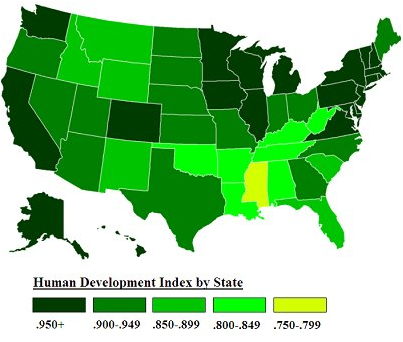
Why I am loyal to Wisconsin...

From the UN Human Development Index for U.S. states and MapScroll:

Hubris syndrome: An acquired personality disorder?

Sigh....a nice clinical description of our recently departed president...Owen and Davidson offer a study of US presidents and UK prime ministers over the past 100 years. Here are a few clips:
We believe that extreme hubristic behaviour is a syndrome, constituting a cluster of features (‘symptoms’) evoked by a specific trigger (power), and usually remitting when power fades. ‘Hubris syndrome’ is seen as an acquired condition, and therefore different from most personality disorders which are traditionally seen as persistent throughout adulthood. The key concept is that hubris syndrome is a disorder of the possession of power, particularly power which has been associated with overwhelming success, held for a period of years and with minimal constraint on the leader.

The ability to make swift decisions, sometimes based on little evidence, is of particular importance—arguably necessary—in a leader. Similarly, a thin-skinned person will not be able to stand the process of public scrutiny, attacks by opponents and back-stabbings from within, without some form of self-exultation and grand belief about their own mission and importance. Powerful leaders are a highly selected sample and many criteria of any syndrome based on hubris are those behaviours by which they are probably selected—they make up the pores of the filter through which such individuals must pass to achieve high office.
Owen and Davidson define hubris syndrome:
...as a pattern of behaviour in a person who: (i) sees the world as a place for self-glorification through the use of power; (ii) has a tendency to take action primarily to enhance personal image; (iii) shows disproportionate concern for image and presentation; (iv) exhibits messianic zeal and exaltation in speech; (v) conflates self with nation or organization; (vi) uses the royal ‘we’ in conversation; (vii) shows excessive self-confidence; (viii) manifestly has contempt for others; (ix) shows accountability only to a higher court (history or God); (x) displays unshakeable belief that they will be vindicated in that court; (xi) loses contact with reality; (xii) resorts to restlessness, recklessness and impulsive actions; (xiii) allows moral rectitude to obviate consideration of practicality, cost or outcome; and (xiv) displays incompetence with disregard for nuts and bolts of policy making.

Meditation alters autonomic and central nervous system interaction.

I pass on this new abstract from Tang et al, which makes observations that correlate with my own subjective experiences of meditation :
Five days of integrative body–mind training (IBMT) improves attention and self-regulation in comparison with the same amount of relaxation training. This paper explores the underlying mechanisms of this finding. We measured the physiological and brain changes at rest before, during, and after 5 days of IBMT and relaxation training. During and after training, the IBMT group showed significantly better physiological reactions in heart rate, respiratory amplitude and rate, and skin conductance response (SCR) than the relaxation control. Differences in heart rate variability (HRV) and EEG power suggested greater involvement of the autonomic nervous system (ANS) in the IBMT group during and after training. Imaging data demonstrated stronger subgenual and adjacent ventral anterior cingulate cortex (ACC) activity in the IBMT group. Frontal midline ACC theta was correlated with high-frequency HRV, suggesting control by the ACC over parasympathetic activity. These results indicate that after 5 days of training, the IBMT group shows better regulation of the ANS by a ventral midfrontal brain system than does the relaxation group. This changed state probably reflects training in the coordination of body and mind given in the IBMT but not in the control group. These results could be useful in the design of further specific interventions.

Tuesday, May 19, 2009

Arts and the Brain

From the Dana Foundation, accounts of several neuro-education conferences on linking the Arts and intelligence. , musical training changing brain networks, etc.

Enhanced attention skills in video game players.

The July issue of Neuropsychologia offers yet another article, by Dye et al., on how video games enhance attentional resources:
Previous research suggests that action video game play improves attentional resources, allowing gamers to better allocate their attention across both space and time. In order to further characterize the plastic changes resulting from playing these video games, we administered the Attentional Network Test (ANT) to action game players and non-playing controls aged between 7 and 22 years. By employing a mixture of cues and flankers, the ANT provides measures of how well attention is allocated to targets as a function of alerting and orienting cues, and to what extent observers are able to filter out the influence of task irrelevant information flanking those targets. The data suggest that action video game players of all ages have enhanced attentional skills that allow them to make faster correct responses to targets, and leaves additional processing resources that spill over to process distractors flanking the targets.

Genetic bias of our amygdala-mediated economic decisions

Yet another nugget from the group associated with Ray Dolan at University College, London.
Genetic variation at the serotonin transporter-linked polymorphic region (5-HTTLPR) is associated with altered amygdala reactivity and lack of prefrontal regulatory control. Similar regions mediate decision-making biases driven by contextual cues and ambiguity, for example the "framing effect." We hypothesized that individuals hemozygous for the short (s) allele at the 5-HTTLPR would be more susceptible to framing. Participants, selected as homozygous for either the long (la) or s allele, performed a decision-making task where they made choices between receiving an amount of money for certain and taking a gamble. A strong bias was evident toward choosing the certain option when the option was phrased in terms of gains and toward gambling when the decision was phrased in terms of losses (the frame effect). Critically, this bias was significantly greater in the ss group compared with the lala group. In simultaneously acquired functional magnetic resonance imaging data, the ss group showed greater amygdala during choices made in accord, compared with those made counter to the frame, an effect not seen in the lala group. These differences were also mirrored by differences in anterior cingulate–amygdala coupling between the genotype groups during decision making. Specifically, lala participants showed increased coupling during choices made counter to, relative to those made in accord with, the frame, with no such effect evident in ss participants. These data suggest that genetically mediated differences in prefrontal–amygdala interactions underpin interindividual differences in economic decision making.

Monday, May 18, 2009

A new brain correlate of intention.

We have another installment in the story of how our conscious intention to move involves brain processes parallel to those that actually command the movements. It has been known for some time that stimulation of the presupplementary motor area in clinical exploration before brain surgery can produce an 'urge to move.' Desmurget et al. now find that stimulating areas in the inferior posterior parietal cortex (usually presumed to be involved in sensory motor coordination, not volition) can cause an urge to move specific body parts. When stimulation intensity was increased in parietal areas, participants believed they had really performed these movements, although no electromyographic activity was detected. Stimulation of the premotor region triggered overt mouth and contralateral limb movements. Yet, patients firmly denied that they had moved. Conscious intention and motor awareness thus arise from increased parietal activity before movement execution. Here is a figure from the review of this work by Haggard.


Voluntary action. (Top) The premotor cortex prepares commands for voluntary actions triggered by external stimuli, whereas the presupplementary motor area prepares commands for internally generated "intentional" actions, which are then executed by the primary motor cortex. Signals containing copies of prepared motor commands are also sent to the parietal cortex, where they are used to predict sensory consequences of movement. (Bottom) The preparation of motor commands for voluntary movement by the presupplementary motor area causes a sense of urge. The inferior part of the posterior parietal cortex generates sensory representations of the predicted consequences of the movement.

Evolutionary change driven by sufficiency, not survival

Polymath Adam Gopnik writes a nice piece in the May 11 issue of The New Yorker titled "The Fifth Blade." The title refers to the appearance (evolution) of razors with increasingly (functionally irrelevant) numbers of blades since the Wilkinson Sword company started mass-producing stainless-steel blades in 1961. This is consonant with a new suggested principle of biological evolution, quite at variance with the classical view that innovation is borne out of a struggle for survival amidst limited resources - that in dull periods of plenty, stasis was supposed to rule.
The new idea is almost the opposite. Terrence Deacon, for instance, a professor of biological anthropology and linguistics at Berkeley, has argued that animals' appearance alters and their behavior changes - birds brighten and their songs grow elaborate - not in conditions of scarcity, where bird fights bird for every seed, but in landscapes of plentitude...once "selection pressure" lifts - once it doesn't matter so much if every claw kills, if every molar crunches - then the animal can do its own thing and find its own pleasures. This pattern makes for what Deacon calls "relaxed selection, like relaxed-fit jeans.

Relaxed evolution favors the Ronald Firbanks over the Cotton Mathers, the playful dandy over the sober saver. Relaxed selection explains creativity in language and literature: once we no longer have to pressure our bodies to chew and hunt, the big heads behind them, having nothing to do, start doing what they please. It isn't the struggle for existence but the serenity of entertainment that explains our lives. The brain starts thinking as the jaw relaxes. We human beings are all three-blade razors, Gillete Mach3 Turbos and Shick Xtreme3s, with needless cutting surfaces and useless batteries, buzzing away, wasting energy and look sexy, forged in plenty and thriving in abundance.

Friday, May 15, 2009

How the brain talks to itself - errors in emotional prediction

Gilbert and Wilson offer an engaging essay in the Philisophical Transactions of the Royal Society B (PDF here) titled: "Why the brain talks to itself: sources of error in emotional prediction." In trying to plan futures that involve more pleasure than pain, we perform mental simulations (previews) of future events, which produce affective reactions (premotions), which are then used as a basis for forecasts (predictions) about the future event’s emotional consequences. Their review summarizes several main sources of systematic errors of these predictions.

Previews have several problems of dissimilar content:
1. They provide a poor basis for prediction because they tend to be based on memories that are not representative of the future events that those previews were meant to simulate.
2. They tend to omit features that are incidental to the event but that nonetheless may have a significant impact on our emotional reactions to it.
3. They tend to emphasize the early occurring moments of the event in which emotions are likely to be the most intense.
4. They include comparisons that views do not. (Imaginary chips are readily compared to imaginary sardines, but real chips are not.)
Previews also have problems of dissimilar context:
...accurate predictions also require that the context in which previewing occurs be similar to the context in which viewing occurs, and as it turns out, this is not always the case either. Why do contexts matter? Premotions are not just reactions to previews; they are reactions to previews and to the context in which those previews are generated. That is why we feel happier when we preview chocolate cake while we are lying on a comfortable couch than on a bed of nails, or when we are hungry rather than sated.

Brain activation in cocaine addicts caused by drug words

From Goldstein et al. :
When exposed to drug conditioned cues (stimuli associated with the drug), addicted individuals experience an intense desire for the drug, which is associated with increased dopamine cell firing. We hypothesized that drug-related words can trigger activation in the mesencephalon, where dopaminergic cells are located. During functional magnetic resonance imaging (fMRI), 15 individuals with cocaine use disorders and 15 demographically matched healthy control subjects pressed buttons for color of drug-related versus neutral words. Results showed that the drug words, but not neutral words, activated the mesencephalon in the cocaine users only. Further, in the cocaine users only, these increased drug-related mesencephalic responses were associated with enhanced verbal fluency specifically for drug words. Our results for the first time demonstrate fMRI response to drug words in cocaine-addicted individuals in mesencephalic regions as possibly associated with dopaminergic mechanisms and with conditioning to language (in this case drug words). The correlation between the brief verbal fluency test, which can be easily administered (crucial for clinical studies), and fMRI cue reactivity could be used as a biomarker of neurobiological changes in addiction.

Thursday, May 14, 2009

Stepping backwards enhances cognitive control.

From Koch et al., some interesting work on the role of body locomotion in the recruitment of control processes.:
In the most fundamental and literal sense, approach refers to decreasing, and avoidance to increasing, the physical distance between the self and the outside world. In our view, body locomotion most purely taps into this fundamental nature of approach and avoidance. In everyday life, individuals typically approach desired stimuli by stepping forward and avoid aversive stimuli by stepping backward

...The idea that body locomotion may trigger approach and avoidance orientations has, so far, not been tested...we expected that stepping backward would increase the recruitment of cognitive control relative to stepping forward. To test this prediction, we gauged cognitive functioning by means of a Stroop task immediately after a participant stepped in one direction. The Stroop task requires naming the color in which stimulus words are printed while ignoring their semantic meaning, which is actually processed more automatically than the color. Cognitive control is required to override the tendency to respond to the semantic meaning and instead respond to the color.

...our study showed that stepping backward significantly enhanced cognitive performance compared to stepping forward or sideways. Considering the effect size, backward locomotion appears to be a very powerful trigger to mobilize cognitive resources. Thus, whenever you encounter a difficult situation, stepping backward may boost your capability to deal with it effectively.

Putting Off Growing Old

I pass on this item by Sherman Sutter from the editor's choice section of Science Magazine:
In a classic 1957 paper on the evolution of senescence, Williams argued that when extrinsic mortality (death due to predation, infectious disease, or accident) is high, natural selection favors investment in early reproduction. When it is low, the increased return from allocating resources to maintain and repair the soma should lead to longer life spans. In the absence of precise information on causes of death, researchers have used hazard models to partition mortality into age-independent (interpreted as extrinsic) and age-dependent components.

Taking this approach, Gurven and Fenelon analyze mortality data from 13 remote, small-scale societies and in historical cohorts from Sweden and England over the past 250 years. They explore two statistical models (Weibull and Gompertz-Makeham) of adult mortality patterns and consider three measures of actuarial aging (mortality rate doubling time, Ricklefs's {omega}, and slope of the mortality function between ages 60 and 70). The variation in results across these two estimation procedures and three measures complicates the interpretation of the data. Nonetheless, some patterns are robust: The subsistence groups and the early Swedish cohorts exhibit similar actuarial aging, but more recent European cohorts show progressively slower aging. In the longitudinal samples, slower aging and reduced extrinsic mortality are linked. Women have lower rates of senescence than men, a difference that has increased over time. These "modest but nontrivial" changes support Williams's claims, and the authors discuss individual-level mechanisms that could underlie them.

Wednesday, May 13, 2009

Experience as what we agree to attend to...

I have decided to paste in just a fragment of writing from a parallel private journal that I keep. It has some of my private jargon, apologies if it is not intelligible to you. It is a random walk...
...that wants to try to crystallize something from last Wednesday’s post on attention together with a reading (still going on) of Metzinger’s recent book “The Ego Tunnel.” Metzinger’s compelling analysis, along with others, shows our introspective selves to be fictions even if they are imaged to fit in a metacognitive hierarchy, such as a watcher (closer to a Damasio-style homeostatic pre-emotional core) that is sensed as observer of its products (being an angry/happy/kind/compassionate/whatever person.) All are actually logically equivalent (watch-ing, be-ing, angry-ing, desire-ing, compassion-ing). Even while being in principle illusory, many of these self models can be shown to correlate with distinctive pattern of brain activity, can be altered by brain lesions. The experiential and behavioral issue is which of these members of an imaginary governing board is being held within the limited attentional resources of the frontal lobes. (William James: “My experience is what I agree to attend to.”). Training regimes that settle this issue by putting in place new habits for what is held in attention (compassion meditation, piano or other athletic practice, etc.) can be transformative. Physical changes in brain areas serving these functions can be documented.

Prelinguistic infants, but not chimps, signal absent entities

Interesting work from Tomasello's group showing that nonlinguistic skills for displaced reference precede and underlie similar linguistic reference:
One of the defining features of human language is displacement, the ability to make reference to absent entities. Here we show that prelinguistic, 12-month-old infants already can use a nonverbal pointing gesture to make reference to absent entities. We also show that chimpanzees—who can point for things they want humans to give them—do not point to refer to absent entities in the same way. These results demonstrate that the ability to communicate about absent but mutually known entities depends not on language, but rather on deeper social-cognitive skills that make acts of linguistic reference possible in the first place. These nonlinguistic skills for displaced reference emerged apparently only after humans' divergence from great apes some 6 million years ago.
In carrying out the experiments the authors:
...confronted 12-month-old prelinguistic human infants and adult chimpanzees with two new situations in which they wanted something they could not see. In both situations, participants first repeatedly saw a human adult place several desired objects of the same kind on top of one platform, while also placing undesired objects of another kind on another, similar platform. Then, for the test, the desired objects were removed. In the occluded-referent condition, participants then saw the adult take another object of the desired kind and place it under its platform, out of sight. In this case, even though participants could not see the desired object, they knew it was there under the platform, and so they could potentially request it by pointing to its location. In the absent-referent condition, in contrast, after the adult removed the desired objects from the platform, she did not add any more, so that the usual location of the desired kind of objects was empty. In this case, if participants pointed to the now-empty platform, it would mean that they expected the adult would be able to infer that what they wanted was one of the missing kind of objects, that is, one of the kind both the adult and the participants knew was usually on that platform.

Judging honesty by story telling.

Benedict Carey summarizes work on detecting lying, not by body language cues, but by what people say. People telling the truth tend to add 20 to 30 percent more external detail than do those who are lying. If you’re telling the truth, this mental reinstatement of contexts triggers more and more external details. Not so if you’ve got a concocted story and you’re sticking to it. “It’s the difference between a tree in full flower in the summer and a barren stick in winter."

Tuesday, May 12, 2009

Antioxidants bad for you?

Check out this open access article by Ristow and et al.

Ramachandran and the plastic brain.

John Colapinto writes a New Yorker article on Vilayanur Ramachandran, whose work I have mentioned several times (actually, in six postings...enter Ramachandran in the search box in the left column to bring them up.) It is a biographical account, describing Ramachandran's professional development, and also describes an interesting syndrome known as apotemnophilia, the compulsion to have a healthy limb amputated. It appears to result from damage to the right superior parietal lobe which causes it to fail in assembling a normal body image for the body part perceived as alien, wanting amputation. Just as was the case with phantom limb pain and stroke induced paralysis, Ramachandran found that use of a simple mirror to differently present a body part could alleviate the symptoms. The article also describes work which suggests a link between autism and defects in the mirror neuron system.

Misconceptions of Memory: The Scooter Libby Effect

Some clips from a recent article from Daniel Gilbert and collaborators (Gilbert is the guy who wrote "Stumbling on Happiness" that I abstracted several years ago on this blog):
...during his 2007 trial, Vice-Presidential Chief of Staff I. Lewis "Scooter" Libby claimed that he could not remember mentioning the identity of a Central Intelligence Agency employee to other government officials or reporters. Jurors found it difficult to believe that Libby could have forgotten having had such important conversations and found him guilty of obstruction of justice, making false statements, and perjury
...Libby's conversations were indeed important, but they were less important at the time he had them than they became months later when the Justice Department launched its investigation. Although important information increases the motivation to remember (MTR), research on human memory suggests that MTR is considerably more effective when it arises before rather than after information is encoded...Do people take the timing of MTR into account when judging other people's memories?
Here is the experimental design:
Memorizers were told that they would study the material for 2 min before seeing the photographs and trying to recall the facts associated with each. They were also told that they would receive $0.10 for each recalled fact. Before they studied the material, memorizers in the MTR-at-encoding condition (n= 21) were told that they would receive a $0.50 bonus for each fact they remembered about the individual named Beryl White. Memorizers in the MTR-at-retrieval condition (n= 22) were told about this bonus immediately after they studied the material. Memorizers in the no-MTR condition (n= 21) were not told about the bonus. After studying the material, memorizers were shown the photograph of Beryl White and were asked to recall the facts about her.

Judges were shown the same material as memorizers and read a detailed description of the instructions from the MTR-at-encoding condition (n= 24), the MTR-at-retrieval condition (n= 21), or the no-MTR condition (n= 21). Judges were then asked to predict the percentage of memorizers in that condition who would remember each fact.
The results, shown in this figure, were extremely clear:
Participants who were asked to judge another individual's memory did not distinguish between information that was important when the individual encountered it and information that became important only later. Clearly, people's theories about the effects of motivation on memory are imperfect. It is interesting to note, in light of these findings, that the U.S. District Court denied Libby's motion to allow expert psychologists to testify about the foibles of memory and metamemory because, the court argued, such research would tell jurors little that they did not already know.

Monday, May 11, 2009

Brain correlates of self-transcendent emotions

Antonio and Hanna Damasio and collaborators have now observed brain activities associated with our internal loftier emotions that transcend self-interest, such as elevation and admiration. These are hard to measure because they don't correlate obviously with facial expressions or body language. Haidt and Morris, in their commentary in the same issue of PNAS, set the context for the work:
Emotion research has something in common with a drunk searching for his car keys under a street lamp. ‘‘Where did you lose them?’’ asks the cop. ‘‘In the alley,’’ says the drunk, ‘‘but the light is so much better over here.’’ For emotion research, the light shines most brightly on the face, whose movements can be coded, compared across cultures, and quantified by electromyography. All of the ‘‘basic’’ emotions described by Paul Ekman and others (happiness, sadness, anger, fear, surprise, and disgust) earned their place on the list by being face-valid. The second source of illumination has long been animal research. Emotions that can be reliably triggered in rats, such as fear and anger, have been well-studied, down to specific pathways through the amygdala. But emotions that cannot be found on the face or in a rat, such as moral elevation and admiration, are largely abandoned back in the alley. We know they are there, but nobody can seem to find a flashlight. It is therefore quite an achievement that Immordino-Yang, McCall, Damasio, and Damasio managed to drag an fMRI scanner back there and have given us a first glimpse of the neurological underpinnings of elevation and admiration.
Here is the abstract and a figure from the paper:
In an fMRI experiment, participants were exposed to narratives based on true stories designed to evoke admiration and compassion in 4 distinct categories: admiration for virtue (AV), admiration for skill (AS), compassion for social/psychological pain (CSP), and compassion for physical pain (CPP). The goal was to test hypotheses about recruitment of homeostatic, somatosensory, and consciousness-related neural systems during the processing of pain-related (compassion) and non-pain-related (admiration) social emotions along 2 dimensions: emotions about other peoples' social/psychological conditions (AV, CSP) and emotions about others' physical conditions (AS, CPP). Consistent with theoretical accounts, the experience of all 4 emotions engaged brain regions involved in interoceptive representation and homeostatic regulation, including anterior insula, anterior cingulate, hypothalamus, and mesencephalon. However, the study also revealed a previously undescribed pattern within the posteromedial cortices (the ensemble of precuneus, posterior cingulate cortex, and retrosplenial region), an intriguing territory currently known for its involvement in the default mode of brain operation and in self-related/consciousness processes: emotions pertaining to social/psychological and physical situations engaged different networks aligned, respectively, with interoceptive and exteroceptive neural systems. Finally, within the anterior insula, activity correlated with AV and CSP peaked later and was more sustained than that associated with CPP. Our findings contribute insights on the functions of the posteromedial cortices and on the recruitment of the anterior insula in social emotions concerned with physical versus psychological pain.


Figure (click to enlarge). Relative activation in the posteromedial cortices (PMC, outlined in pink) for admiration for virtue and compassion for social pain (AV/CSP, blue3 green) versus admiration for skill and compassion for physical pain (AS/CPP, orange 3 yellow). The image is thresholded at q(FDR)  0.05. The bar to the right provides a color code for t statistics associated with the contrast. The red box frames the location of the magnified view. Note the clear separation between the anterosuperior sector activated by AS/CPP, and the posteroinferior activated by AV/CSP.
As an added note: The commentary by Haidt and Morris offers an interesting table summarizing the number of articles on the main moral emotions other than compassion (on which a lot has been done), showing the number of articles in the PsycINFO database for which the emotion name was in the title or keywords fields.

The amazing aging brain - continued

This website on aging created by the Oregon Museum of Science and Industry has shifted locations quite a bit since I first mentioned it. My thanks to MindBlog reader Maryann S. Marino for tracking it down.

Friday, May 08, 2009

Gross national happiness

Seth Mydans describes how the tiny Himalayan kingdom of Bhutan (population ~700,000) is making an effort to replace GNP (gross national product) with GNH (gross national happiness) as the most meaningful indicator of a nation's health. After the World Bank and the I.M.F. essentially said OK.......but how do you measure it?, the government devised an intricate model of well-being, that in true Buddhist form, gets into huge lists and sub-lists: the four pillars, nine domains, and 72 indicators of happiness.
Gross national happiness has a broader application for Bhutan as it races to preserve its identity and culture from the encroachments of the outside world...Bhutan is pitting its four pillars, nine domains and 72 indicators against the 48 channels of Hollywood and Bollywood that have invaded since television was permitted a decade ago...Before June 1999 if you asked any young person who is your hero, the inevitable response was, ‘The king,’ Immediately after that it was David Beckham, and now it’s 50 Cent, the rap artist. Parents are helpless...So if G.N.H. may hold the secret of happiness for people suffering from the collapse of financial institutions abroad, it offers something more urgent here in this pristine culture.

The neuroeconomics of taking your pick.

Whaley offers a summary of papers by Martino et al. (open access) and Sharot et al. in a recent issue of J. Neurosci and a more recent paper by Croxson et al. notes correlates of cost-benefits valuation. Excerpts from Whaley:
To deal with the countless decisions that it makes, the brain must assign values to each available option. However, the perceived value of an option can be influenced by multiple factors. Two recent papers shed light on the brain regions involved in the neural representation of value.

Choosing between several equally appealing options is difficult; however, once a decision is made, our expectations of our chosen option's value often become inflated with respect to that of the rejected alternatives. Sharot et al. carried out functional MRI (fMRI) of participants as they estimated how much they would enjoy vacationing in various destinations before and after choosing one of two equally rated vacations. This demonstrated that the relative sizes of the blood oxygen level-dependent (BOLD) signals in the caudate nucleus in response to the initial presentation of the destinations predicted subsequent choices. As expected, after making their selection, participants rated their chosen destination higher than the rejected destination. Furthermore, the differences in the caudate nucleus BOLD signal response to selected versus rejected options increased after the selection, suggesting that the act of choosing can itself alter the neurobiological representation of an option's value.

The 'endowment effect' is our tendency to value objects that we own and are selling more highly than identical objects belonging to others that we are thinking of buying. It is thought to arise because an object's value with respect to a reference point (in this case, owning the item) is altered by the individual's position as buyer or seller in the transaction. De Martino et al. asked participants how much they would accept in payment for or spend on lottery tickets with different expected payoffs. fMRI showed that activity in the ventral striatum correlated highly with the behavioural tendency to overvalue items when selling and undervalue items when buying, suggesting that this region contributes to the reference-dependent valuation of items.

These two studies provide insights into some of the neural mechanisms involved in encoding value in the brain and how these representations may be altered by previous decisions or social context.