Social isolation has dramatic long-term physiological and psychological consequences; however, the mechanisms by which social isolation influences disease outcome are largely unknown. The purpose of the present study was to investigate the effects of social isolation on neuronal damage, neuroinflammation, and functional outcome after focal cerebral ischemia. Male mice were socially isolated (housed individually) or pair housed with an ovariectomized female before induction of stroke, via transient intraluminal middle cerebral artery occlusion (MCAO), or SHAM surgery. In these experiments, peri-ischemic social isolation decreases poststroke survival rate and exacerbates infarct size and edema development. The social influence on ischemic damage is accompanied by an altered neuroinflammatory response; specifically, central interleukin-6 (IL-6) signaling is down-regulated, whereas peripheral IL-6 is up-regulated, in isolated relative to socially housed mice. In addition, intracerebroventricular injection of an IL-6 neutralizing antibody (10 ng) eliminates social housing differences in measures of ischemic outcome. Taken together, these data suggest that central IL-6 is an important mediator of social influences on stroke outcome.
Tuesday, April 14, 2009
Social isolation enhances neuroinflammatory response to stroke.
Karelina et al. give more detail on how social isolation can alter the expression of the interleukin molecules that regulate inflammation:
Sinning Saints and Saintly Sinners
From Sachdeva et al (The first two experiments measured altruistic behavior as a donation amount pledged by participants. The third experiments used a cooperative decision-making task in an environmental context to assess whether people would show moral cleansing and licensing when they were asked to cooperate with others for the good of the environment.):
The question of why people are motivated to act altruistically has been an important one for centuries, and across various disciplines. Drawing on previous research on moral regulation, we propose a framework suggesting that moral (or immoral) behavior can result from an internal balancing of moral self-worth and the cost inherent in altruistic behavior. In a first experiment, participants were asked to write a self-relevant story containing words referring to either positive or negative traits. Participants who wrote a story referring to the positive traits donated one fifth as much as those who wrote a story referring to the negative traits. In the second experiment, we showed that this effect was due specifically to a change in the self-concept. Finally, in experiment 3, we replicated these findings and extended them to cooperative behavior in environmental decision making. We suggest that affirming a moral identity leads people to feel licensed to act immorally. However, when moral identity is threatened, moral behavior is a means to regain some lost self-worth.
Monday, April 13, 2009
Seeing is remembering
A fascinating article from Harrison and Tong on how we hold fine details in our working memory by a top down mechanism in which frontal working memory areas apparently instruct early visual areas (V1-V4) at the rear of our cortex to retain information about visual features held in working memory :
Visual working memory provides an essential link between perception and higher cognitive functions, allowing for the active maintenance of information about stimuli no longer in view. Research suggests that sustained activity in higher-order prefrontal, parietal, inferotemporal and lateral occipital areas supports visual maintenance, and may account for the limited capacity of working memory to hold up to 3–4 items. Because higher-order areas lack the visual selectivity of early sensory areas, it has remained unclear how observers can remember specific visual features, such as the precise orientation of a grating, with minimal decay in performance over delays of many seconds. One proposal is that sensory areas serve to maintain fine-tuned feature information, but early visual areas show little to no sustained activity over prolonged delays. Here we show that orientations held in working memory can be decoded from activity patterns in the human visual cortex, even when overall levels of activity are low. Using functional magnetic resonance imaging and pattern classification methods, we found that activity patterns in visual areas V1–V4 could predict which of two oriented gratings was held in memory with mean accuracy levels upwards of 80%, even in participants whose activity fell to baseline levels after a prolonged delay. These orientation-selective activity patterns were sustained throughout the delay period, evident in individual visual areas, and similar to the responses evoked by unattended, task-irrelevant gratings. Our results demonstrate that early visual areas can retain specific information about visual features held in working memory, over periods of many seconds when no physical stimulus is present.
The 100 year old neuroscientist
 Nature does a brief review of the life of Rita Levi-Montalcini, the first Nobel Laureate to reach their 100th birthday. It makes a fascinating read. I was just getting into neuroscience in the late 1950's when she, along with others, discovered NGF (nerve growth factor). Things were very competitive, a number of priority disputes arose, there were accusations of dishonest behavior. (My own bit of gossip from the sidelines: a colleague of mine at the time sent a letter to her describing in detail some of his recent experimental results, then told me that three verbatim paragraphs from his letter appeared in Levi-Montalcini's next paper, which claimed priority for the discoveries.) Here is a striking clip about her more recent, and laudable, efforts.
...on the morning of 18 November 2006, she had the attention of the entire Italian government. A senator for life, Levi-Montalcini held the deciding vote on a budget backed by the government of Romano Prodi, which held a parliamentary majority of just one.
A few days earlier, Levi-Montalcini had said she would withdraw her support for the budget unless the government reversed a last-minute decision to sacrifice science funds. It was Levi-Montalcini versus Prodi — and Levi-Montalcini won. On the morning of the vote, immaculately turned out as always, she walked regally on the arm of an usher to her seat in the Italian senate and cast her vote. At one stroke, she secured the budget, won a battle for Italian science and snubbed Francesco Storace, leader of the Right party and part of the opposition coalition. A few weeks earlier, Storace had caused a national scandal by announcing his intention to send crutches to Levi-Montalcini's home — symbolic of her both being a crutch to an ailing government, he said, and her age, which he considered too old to be allowed to vote.
Levi-Montalcini didn't consider herself too old then, when she was 97 years old, and she certainly doesn't now when, on 22 April, she will become the first Nobel laureate to reach the age of 100. Italy — and quite possibly the world — has never seen a scientist quite like her.
Friday, April 10, 2009
Family Tree
Check out this site. The artist has photographed father/son, mother/daughter, and even father/daughter and mother/son individually, sized and printed the photos at the same proportions, then torn and glued them together to make one portrait. (click to enlarge).


Sites for abstract versus concrete actions in frontal lobes.
By observing behavioral deficits of lesion patients Badre et al. find that there is a hierarchical organization of cognitive control, with rostral (towards top of head) areas of the frontal lobes being required for decisions about more abstract actions and lower caudal areas (towards spinal column or tail) being required for decisions about more concrete actions.
Cognitive control permits us to make decisions about abstract actions, such as whether to e-mail versus call a friend, and to select the concrete motor programs required to produce those actions, based on our goals and knowledge. The frontal lobes are necessary for cognitive control at all levels of abstraction. Recent neuroimaging data have motivated the hypothesis that the frontal lobes are organized hierarchically, such that control is supported in progressively caudal regions as decisions are made at more concrete levels of action. We found that frontal damage impaired action decisions at a level of abstraction that was dependent on lesion location (rostral lesions affected more abstract tasks, whereas caudal lesions affected more concrete tasks), in addition to impairing tasks requiring more, but not less, abstract action control. Moreover, two adjacent regions were distinguished on the basis of the level of control, consistent with previous functional magnetic resonance imaging results. These results provide direct evidence for a rostro-caudal hierarchical organization of the frontal lobes.
Thursday, April 09, 2009
Neural mechanism of first impressions.
From Schiller et al:
Evaluating social others requires processing complex information. Nevertheless, we can rapidly form an opinion of an individual during an initial encounter. Moreover, people can vary in these opinions, even though the same information is provided. We investigated the brain mechanisms that give rise to the impressions that are formed on meeting a new person. Neuroimaging revealed that responses in the amygdala and the posterior cingulate cortex (PCC) were stronger while encoding social information that was consistent, relative to inconsistent, with subsequent evaluations. In addition, these responses scaled parametrically with the strength of evaluations. These findings provide evidence for encoding differences on the basis of subsequent evaluations, suggesting that the amygdala and PCC are important for forming first impressions.Figure. (Click to enlarge) a - Functional regions of interest (ROIs) were identified by contrasting faces with person-descriptive sentences versus face-alone presentations. The dmPFC and left amygdala are denoted by yellow circle on the statistical activation map. b - To examine whether these ROIs show differential neural response to information that is relevant versus irrelevant to later evaluations, we extracted the BOLD response from each of these regions and compared the mean percentage BOLD signal change during the presentation of evaluation-relevant versus evaluation-irrelevant person-descriptive sentences. The differential score was calculated by subtracting evaluation-irrelevant from evaluation-relevant responses, so positive scores correspond to stronger responses to the evaluation-relevant information. A significant differential responding was shown by the PCC and the amygdala, but not by the dmPFC.

Thinking like a trader reduces your loss aversion.
Sokol-Hessnera et al (open access). note that a cognitive regulation strategy can reduce loss aversion:
Research on emotion regulation has focused upon observers' ability to regulate their emotional reaction to stimuli such as affective pictures, but many other aspects of our affective experience are also potentially amenable to intentional cognitive regulation. In the domain of decision-making, recent work has demonstrated a role for emotions in choice, although such work has generally remained agnostic about the specific role of emotion. Combining psychologically-derived cognitive strategies, physiological measurements of arousal, and an economic model of behavior, this study examined changes in choices (specifically, loss aversion) and physiological correlates of behavior as the result of an intentional cognitive regulation strategy. Participants were on average more aroused per dollar to losses relative to gains, as measured with skin conductance response, and the difference in arousal to losses versus gains correlated with behavioral loss aversion across subjects. These results suggest a specific role for arousal responses in loss aversion. Most importantly, the intentional cognitive regulation strategy, which emphasized “perspective-taking,” uniquely reduced both behavioral loss aversion and arousal to losses relative to gains, largely by influencing arousal to losses. Our results confirm previous research demonstrating loss aversion while providing new evidence characterizing individual differences and arousal correlates and illustrating the effectiveness of intentional regulation strategies in reducing loss aversion both behaviorally and physiologically.
Wednesday, April 08, 2009
Fetal ethanol exposure increases ethanol intake of offspring
More sobering information on how maternal patterns of drug use, can be passed on to offspring, presumably by means of epigenetic chemosensory mechanisms.
Human epidemiologic studies reveal that fetal ethanol exposure is highly predictive of adolescent ethanol avidity and abuse. Little is known about how fetal exposure produces these effects. It is hypothesized that fetal ethanol exposure results in stimulus-induced chemosensory plasticity. Here, we asked whether gestational ethanol exposure increases postnatal ethanol avidity in rats by altering its taste and odor. Experimental rats were exposed to ethanol in utero via the dam's diet, whereas control rats were either pair-fed an iso-caloric diet or given food ad libitum. We found that fetal ethanol exposure increased the taste-mediated acceptability of both ethanol and quinine hydrochloride (bitter), but not sucrose (sweet). Importantly, a significant proportion of the increased ethanol acceptability could be attributed directly to the attenuated aversion to ethanol's quinine-like taste quality. Fetal ethanol exposure also enhanced ethanol intake and the behavioral response to ethanol odor. Notably, the elevated intake of ethanol was also causally linked to the enhanced odor response. Our results demonstrate that fetal exposure specifically increases ethanol avidity by, in part, making it taste and smell better. More generally, they establish an epigenetic chemosensory mechanism by which maternal patterns of drug use can be transferred to offspring. Given that many licit (e.g., tobacco products) and illicit (e.g., marijuana) drugs have noteworthy chemosensory components, our findings have broad implications for the relationship between maternal patterns of drug use, child development, and postnatal vulnerability.
Visual neglect overcome by pleasant music
Soto et al. make the fascinating observation that positive emotions can overcome the neglect of part of the visual field that can result from brain lesions:
During the past 20 years there has been much research into the factors that modulate awareness of contralesional information in neurological patients with visual neglect or extinction. However, the potential role of the individual's emotional state in modulating awareness has been largely overlooked. In the current study, we induced a pleasant and positive affective response in patients with chronic visual neglect by allowing them to listen to their pleasant preferred music. We report that the patients showed enhanced visual awareness when tasks were performed under preferred music conditions relative to when tasks were performed either with unpreferred music or in silence. These results were also replicated when positive affect was induced before neglect was tested. Functional MRI data showed enhanced activity in the orbitofrontal cortex and the cingulate gyrus associated with emotional responses when tasks were performed with preferred music relative to unpreferred music. Improved awareness of contralesional (left) targets with preferred music was also associated with a strong functional coupling between emotional areas and attentional brain regions in spared areas of the parietal cortex and early visual areas of the right hemisphere. These findings suggest that positive affect, generated by preferred music, can decrease visual neglect by increasing attentional resources. We discuss the possible roles of arousal and mood in generating these effects.
Tuesday, April 07, 2009
The end of moral philosophy
Again I am amazed at how well David Brooks keeps up with contemporary psychology and brain science, picking up on the recent upsurge in research on the good stuff in human nature like our evolved affiliative emotions. Check out this Op-Ed piece.
Medial prefrontal cortex exhibits money illusion
My Feb. 23 post noted work showing, yet again, that we can be lured into making decisions by numbers that seem bigger than they really are. We apparently go with numerical values rather than real economic values. Weber et al. look at brain activity at accompanies the money illusion:
Behavioral economists have proposed that money illusion, which is a deviation from rationality in which individuals engage in nominal evaluation, can explain a wide range of important economic and social phenomena. This proposition stands in sharp contrast to the standard economic assumption of rationality that requires individuals to judge the value of money only on the basis of the bundle of goods that it can buy—its real value—and not on the basis of the actual amount of currency—its nominal value. We used fMRI to investigate whether the brain's reward circuitry exhibits money illusion. Subjects received prizes in 2 different experimental conditions that were identical in real economic terms, but differed in nominal terms. Thus, in the absence of money illusion there should be no differences in activation in reward-related brain areas. In contrast, we found that areas of the ventromedial prefrontal cortex (vmPFC), which have been previously associated with the processing of anticipatory and experienced rewards, and the valuation of goods, exhibited money illusion. We also found that the amount of money illusion exhibited by the vmPFC was correlated with the amount of money illusion exhibited in the evaluation of economic transactions.
Delayed brain development in humans compared with other primates
A prevailing view is that the appearance of many human-specific features during development has been made possible by a slowing down of the process, particularly in the brain (developmental retardation, or neoteny). Somel et al. prove the point by looking at gene expression in humans and other primates during development:
In development, timing is of the utmost importance, and the timing of developmental processes often changes as organisms evolve. In human evolution, developmental retardation, or neoteny, has been proposed as a possible mechanism that contributed to the rise of many human-specific features, including an increase in brain size and the emergence of human-specific cognitive traits. We analyzed mRNA expression in the prefrontal cortex of humans, chimpanzees, and rhesus macaques to determine whether human-specific neotenic changes are present at the gene expression level. We show that the brain transcriptome is dramatically remodeled during postnatal development and that developmental changes in the human brain are indeed delayed relative to other primates. This delay is not uniform across the human transcriptome but affects a specific subset of genes that play a potential role in neural development.
Monday, April 06, 2009
MindBlog is on the road again.
This is the time of year when I leave Fort Lauderdale with my new one year old children, shown in the photographs, to drive first to Austin Texas for a visit with my son and his wife, and then on to my home in Madison Wisconsin. (The photos show Marvin and Melvin checking out their carrier, then in the carrier on top of the car, but in fact they are given free range while in the car ). The posts in the queue this week for Tuesday through Friday are mainly passing on abstracts that I have found interesting, with an occasional figure.




The surprising power of neighborly advice.
I did a series of posts in June, 2006 abstracting Dan Gilberts book "Stumbling on Happiness." (You can use the blog search box to find them by entering the word "stumbling.") His main suggestion for knowing how you might actually feel emotionally about a desired future situation was simply to ask someone who has been there (become a successful doctor, actor, writer, etc.) Following in this vein, his group has recently obtained a very simple result concerning how people predict their future emotional reactions. Their abstract, following by some text:
Two experiments revealed that (i) people can more accurately predict their affective reactions to a future event when they know how a neighbor in their social network reacted to the event than when they know about the event itself and (ii) people do not believe this. Undergraduates made more accurate predictions about their affective reactions to a 5-minute speed date (n = 25) and to a peer evaluation (n = 88) when they knew only how another undergraduate had reacted to these events than when they had information about the events themselves. Both participants and independent judges mistakenly believed that predictions based on information about the event would be more accurate than predictions based on information about how another person had reacted to it.Some context from the text of the article:
People make systematic errors when attempting to predict their affective reactions to future events...to overestimate how unhappy they will be after receiving bad test results, becoming disabled, or being denied a promotion, and to overestimate how happy they will be after winning a prize, initiating a romantic relationship, or taking revenge against those who have harmed them. Research suggests that the main reason people mispredict their affective reactions to future events is that they imagine those events inaccurately.Their summary and conclusions:
The 17th century writer François de La Rochefoucauld suggested that rather than mentally simulating a future event, people should consult those who have experienced it. "Before we set our hearts too much upon anything," he wrote, "let us first examine how happy those are who already possess it" . La Rochefoucauld was essentially suggesting that forecasters should use other people as surrogates for themselves, and the advantages of his "surrogation strategy" are clear: Because surrogation does not rely on mental simulation, it is immune to the many errors that inaccurate simulations produce.
The disadvantages of surrogation are also clear: Individuals differ, and thus, one person's affective reaction is almost certainly an imperfect predictor of another's. But there are at least two reasons to suspect that affective reactions are not as different as people may believe. First, affective reactions are produced in large part by physiological mechanisms that are evolutionarily ancient, which is why people the world over have very different beliefs and opinions but very similar affective reactions to a wide range of stimuli, preferring warm to cold, satiety to hunger, friends to enemies, winning to losing, and so on.
In two experiments, participants more accurately predicted their affective reactions to a future event when they knew how a neighbor in their social network had reacted to it than when they knew about the event itself. Women made more accurate predictions about how much they would enjoy a date with a man when they knew how much another woman in their social network enjoyed dating the man than when they read the man's personal profile and saw his photograph. Men and women made more accurate predictions about how they would feel after being evaluated by a peer when they knew how another person in their social network had felt after being evaluated than when they previewed the evaluation itself. Although surrogation trumped simulation, both participants and independent judges had precisely the opposite intuition. By a wide margin, they believed that simulation was more likely than surrogation to produce accurate affective forecasts.
Two points are worthy of note. First, surrogation is by definition superior to simulation when individual differences are relatively small and simulations errors are relatively large, and it is inferior to simulation when the opposite is true. Although there is no way to know which of these is more typical in everyday life, the situations we studied—dating and peer-evaluation—are by no means exotic.
Second, although our experiments demonstrate the power of surrogation, they also suggest that people may not normally take advantage of this power. Our participants mistakenly believed that simulation was the superior strategy even after it had failed them, which suggests that people may be reluctant to engage in surrogation if they have the opportunity to do otherwise...it seems likely that in everyday life, La Rochefoucauld's advice—like the advice of good neighbors—is more often than not ignored. When we want to know our emotional futures, it is difficult to believe that a neighbor's experience can provide greater insight than our own best guess.
Language shapes fundamental unconscious visual perception.
From Thierry et al:
It is now established that native language affects one's perception of the world. However, it is unknown whether this effect is merely driven by conscious, language-based evaluation of the environment or whether it reflects fundamental differences in perceptual processing between individuals speaking different languages. Using brain potentials, we demonstrate that the existence in Greek of 2 color terms—ghalazio and ble—distinguishing light and dark blue leads to greater and faster perceptual discrimination of these colors in native speakers of Greek than in native speakers of English. The visual mismatch negativity, an index of automatic and preattentive change detection, was similar for blue and green deviant stimuli during a color oddball detection task in English participants, but it was significantly larger for blue than green deviant stimuli in native speakers of Greek. These findings establish an implicit effect of language-specific terminology on human color perception.
Friday, April 03, 2009
Previous choice shapes MRI signals reflecting future expectation and choice
An interesting piece from Dolan's group (open access) on correlates of future expected hedonic outcome:
Humans tend to modify their attitudes to align with past action. For example, after choosing between similarly valued alternatives, people rate the selected option as better than they originally did, and the rejected option as worse. However, it is unknown whether these modifications in evaluation reflect an underlying change in the physiological representation of a stimulus' expected hedonic value and our emotional response to it. Here, we addressed this question by combining participants' estimations of the pleasure they will derive from future events, with brain imaging data recorded while they imagined those events, both before, and after, choosing between them. Participants rated the selected alternatives as better after the decision stage relative to before, whereas discarded alternatives were valued less. Our functional magnetic resonance imaging findings reveal that postchoice changes in preference are tracked in caudate nucleus activity. Specifically, the difference in blood oxygenation level-dependent (BOLD) signal associated with the selected and rejected stimuli was enhanced after a decision was taken, reflecting the choice that had just been made. This finding suggests that the physiological representation of a stimulus' expected hedonic value is altered by a commitment to it. Furthermore, before any revaluation induced by the decision process, our data show that BOLD signal in this same region reflects the choices we are likely to make at a later time.Brain activity related to estimated hedonic experience. Regions in which BOLD response was positively correlated with participants' ratings of estimated hedonic experience included the right and left caudate nucleus, previously associated with reward expectancy (a), as well as the left amygdala (b), and left pregenual anterior cingulate cortex (c), both previously shown to be engaged when imagining positive future autobiographical events.

The decline of science journalism.
Brumfield writes an essay on the rise of science blogging alongside the decay of science journalism:
because of a generalized downturn, especially in newspaper revenues, the traditional media are shedding full-time science journalists...At the same time, researcher-run blogs and websites are growing apace in both number and readership.
because of a generalized downturn, especially in newspaper revenues, the traditional media are shedding full-time science journalists...At the same time, researcher-run blogs and websites are growing apace in both number and readership.
An online 'science of happiness' course.
Foundations of Positive Psychology, from the University of Pennsylvania College of Liberal and Professional Studies.
Thursday, April 02, 2009
Facebook, Twitter...can evolution keep up with us? A coming crash?
This post continues the thread started in last Monday's post on future shock and yesterday's iParticipate post. I try to stay informed about (and even join, to check out) the emerging connectivity contexts such as Facebook and Twitter (these links are to NY Times articles on these services, some graphics are shown below). All of these can bind us into increasingly complex and numerous interactions at an ever accelerating pace (see also Rapid Publishing). This may be congenial to the 18-30 demographic, but it leaves me with a sense of vertigo and overload. We know that human evolution occurs much more rapidly than previously thought, and that the plasticity of developing brains allows young people to acquire more complex mental abilities. But, how long will it be until our physiological and emotional repertoires, still largely those of our paleolithic ancestors, are sufficiently overwhelmed that the resulting stress and immune dysfunction increases from being a 'problem' to really shutting us down? I find myself wishing there was a STOP! function, with a RESET button, that could start us all over again with the rate knob dialed down ten-fold, in the spirit of slow food.
Facebook just passed the 200 million mark in membership. It started with 17-24 year olds, but the fastest growing member group of members is now over 35. What a 'friend' is on Facebook depends on how you define friend (click to enlarge):

Here is a small subset of the Twitter-verse, a subsection of a larger graphic that focuses on celebrities (click to enlarge):

Facebook just passed the 200 million mark in membership. It started with 17-24 year olds, but the fastest growing member group of members is now over 35. What a 'friend' is on Facebook depends on how you define friend (click to enlarge):

Here is a small subset of the Twitter-verse, a subsection of a larger graphic that focuses on celebrities (click to enlarge):

MindBlog on Twitter
In spite of today's companion post on potential toxic effects of new social phenomena such as Twitter and Facebook, I can't give it a rest, and so have decided to jump in and see what happens. My twitter name is DericBownds. I've put a link to my "tweets" in the left column of the blog under the links to the podcasts. I'm thinking this might be useful not to tell you things like 'now I'm brushing my teeth', but rather to pass on ideas and URLs that I think are interesting, but that are unlikely to make it into a regular post. And to continue my (headache-inducing) entry into the Twitter/Facebook world I've linked the two. I hope I can back track and delete all this if I panic at some point.
Check out this humorous video on the follies:
Check out this humorous video on the follies:
Wednesday, April 01, 2009
iParticipate - social participation networks
 I guess I am a hard wired old curmudgeon. I wonder how many of you also get an overload headache when confronting this brave new social networking environment on the internet (Facebook, Twitter, etc)? I pass on a few points from an enthusiastic bubbly letter to Science Magazine titled "A National Initiative for Social Participation" which proposes an organized research program to study social action networks:
This program would systematically study the emerging phenomena, determine the sources of success or failure, and disseminate best practices. The payoffs are large enough to warrant an intense national effort akin to NASA's space program or the National Institutes of Health.Some clips from the letter:
Health discussion groups have long been one of the Internet's success stories. Now, clever entrepreneurs are exploring new social participation ideas with projects such as the www.PatientsLikeMe.com Web site, where users offer their medical experiences in the hope of learning about treatment outcomes from one another. At the same time, these users are building a remarkable resource for medical research and discovery. Physicians have already discussed 30,000 cases at www.sermo.com, where they can offer insights about innovative treatments as well as detect unusual disease patterns. Large corporations also recognize the opportunities and are inviting users to store their medical histories in the Microsoft Health Vault or at Google Health.
Although social networking plays only a small role in national security, community safety could be enormously improved by expanding resident reporting systems, such as www.WatchJeffersonCounty.net, which collects reports of unusual behaviors. These reports provide important clues for civic officials to prevent crimes, control teenage gangs, or simply fix potholes.
The micro-blogging tool Twitter is now rapidly spreading, as users from Orange County fire-fighters to Mumbai police post their 140-character messages about where they are and what they are doing.
The benefits of social media participation are well understood by Obama's staff--during the campaign, they engaged 4 million donors and volunteers. To replicate their success, a National Initiative for Social Participation could stimulate effective collaborations in many professions, restore community social capital, and coordinate national service projects. The challenge is to understand what motivates participants, such as altruism, reputation, or community service. Researchers would have to develop fresh strategies that increased the conversion rates from readers to contributors from the currently typical 100 to 1 to much higher rates. Getting contributors to collaborate for ambitious efforts and to become leaders or mentors are further challenges. Coping with legitimate dangers such as privacy violations, misguided rumors, malicious vandalism, and infrastructure destruction or overload all demand careful planning and testing of potential solutions.
The huge research effort required for a National Initiative for Social Participation would tap the skills of computer scientists to build scalable and reliable systems, interface designers to accommodate diverse user needs, and social scientists to study successes and failures. The risks are substantial, but the payoffs could be enormous.
Markers of conscious access.
An interesting study from Gaillard et. al. :
What is the neural signature of the conscious perception of a visual stimulus? To address this question, we recorded neural activity directly from the brains of human subjects (who were undergoing neural surgery for medical reasons). This rare opportunity afforded greater spatial and temporal resolution than noninvasive methods used previously to probe the neural basis of consciousness. We compared neural activity concomitant with conscious and nonconscious processing of words by using a visual masking procedure that allowed us to manipulate the conscious visibility of briefly masked words. Nonconscious processing of words elicited short-lasting activity across multiple cortical areas, including parietal and visual areas. In sharp contrast, only consciously perceived words were accompanied by long-lasting effects (>200 ms) across a great variety of cortical sites, with a special involvement of the prefrontal lobes. This sustained pattern of neural activity was characterized by a specific increase of coherence between distant areas, suggesting conscious perception is broadcasted widely across the cortex.
Tuesday, March 31, 2009
The enlightenment returns.
I have been almost reduced to tears of gratitude by Obama's statements on restoring an American government that is guided by rationality and scientific integrity rather than a conservative religious faith that distorts both. Kurt Gottfried and Harold Varmus (see below) write an editorial in Science Magazine that salutes this (Here is the President's memorandum):
The authors of the Declaration of Independence and the Constitution of the United States were children of the Enlightenment. They understood the power that flows from combining human reason with empirical knowledge, and they assumed that the political system they were creating would thrive only in a culture that upheld the values of the Enlightenment. And thrive it did, in large part because our people and government upheld those values throughout most of U.S. history. Recently, however, the precepts of the Enlightenment were ignored and even disdained with respect to the manner in which science was used in the nation's governance. Dogma took precedence over evidence, and opinion over facts. Happily, as was made clear by two policy announcements by President Barack Obama on 9 March 2009, the break in the traditionally harmonious relationship between science and government is now ending(Kurt Gottfried is a cofounder of the Union of Concerned Scientists and chair of its board of directors. He is professor of physics emeritus at Cornell University. Harold Varmus is president of the Memorial Sloan-Kettering Cancer Center, a cochair of the President's Council of Advisors on Science and Technology, and a former director of the National Institutes of Health.)
As the president put it, "promoting science isn't just about providing resources--it is also about protecting free and open inquiry … free from manipulation or coercion, and listening to what [scientists] tell us, even when it's inconvenient--especially when it's inconvenient." In using the words "manipulation" and "coercion," the president was not speaking purely in the abstract; he was alluding to recent breaches of a code to which government must adhere if science is to play its proper role in advising the government on such complex issues as public health, climate change, or environmental protection. When the government systematically disregards this code, it undermines the historic role of science as a bulwark of an enlightened democracy.
In the president's Memorandum on Scientific Integrity last week, addressed to the heads of all executive departments and agencies, he directed those officials to neither suppress nor alter scientific and technological findings solicited in the process of policy formulation. He also asked that scientific information developed or used by the government be made readily available to the public. To put these directives in place, the president requested the director of the Office of Science and Technology Policy to develop, within 120 days, recommendations "designed to guarantee scientific integrity throughout the executive branch" and to ensure "that scientific data is never distorted or concealed to serve a political agenda."
Brain structures that correlate with impulse control in boys.
From Boes et al.:
Emerging data on the neural mechanisms of impulse control highlight brain regions involved in emotion and decision making, including the ventromedial prefrontal cortex (vmPFC), anterior cingulate cortex (ACC) and amygdala. Variation in the development of these regions may influence one's propensity for impulsivity and, by extension, one's vulnerability to disorders involving low impulse control (e.g. substance abuse). Here we test the hypothesis that lower impulse control is associated with structural differences in these regions, particularly on the right side, in 61 normal healthy boys aged 7–17. We assessed parent- and teacher-reported behavioral ratings of impulse control (motor impulsivity and non-planning behavior) in relation to vmPFC, ACC and amygdala volume, measured using structural magnetic resonance imaging and FreeSurfer. A regression analysis showed that the right vmPFC was a significant predictor of impulse control ratings. Follow-up tests showed (i) a significant correlation between low impulse control and decreased right vmPFC volume, especially the medial sector of the vmPFC and (ii) significantly lower right vmPFC volume in a subgroup of 20 impulsive boys relative to 20 non-impulsive boys. These results are consistent with the notion that right vmPFC provides a neuroanatomical correlate of the normal variance in impulse control observed in boys.
Monday, March 30, 2009
Future shock...
I found this video about the growth of information interesting and overwhelming...you will want to turn down the volume a bit. Again, a tip of the hat to my son Jon for finding it.
Restore damaged brain circuits with light...
I generally don't delve into cellular and molecular stuff in this blog (even though my previous lab research was at this level), but sometimes a trick comes along that is so neat that I want to mention it. Alilain et al. manage to restore breathing in rodents with acute spinal cord injury by infecting neurons that constitute the phrenic motor nucleus with a sindbis virus that expresses an algal light-gated ion channel that activates nerve cells by driving cation influx when illuminated with blue light, and also expresses green fluorescent protein (to visualize the nerve cells that have taken up the virus). The authors were able to both visualize and photostimulate the target cells that directly innervate the diaphragm muscles. Here is their abstract, following by a summary graphic from the review by Arenkiel and Peca.
Paralysis is a major consequence of spinal cord injury (SCI). After cervical SCI, respiratory deficits can result through interruption of descending presynaptic inputs to respiratory motor neurons in the spinal cord. Expression of channelrhodopsin-2 (ChR2) and photostimulation in neurons affects neuronal excitability and produces action potentials without any kind of presynaptic inputs. We hypothesized that after transducing spinal neurons in and around the phrenic motor pool to express ChR2, photostimulation would restore respiratory motor function in cervical SCI adult animals. Here we show that light activation of ChR2-expressing animals was sufficient to bring about recovery of respiratory diaphragmatic motor activity. Furthermore, robust rhythmic activity persisted long after photostimulation had ceased. This recovery was accomplished through a form of respiratory plasticity and spinal adaptation which is NMDA receptor dependent. These data suggest a novel, minimally invasive therapeutic avenue to exercise denervated circuitry and/or restore motor function after SCI.
Figure: (click to enlarge) Phrenic motor neurons in the respiratory circuit show light-induced plasticity. A: anatomical diagram of the respiratory circuit. Dashed blue and red lines represent known ipsilateral and contralateral connections between the ventral respiratory group neurons, whereas the solid gray line represents potential cross talk between the phrenic motor neurons. Lesion region is highlighted in addition to the neurons targeted for Channelrhodopsin-2 (ChR2) expression (green circles). B: cellular model of how light-gated ion influx leads to classic potentiation. Photostimulation of ChR2 drives rapid cation influx, which in turn removes N-methyl-D-aspartate receptor (NMDAR) block and allows sparse glutamate signaling to activate NMDARs. NMDAR activation might then mediate classic potentiation mechanisms by promoting AMPA receptor insertion.

Digit ratios and high frequency trading
As a followup to my Jan 16 posting on this topic, I pass on a 'letters to the editor' exchange.
From Kobe Miller:
From Kobe Miller:
The article by Coates et al. adds interesting evidence that a low 2D:4D ratio in men predicts success, not only in sports or music, but also in job performance. According to the authors, low-2D:4D traders perform better (i.e., they earn more) because of basic characteristics: rapid visuomotor scanning and physical reflexes. However, they overlook another frugal explanation for their findings. Recently, it has been shown that low-2D:4D men react much more strongly on performance feedback than high-2D:4D men, irrespective of the performance itself. When men with a low 2D:4D ratio find themselves in a subordinate status position (e.g., when they lose a game), they might react strongly, e.g., by acting impulsively, or perhaps even abandoning the activity if possible. Following this rationale, my hypothesis is that low-2D:4D men want to excel and therefore will look for a specific domain (in both hobbies and jobs) where they have the abilities to excel. This idea might help to explain why a low 2D:4D ratio in men is related to better performance in completely different domains such as sports and music.The same mechanism might also lead to a better performance in trading in the financial world but needs not be limited to this type of job. I expect low-2D:4D people to outperform high-2D:4D people in all kind of competitive jobs, sports, and other activities, not because of specific physical characteristics, but because of one specific psychological characteristic: a higher need for achievement.From the original author, Coates:
Kobe Millet, in a letter commenting on the correlations we found between digit ratios and success in high-frequency trading, suggests that digit ratios gauge the psychological need to excel rather than a physiological characteristic. However, if this were true, then we would find low 2D:4D among successful people of most occupations, but I do not believe we do. One study, for example, found that faculty in the math and science departments of universities had higher more-feminine digit ratios. Furthermore, several digit-ratio studies have controlled for effort and found that relative performance in many sports is predicted by 2D:4D independently of training intensity. Lastly, our own findings show that a lower 2D:4D predicts greater trading profit and loss when the volatility of the market increases, higher volatility demanding faster reaction times. This result, together with the sporting studies mentioned above, suggests that a physiological trait rather than a psychological one is at least partly responsible for success in these fields.
We should, however, point out that our study could not fully test for the mechanism underlying the correlations between trading success and digit ratio. Only laboratory work can establish this mechanism. Our study rather was a piece of field work, a type of study we feel is sadly lacking in the new subject of neuroscience and economics. In field work, you forgo the ability to establish mechanism, but what you lose in rigor you pick up in relevance.
Friday, March 27, 2009
We are all wired differently - first analysis of a mammalian "connectome"
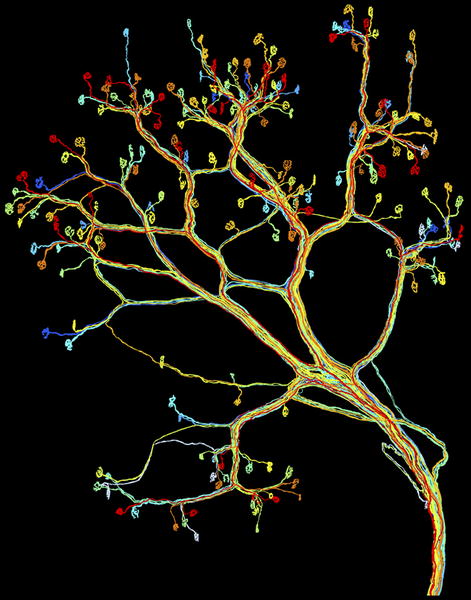 In a striking demonstration, Lu et al have shown that even for one of the smallest muscles in a mouse, the wiring diagram differs between two individuals, and even between the left and right sides of the same mouse. Almost every axon was longer than optimal, breaking a long-held assumption that the total wiring length in a branched axon should be minimized, since the energy costs for conduction increase with length. From Richard Robinson's review:
A complete wiring diagram—where axons go, how they branch, and where they link to muscle—has been developed for roundworms, but never before for a mammal. Performing the same feat in the mouse has presented an enormous technical challenge because of the larger size and complexity of the nervous system. The authors chose to study the interscutularis muscle, which connects the base of the ear to the middle of the skull, because it was small, accessible, and innervated by relatively few neurons...Using mice whose cells all bore a fluorescent tag, and a confocal microscope with a computer-controlled, motorized stage, the authors took thousands of individual photographs and reconstructed them to trace individual axons as they stretched across the skull, entered the muscle, branched repeatedly, and ultimately formed synapses with individual muscle fibers.
In the worm, the routes taken and connections made by axons are highly stereotyped, indicating a high degree of genetic control. But in the mouse, the actual number of axons innervating a single muscle ranged from 13 to 16, differing between mice and even between the left and right sides of the same mouse. Axonal length, including all the branches, varied much more widely, from 1.5 millimeters to 13.3 millimeters, and the number of synapses formed by a single axon ranged from a low of one (for an axon that didn't branch at all) to a high of 37. The branching pattern of axons that innervate a similar number of muscle fibers from different muscles also differed significantly, suggesting that unlike in the worm, branching in the mammal is not a deterministic process; instead it is governed by some general developmental rules, while the details of final connection are shaped by contingencies, as excess synapses are pruned.
Observing a brain rewiring itself
 Our motor cortex has a topographic representation of our bodies (a homunculus), as shown in the figure. It has generally been assumed that this organization is "hard wired" by genetic instructions. Stoeckel et al. have now made the fascinating observation that in subjects with congenitally compromised hand function and compensatory skillful foot use, a representation of the foot appears in the vicinity of the normal hand area. Their results imply that during early motor development experience may play a more critical role in the shaping of genetically determined neural networks than previously assumed.
Thursday, March 26, 2009
I feel what you feel if we are similar
From Serino et al.:
Social interactions are influenced by the perception of others as similar or dissimilar to the self. Such judgements could depend on physical and semantic characteristics, such as membership in an ethnic or political group. In the present study we tested whether social representations of the self and of others could affect the perception of touch. To this aim, we assessed tactile perception on the face when subjects observed a face being touched by fingers. In different conditions we manipulated the identity of the shown face. In a first experiment, Caucasian and Maghrebian (Northern African) participants viewed a face belonging either to their own or to a different ethnic group; in a second experiment, Liberal and Conservative politically active participants viewed faces of politicians belonging to their own or to the opposite political party. The results showed that viewing a touched face most strongly enhanced the perception of touch on the observer's face when the observed face belonged to his/her own ethnic or political group.
Who you are depends on how you feel.
Here is a curious bit by Ashton-James et al., from the journal Psychological Science, noting yet another distinction between Western and Asian cultures. The studies recruited students from the University of British Columbia (74 Asian and Asian Canadian students, 72 European and European Canadian students) who engaged memory tasks designed to induce positive, neutral, or negative affect. Their abstract:
We present a novel role of affect in the expression of culture. Four experiments tested whether individuals' affective states moderate the expression of culturally normative cognitions and behaviors. We consistently found that value expressions, self-construals, and behaviors were less consistent with cultural norms when individuals were experiencing positive rather than negative affect. Positive affect allowed individuals to explore novel thoughts and behaviors that departed from cultural constraints, whereas negative affect bound people to cultural norms. As a result, when Westerners experienced positive rather than negative affect, they valued self-expression less, showed a greater preference for objects that reflected conformity, viewed the self in more interdependent terms, and sat closer to other people. East Asians showed the reverse pattern for each of these measures, valuing and expressing individuality and independence more when experiencing positive than when experiencing negative affect. The results suggest that affect serves an important functional purpose of attuning individuals more or less closely to their cultural heritage.
Wednesday, March 25, 2009
Globalization and the internet enhance world cooperation...
Buchan et al. tabulate the relationship between a country-level globalization index (CGI) produced by the Centre for the Study of Globalization and Regionalisation at the University of Warwick, U.K and the results of a game experiment carried out 190 study participants from Columbus (Ohio, U.S.), Milan (Italy), Kazan (Tatarstan, Russia), Buenos Aires (Argentina), Johannesburg (South Africa), Tehran (Iran), and in surrounding areas. In the game (rather involved, here is a PDF describing the details), participants (who are randomly matched with 8 others from other countries and 4 local people) distribute cash tokens between 'personal', 'local', and 'world' envelopes in a sequential series of decisions that result in varying rewards depending on how many other local and other country participants give matched contributions to their local and world envelopes. Their finding and conclusion:
 As the authors describe their nested world decision game:
...as country and individual levels of globalization increase, so too does individual cooperation at the global level vis-à-vis the local level. In essence, “globalized” individuals draw broader group boundaries than others, eschewing parochial motivations in favor of cosmopolitan ones. Globalization may thus be fundamental in shaping contemporary large-scale cooperation and may be a positive force toward the provision of global public goods.
 As the authors describe their nested world decision game:
A participant (Individual I) may allot the money to his or her Personal account and/or allot it to his or her Local or World group account. The 3 numbers in brackets [x, y, z] represent the returns to I (x), to another person from I's local group (y), and to a person from a different country (z) from a token allotted to I's Personal, Local, or World account, respectively. That is, a token allotted to the Personal account (dotted line) gives 1 token to I and nothing to anyone else. A token allotted to the Local account (dashed line) yields half a token to all of the 3 members of I's Local account but nothing to the people from the other two Local groups. A token allotted to I's World account (solid line) yields a quarter of a token to all of the 12 people in the World group.
Figure - Relationship between CGI and mean Allocations to World and Local Accounts. Countries are plotted according to their macrolevel globalization score on the x axis and mean aggregate levels of contribution to the World account (diamond points), and Local accounts (square points) on the y axis. The linear predictions for both variables are also plotted.

Globalization and the internet diminish cooperation.
As a partial counter to today's other MindBlog posting, a Kristoff essay, "The Daily Me," argues that we use the internet for interactions that confirm and enhance our existing attitudes, thus diminishing the prospect of cooperation or agreement with people who hold different views:
When we go online, each of us is our own editor, our own gatekeeper. We select the kind of news and opinions that we care most about....Nicholas Negroponte of M.I.T. has called this emerging news product The Daily Me. And if that’s the trend, God save us from ourselves...That’s because there’s pretty good evidence that we generally don’t truly want good information — but rather information that confirms our prejudices. We may believe intellectually in the clash of opinions, but in practice we like to embed ourselves in the reassuring womb of an echo chamber.
One of last year’s more fascinating books was Bill Bishop’s “The Big Sort: Why the Clustering of Like-Minded America is Tearing Us Apart.” He argues that Americans increasingly are segregating themselves into communities, clubs and churches where they are surrounded by people who think the way they do...The nation grows more politically segregated — and the benefit that ought to come with having a variety of opinions is lost to the righteousness that is the special entitlement of homogeneous groups...The result is polarization and intolerance.
Tuesday, March 24, 2009
Why jokes are hard to remember.
Natalie Angier has a nice piece on foibles of our memory in last Tuesday's science section of the NYTimes. Some edited clips:
The ease with which people forget jokes is one of those quirks...that ends up revealing a surprising amount about the underlying architecture of memory....We have our version of a buffer...a short-term working memory of limited scope and fast turnover rate...our equivalent of a save button: the hippocampus, deep in the forebrain is essential for translating short-term memories into a more permanent form...what really distinguishes the lasting from the transient is how strongly the memory is engraved in the brain...The deeper the memory, the more readily and robustly an ensemble of like-minded neurons will fire...A simple melody with a simple rhythm and repetition can be a tremendous mnemonic device...It would be a virtually impossible task for young children to memorize a sequence of 26 separate letters if you just gave it to them as a string of information, but when the alphabet is set to the tune of the ABC song with its four melodic phrases, preschoolers can learn it with ease.
Really great jokes, on the other hand, punch the lights out of do re mi. They work not by conforming to pattern recognition routines but by subverting them...Jokes work because they deal with the unexpected, starting in one direction and then veering off into another...What makes a joke successful are the same properties that can make it difficult to remember.
As frustrating as it can be to forget something new, it’s worse to forget what you already know... Behind the tying up of tongues are the too-delicate nerves of our brain’s frontal lobes and their sensitivity to anxiety and the hormones of fight or flight. The frontal lobes that rifle through stored memories and perform other higher cognitive tasks tend to shut down when the lower brain senses danger and demands that energy be shunted its way....For that reason anxiety can be a test taker’s worst foe.
Pride: Adaptive Social Emotion or Seventh Sin?
The title of this post is taken from a tidy little article by Williams and DeSteno who perform a very simple manipulation to boost the pride (self esteem) of some of the participants in an experiment (telling them they have scored brilliantly on a previous test of visuospatial acuity regardless of their actual score), finding that they then take a dominant role within a subsequent group problem-solving task (working together on a three-dimensional puzzle), and also are perceived as the most likeable interaction partners. Here is their abstract:
This experiment examined the ability of pride to serve as an adaptive emotion within the context of social interaction. After an in vivo induction of pride or a neutral state, participants engaged in a group problem-solving task. In contrast to a conventional view that pride is often associated with negative interpersonal outcomes, results confirmed that proud individuals not only took on a dominant role within the group problem-solving task, but also were perceived as the most likeable interaction partners. These findings suggest that pride, when representing an appropriate response to actual performance (as opposed to overgeneralized hubris), constitutes a functional social emotion with important implications for leadership and the building of social capital.
Monday, March 23, 2009
Musical training enhances detection of emotional components of speech.
As a followup to my Feb. 25 post, I pass on work by Kraus and collaborators at Northwestern Univ. in which they tested 30 young adults in three categories: those with no musical training, those who started learning to play a musical instrument before age 7, and those who started later but had at least 10 years of training. The scientists hooked them up to electrodes that recorded the response of the auditory brainstem to a quarter-second of an emotion-laden sound: an infant's wail (see the figure below). The subjects with the most musical experience responded the fastest to the sound. with those who had practiced since early childhood having the strongest response to the parts of the cry for which timing, pitch, and timbre were most complex. Non-musicians did not pick up on fine-grained information in the signal.
Here is their abstract, followed by a figure:
Here is their abstract, followed by a figure:
Musicians exhibit enhanced perception of emotion in speech, although the biological foundations for this advantage remain unconfirmed. In order to gain a better understanding for the influences of musical experience on neural processing of emotionally salient sounds, we recorded brainstem potentials to affective human vocal sounds. Musicians showed enhanced time-domain response magnitude to the most spectrally complex portion of the stimulus and decreased magnitude to the more periodic, less complex portion. Enhanced phase-locking to stimulus periodicity was likewise seen in musicians' responses to the complex portion. These results suggest that auditory expertise engenders both enhancement and efficiency of subcortical neural responses that are intricately connected with acoustic features important for the communication of emotional states. Our findings provide the first biological evidence for behavioral observations indicating that musical training enhances the perception of vocally expressed emotion in addition to establishing a subcortical role in the auditory processing of emotional cues.
Fig. 1. Stimulus and grand average response waveforms. Response waveforms have been shifted back in time (∼7 msec) to align the stimulus and response onsets. Boxes delineate two stimulus subsections and the corresponding brainstem responses. The first subsection (112–142 ms) corresponds to the periodic portion and the second (145–212 ms) corresponds to the more complex portion. (A) Stimulus time-amplitude waveform. (B) Stimulus spectrogram. The stimulus F0 is superimposed as a highlighted line (∼280 Hz, left axis) with higher frequency spectral components plotted between white dotted lines (right axis). Although the F0 is detectable during the first section, the greater acoustic complexity of the second section results in the inability of the sound analyzing software (Praat) to track the F0 . The harmonics are likewise more aperiodic. (C) The averaged responses of MusYrs and NonMus. Major peaks (β, 1 and 2) are labeled above the waveform.

A model for the outbreak of cooperation.
Helbing and Yu, in an open access article, offer a fascinating game theoretic model that turns defectors into cooperators. The trick is to incorporate success-driven migration. The graphic illustrations are interesting and clear, and I suggest you check them out. Here is their abstract:
According to Thomas Hobbes' Leviathan [1651; 2008 (Touchstone, New York), English Ed], “the life of man [is] solitary, poor, nasty, brutish, and short,” and it would need powerful social institutions to establish social order. In reality, however, social cooperation can also arise spontaneously, based on local interactions rather than centralized control. The self-organization of cooperative behavior is particularly puzzling for social dilemmas related to sharing natural resources or creating common goods. Such situations are often described by the prisoner's dilemma. Here, we report the sudden outbreak of predominant cooperation in a noisy world dominated by selfishness and defection, when individuals imitate superior strategies and show success-driven migration. In our model, individuals are unrelated, and do not inherit behavioral traits. They defect or cooperate selfishly when the opportunity arises, and they do not know how often they will interact or have interacted with someone else. Moreover, our individuals have no reputation mechanism to form friendship networks, nor do they have the option of voluntary interaction or costly punishment. Therefore, the outbreak of prevailing cooperation, when directed motion is integrated in a game-theoretical model, is remarkable, particularly when random strategy mutations and random relocations challenge the formation and survival of cooperative clusters. Our results suggest that mobility is significant for the evolution of social order, and essential for its stabilization and maintenance.
Friday, March 20, 2009
Empathy modulated by genetic background.
In mice, to be sure, but if this is like so many other genetics/behavior studies in mice, the same observations will probably soon be made in humans.
Empathy, as originally defined, refers to an emotional experience that is shared among individuals. When discomfort or alarm is detected in another, a variety of behavioral responses can follow, including greater levels of nurturing, consolation or increased vigilance towards a threat. Moreover, changes in systemic physiology often accompany the recognition of distressed states in others. Employing a mouse model of cue-conditioned fear, we asked whether exposure to conspecific distress influences how a mouse subsequently responds to environmental cues that predict this distress. We found that mice are responsive to environmental cues that predict social distress, that their heart rate changes when distress vocalizations are emitted from conspecifics, and that genetic background substantially influences the magnitude of these responses. Specifically, during a series of pre-exposure sessions, repeated experiences of object mice that were exposed to a tone-shock (CS-UCS) contingency resulted in heart rate deceleration in subjects from the gregarious C57BL/6J (B6) strain, but not in subjects from the less social BALB/cJ (BALB) strain. Following the pre-exposure sessions, subjects were individually presented with the CS-only for 5 consecutive trials followed by 5 consecutive pairings of the CS with the UCS. Pre-exposure to object distress increased the freezing responses of B6 mice, but not BALB mice, on both the CS-only and the CS-UCS trials. These physiological and behavioral responses of B6 mice to social distress parallel features of human empathy. Our paradigm thus has construct and face validity with contemporary views of empathy, and provides unequivocal evidence for a genetic contribution to the expression of empathic behavior.
Neural correlates of aesthetic preference - differences between men and women
The abstract from Cela-Condea et al.:
The capacity to appreciate beauty is one of our species' most remarkable traits. Although knowledge about its neural correlates is growing, little is known about any gender-related differences. We have explored possible differences between men and women's neural correlates of aesthetic preference. We have used magnetoencephalography to record the brain activity of 10 male and 10 female participants while they decided whether or not they considered examples of artistic and natural visual stimuli to be beautiful. Our results reveal significantly different activity between the sexes in parietal regions when participants judged the stimuli as beautiful. Activity in this region was bilateral in women, whereas it was lateralized to the right hemisphere in men. It is known that the dorsal visual processing stream, which encompasses the superior parietal areas, has been significantly modified throughout human evolution. We posit that the observed gender-related differences are the result of evolutionary processes that occurred after the splitting of the human and chimpanzee lineages. In view of previous results on gender differences with respect to the neural correlates of coordinate and categorical spatial strategies, we infer that the different strategies used by men and women in assessing aesthetic preference may reflect differences in the strategies associated with the division of labor between our male and female hunter-gatherer hominin ancestors.They suggest:
...One possible explanation for the greater lateralization in men than in women could be grounded on differences between exploration strategies. Women would carry out an exploration of categorical spatial relations. The processes occurring in the right hemisphere of male participants suggest an exploration strategy based on coordinate spatial relations.They feel that:
...there are other alternatives to the interpretation based on spatial exploration strategies. It is generally accepted that the right parietal cortex is associated with global visual attention and the left with local attention. Perhaps women make use of both global and local features in making their judgments, whereas men only rely on global features.
...Another hypothesis could link the observations to language. Women obtain higher scores on a diversity of verbal and language tasks. Perhaps women are more likely to associate the images with verbal labels than men, producing the lateralizing differences in neural activity.
...hunter-gatherer hypothesis of gender differences in spatial abilities provides the most convincing scenario. Differences in spatial ability between men and women would be associated with the division of labor between the sexes in hunting and gathering.
Thursday, March 19, 2009
A map of knowledge
When we click from one page to another while looking through online scientific journals, we generate a chain of connections between things we think belong together. Now a billion such 'clickstream events' have been analyzed to map these connections on a grand scale. What emerges is a fascinating snapshot of the web of interconnections between disciplines, which some data-mining experts believe reveals the degree to which work that is not often cited — including work in the social sciences and humanities — is widely consulted and can form bridges between scientific disciplines. The authors of the maps argue that web-usage metrics give an alternative and more up-to-date view of science than existing maps and indicators, which are largely based on out-of-date citation data. (Try clicking on the map to enlarge it.)


How to lower your self control.
An interesting piece of work from Ackerman et al. We know that imagining or actively perceiving other people's actions can elicit many of the same neural and embodied responses that would occur if we performed those actions ourselves. This work shows that observing someone exerting self control sufficiently engages our empathetic mirroring of that process that it fatigues our own self control!
Acts of self-control may deplete an individual's self-regulatory resources. But what are the consequences of perceiving other people's use of self-control? Mentally simulating the actions of others has been found to elicit psychological effects consistent with the actual performance of those actions. Here, we consider how simulating versus merely perceiving the use of willpower can affect self-control abilities. In a first study, participants who simulated the perspective of a person exercising self-control exhibited less restraint over spending on consumer products than did other participants. In a second study, participants who took the perspective of a person using self-control exerted less willpower on an unrelated lexical generation task than did participants who took the perspective of a person who did not use self-control. Conversely, participants who merely read about another person's self-control exerted more willpower than did those who read about actions not requiring self-control. These findings suggest that the actions of other people may either deplete or boost one's own self-control, depending on whether one mentally simulates those actions or merely perceives them.
Gay scientists isolate christian gene.
My thanks to Mark Weber for bringing this satire to my attention.
Wednesday, March 18, 2009
Gesturing enhances learning in children
Goldin-Meadow and collaborators, whose work on the role of gesture in language development I have mentioned previously in two posts, now demonstrate that gesturing helps children learn math:
How does gesturing help children learn? Gesturing might encourage children to extract meaning implicit in their hand movements. If so, children should be sensitive to the particular movements they produce and learn accordingly. Alternatively, all that may matter is that children move their hands. If so, they should learn regardless of which movements they produce. To investigate these alternatives, we manipulated gesturing during a math lesson. We found that children required to produce correct gestures learned more than children required to produce partially correct gestures, who learned more than children required to produce no gestures. This effect was mediated by whether children took information conveyed solely in their gestures and added it to their speech. The findings suggest that body movements are involved not only in processing old ideas, but also in creating new ones. We may be able to lay foundations for new knowledge simply by telling learners how to move their hands.
Rehab, neuroscience, and religion
Jim Schnabel offers a brief essay in NatureNews on neuroscientists who are suggesting that is effectiveness of drug intervention programs is related to their strengthening of executive frontal lobe functions. Here are a few clips:
The modern addiction rehabilitation industry...even today is dominated by Wilson's Alcoholics Anonymous (AA) paradigm and its 'twelve-step' approach to recovery. Perhaps unsurprisingly, given its spiritual origins, this approach has had an uneasy relationship with the evidence-based culture of medical research. Both perceive addiction as a chronic disease; but whereas scientists seek rationally targeted interventions to blunt drug cravings, AA and related programmes tend to feature group therapy, tearful confessions and the call to "surrender to a higher power"...In the past few years, however, these two cultures have been finding common ground. Neuroscientists have begun to recognize that some of the most important brain systems impaired in addiction are those in the prefrontal cortex that regulate social cognition, self-monitoring, moral behaviour and other processes that the AA-type approach seems to target....treatment programmes are targeting these systems without necessarily knowing that they are doing it.
Religion has been shown to have a strong inverse association with drug addiction...Michael McCullough, who studies religion and behaviour at the University of Miami in Florida, suggests that when a person commits to any cultural system that regulates behaviour, the psychological effort to conform strengthens the brain systems that mediate self-monitoring and self-control. "What makes religion unique, I think, is that the code of conduct isn't just laid down by your parents or your friends or your principal at school, but ostensibly by the individual who is superintending the Universe, so it has an extra moral force." Some religious rituals, he says, have been shown to provoke enhanced activity in prefrontal regions (see Azari et al.). "It's as if certain forms of prayer and meditation are pinpointing precisely those [prefrontal] areas of the brain that people rely on to control attention, to control negative emotion and resolve mental conflict."
In pursuing other ways to boost prefrontal systems medicines for ADHD seem an obvious place to start. Attention-enhancing drugs such as methyl-phenidate and atomoxetine boost the activity of key receptor systems in the prefrontal cortex, in particular those for noradrenaline and dopamine. ..The National Institute on Drug Abuse has also been supporting studies of cognitive and behavioural strategies, and Volkow says that she is particularly enthusiastic about an approach that involves "real-time fMRI feedback". Developed by researcher and entrepreneur Christopher deCharms earlier this decade, the technique involves placing drug users in an fMRI machine and showing them a symbolic representation — a flame — of the fMRI-measured brain activity that corresponds to their cravings. The users are then asked to apply their own cognitive exercises, such as imagining their child is with them, to quench their cravings and douse the flame. After half a dozen sessions with this feedback the user will, in principle, develop cognitive circuitry that is more efficient at suppressing craving and that can then be used in ordinary life. A version of the technique, used for pain relief, has already shown some efficacy in a small clinical trial, and deCharms and his Silicon Valley start-up, Omneuron, are currently running a small trial in smokers — with plans for a follow up with some of Childress's cocaine users.
Tuesday, March 17, 2009
Negative attitude towards aging when young: decrease in later cardiovascular health.
Levy et al. examine a cohort of 440 individuals drawn from the Baltimore Longitudinal Study of Aging whose attitudes on aging was tested starting in 1968 when they were young (18–49 years, mean age = 36.5 years) and then noted cardiovascular events (89 total, including angina attacks, congestive heart failures, myocardial infarctions, strokes, and transient ischemic attacks) until 2007. 30 years after participants had responded to the age stereotype measure 25% of those with negative-age-stereotypes had experienced a cardiovascular event, compared to 13% who had positive-age-stereotypes.

Association between age stereotypes and time until experiencing a first cardiovascular (CV) event. The graph shows the percentage of participants who had not experienced a CV event as a function of time in each age-stereotype group.

Association between age stereotypes and time until experiencing a first cardiovascular (CV) event. The graph shows the percentage of participants who had not experienced a CV event as a function of time in each age-stereotype group.
Mental fatigue impairs our physical performance.
This study by Marcora et al. compared subjects who first either watched a movie for 90 min., or did computer exercises requiring concentration, memory and reaction speed - following which all exercised on a stationary bicycle until they were exhausted — that is, unable to maintain a cadence of 60 revolutions per minute. There were no significant differences in physiological measures (heart rate, cardiac output and others) under the two conditions, but bicyclers consistently tired about 15 percent more quickly after the mental exercise than after watching the movies. Apparently their poorer exercise results after mental effort were not caused by reduced performance of their bodies, but because mental fatigue limits exercise tolerance through higher perception of effort.
Monday, March 16, 2009
The Ricky Gervais Show on the "I-Illusion"
Thanks to my son Jon for pointing me to this humorous video.
Subscribe to:
Comments (Atom)