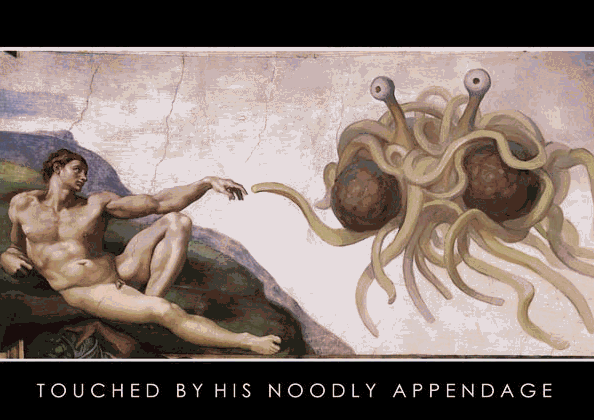
For some strange reason the Times doesn't mention another major and growing group, The Church of the Flying Spagetti Monster.
This blog reports new ideas and work on mind, brain, behavior, psychology, and politics - as well as random curious stuff. (Try the Dynamic Views at top of right column.)
Sunday, January 14, 2007
Varieties of Delusion - I'll take the Flying Spagetti Monster
For some strange reason the Times doesn't mention another major and growing group, The Church of the Flying Spagetti Monster.
Tuesday, January 02, 2007
Explaining away the supernatural as brain misfirings?
Blum then continues: "The nonpurists suggest a different conclusion: willful scientific blindness. And there’s no reason Dr. Blanke’s study can’t support their theories of the paranormal. Perhaps his experimental electric current simply mimics the work of an equally powerful spirit. Much of the psychical research done today applies similar principles: brain-imaging machines highlight parts of the brain that respond to psychic phenomena, while other devices are used to search for infrared radiation or increased electrical activity in haunted houses."
Wait a minute... Equally powerful spirit? Will someone please measure this spirit with a physical instrument, because it is altering physical processes in the brain! Or, "parts of the brain that respond to psychic phenomena?" What is cause and what is effect here? Are we presupposing the existence of psychic phenomena as causes? Then please measure them. I'm sorry, but I can't give up my skepticism about things that alter material physical processes in the brain, how can a non-physical process (spirit, ectoplasm, soul, whatever) change them? We're back to Descartes putting the soul in the pineal gland.
Photo credit: New York Times.
Monday, December 11, 2006
The Buddha and viscoelastic foam
Tuesday, December 05, 2006
Terror Management and Religious Belief
Their complete abstract: "Terror management theory suggests that people cope with awareness of death by investing in some kind of literal or symbolic immortality. Given the centrality of death transcendence beliefs in most religions, the authors hypothesized that religious beliefs play a protective role in managing terror of death. The authors report three studies suggesting that affirming intrinsic religiousness reduces both death-thought accessibility following mortality salience and the use of terror management defenses with regard to a secular belief system. Study 1 showed that after a naturally occurring reminder of mortality, people who scored high on intrinsic religiousness did not react with worldview defense, whereas people low on intrinsic religiousness did. Study 2 specified that intrinsic religious belief mitigated worldview defense only if participants had the opportunity to affirm their religious beliefs. Study 3 illustrated that affirmation of religious belief decreased death-thought accessibility following mortality salience only for those participants who scored high on the intrinsic religiousness scale. Taken as a whole, these results suggest that only those people who are intrinsically vested in their religion derive terror management benefits from religious beliefs."
Wednesday, November 22, 2006
The Case Against Faith .. and what's the alternative
What is absent from his critique of religion is a positive scientifically grounded alternative that meets the same human needs for solice and community that religion sometimes serves. Relevant to this is the recent NYTimes article "A Free-for-All on Science and Religion." which describes a meeting held at th Salk Institute in San Diego which "began to resemble the founding convention for a political party built on a single plank: in a world dangerously charged with ideology, science needs to take on an evangelical role, vying with religion as teller of the greatest story ever told."
The Harris essay:
"Despite a full century of scientific insights attesting to the antiquity of life and the greater antiquity of the Earth, more than half the American population believes that the entire cosmos was created 6,000 years ago. This is, incidentally, about a thousand years after the Sumerians invented glue. Those with the power to elect presidents and congressmen—and many who themselves get elected—believe that dinosaurs lived two by two upon Noah's Ark, that light from distant galaxies was created en route to the Earth and that the first members of our species were fashioned out of dirt and divine breath, in a garden with a talking snake, by the hand of an invisible God.
This is embarrassing. But add to this comedy of false certainties the fact that 44 percent of Americans are confident that Jesus will return to Earth sometime in the next 50 years, and you will glimpse the terrible liability of this sort of thinking. Given the most common interpretation of Biblical prophecy, it is not an exaggeration to say that nearly half the American population is eagerly anticipating the end of the world. It should be clear that this faith-based nihilism provides its adherents with absolutely no incentive to build a sustainable civilization—economically, environmentally or geopolitically. Some of these people are lunatics, of course, but they are not the lunatic fringe. We are talking about the explicit views of Christian ministers who have congregations numbering in the tens of thousands. These are some of the most influential, politically connected and well-funded people in our society.
It is, of course, taboo to criticize a person's religious beliefs. The problem, however, is that much of what people believe in the name of religion is intrinsically divisive, unreasonable and incompatible with genuine morality. One of the worst things about religion is that it tends to separate questions of right and wrong from the living reality of human and animal suffering. Consequently, religious people will devote immense energy to so-called moral problems—such as gay marriage—where no real suffering is at issue, and they will happily contribute to the surplus of human misery if it serves their religious beliefs.
A case in point: embryonic-stem-cell research is one of the most promising developments in the last century of medicine. It could offer therapeutic breakthroughs for every human ailment (for the simple reason that stem cells can become any tissue in the human body), including diabetes, Parkinson's disease, severe burns, etc. In July, President George W. Bush used his first veto to deny federal funding to this research. He did this on the basis of his religious faith. Like millions of other Americans, President Bush believes that "human life starts at the moment of conception." Specifically, he believes that there is a soul in every 3-day-old human embryo, and the interests of one soul—the soul of a little girl with burns over 75 percent of her body, for instance—cannot trump the interests of another soul, even if that soul happens to live inside a petri dish. Here, as ever, religious dogmatism impedes genuine wisdom and compassion.
A 3-day-old human embryo is a collection of 150 cells called a blastocyst. There are, for the sake of comparison, more than 100,000 cells in the brain of a fly. The embryos that are destroyed in stem-cell research do not have brains, or even neurons. Consequently, there is no reason to believe they can suffer their destruction in any way at all. The truth is that President Bush's unjustified religious beliefs about the human soul are, at this very moment, prolonging the scarcely endurable misery of tens of millions of human beings.
Given our status as a superpower, our material wealth and the continuous advancements in our technology, it seems safe to say that the president of the United States has more power and responsibility than any person in history. It is worth noting, therefore, that we have elected a president who seems to imagine that whenever he closes his eyes in the Oval Office—wondering whether to go to war or not to go to war, for instance—his intuitions have been vetted by the Creator of the universe. Speaking to a small group of supporters in 1999, Bush reportedly said, "I believe God wants me to be president." Believing that God has delivered you unto the presidency really seems to entail the belief that you cannot make any catastrophic mistakes while in office. One question we might want to collectively ponder in the future: do we really want to hand the tiller of civilization to a person who thinks this way?
Religion is the one area of our discourse in which people are systematically protected from the demand to give good evidence and valid arguments in defense of their strongly held beliefs. And yet these beliefs regularly determine what they live for, what they will die for and—all too often—what they will kill for. Consequently, we are living in a world in which millions of grown men and women can rationalize the violent sacrifice of their own children by recourse to fairy tales. We are living in a world in which millions of Muslims believe that there is nothing better than to be killed in defense of Islam. We are living in a world in which millions of Christians hope to soon be raptured into the stratosphere by Jesus so that they can safely enjoy a sacred genocide that will inaugurate the end of human history. In a world brimming with increasingly destructive technology, our infatuation with religious myths now poses a tremendous danger. And it is not a danger for which more religious faith is a remedy."
Monday, November 13, 2006
Imaging the brain during "speaking in tongues"
The charismatic practice of speaking with the full conviction that God is talking through you has ancient roots in many religious traditions, notably the Old and New Testaments. Its technical term is glossolalia. It is experienced as a normal and expected behavior in religious prayer groups in which the individual appears to be speaking in an incomprehensible language.
Newberg et al. at the University of Pennsylvania have now performed brain imaging on five women while they spoke in tongues (Psychiatry Research: Neuroimaging, Volume 148, Issue 1 , 22 November 2006, Pages 67-71) They tracked changes in blood flow in each woman’s brain as she sang a gospel song and again while speaking in tongues.
An interesting difference was observed between these two emotional, devotional activities , described in a review by Carey, was that the "frontal lobes — the thinking, willful part of the brain through which people control what they do — were relatively quiet, as were the language centers. The regions involved in maintaining self-consciousness were active. The women were not in blind trances, and it was unclear which region was driving the behavior."... "a co-author of the study, was also a research subject. She is a born-again Christian who says she considers the ability to speak in tongues a gift. “You’re aware of your surroundings,” she said. “You’re not really out of control. But you have no control over what’s happening. You’re just flowing. You’re in a realm of peace and comfort, and it’s a fantastic feeling.”
"The scans also showed a dip in the activity of the left caudate. .. the caudate is usually active when you have positive affect, pleasure, positive emotions, and is also involved in motor and emotional control...it may be that practitioners, while mindful of their circumstances, nonetheless cede some control over their bodies and emotions."
Thursday, October 26, 2006
The God Delusion
"Dawkins’s case against religion follows an outline that goes back to Bertrand Russell’s classic 1927 essay “Why I Am Not a Christian.” First, discredit the traditional reasons for supposing that God exists. (“God” is here taken to denote the Judeo-Christian deity, presumed to be eternal, all-powerful, all-good and the creator of the world.) Second, produce an argument or two supporting the contrary hypothesis, that God does not exist. Third, cast doubt on the transcendent origins of religion by showing that it has a purely natural explanation. Finally, show that we can have happy and meaningful lives without worshiping a deity, and that religion, far from being a necessary prop for morality, actually produces more evil than good. The first three steps are meant to undermine the truth of religion; the last goes to its pragmatic value."
"If God is indeed more complex and improbable than his creation, does that rule him out as a valid explanation for the universe? The beauty of Darwinian evolution, as Dawkins never tires of observing, is that it shows how the simple can give rise to the complex. But not all scientific explanation follows this model. In physics, for example, the law of entropy implies that, for the universe as a whole, order always gives way to disorder; thus, if you want to explain the present state of the universe in terms of the past, you are pretty much stuck with explaining the probable (messy) in terms of the improbable (neat). It is far from clear which explanatory model makes sense for the deepest question, the one that, Dawkins complains, his theologian friends keep harping on: why does the universe exist at all? Darwinian processes can take you from simple to complex, but they can’t take you from Nothing to Something. If there is an ultimate explanation for our contingent and perishable world, it would seemingly have to appeal to something that is both necessary and imperishable, which one might label “God.” Of course, it can’t be known for sure that there is such an explanation. Perhaps, as Russell thought, “the universe is just there, and that’s all.”
"This sort of coolly speculative thinking could not be more remote from the rococo rituals of religion as it is actually practiced across the world. Why is it that all human cultures have religion if, as Dawkins believes he has proved, it rests on a delusion? Many thinkers — Marx, Freud, Durkheim — have produced natural histories of religion, arguing that it arose to serve some social or psychological function, such as, in Freud’s account, the fulfillment of repressed wishes toward a father-figure.
"Dawkins’s own attempt at a natural history is Darwinian, but not in the way you might expect. He is skeptical that religion has any survival value, contending that its cost in blood and guilt outweighs any conceivable benefits. Instead, he attributes religion to a “misfiring” of something else that is adaptively useful; namely, a child’s evolved tendency to believe its parents. Religious ideas, he thinks, are viruslike “memes” that multiply by infecting the gullible brains of children. (Dawkins coined the term “meme” three decades ago to refer to bits of culture that, he holds, reproduce and compete the way genes do.) Each religion, as he sees it, is a complex of mutually compatible memes that has managed to survive a process of natural selection. (“Perhaps,” he writes in his usual provocative vein, “Islam is analogous to a carnivorous gene complex, Buddhism to a herbivorous one.”) Religious beliefs, on this view, benefit neither us nor our genes; they benefit themselves. "
"But the objectivity of ethics is undermined by Dawkins’s logic just as surely as religion is. The evolutionary biologist E. O. Wilson, in a 1985 paper written with the philosopher Michael Ruse, put the point starkly: ethics “is an illusion fobbed off on us by our genes to get us to cooperate,” and “the way our biology enforces its ends is by making us think that there is an objective higher code to which we are all subject.” In reducing ideas to “memes” that propagate by various kinds of “misfiring,” Dawkins is, willy-nilly, courting what some have called Darwinian nihilism."
"He is also hasty in dismissing the practical benefits of religion. Surveys have shown that religious people live longer (probably because they have healthier lifestyles) and feel happier (perhaps owing to the social support they get from church). Judging from birthrate patterns in the United States and Europe, they also seem to be outbreeding secular types, a definite Darwinian advantage. On the other hand, Dawkins is probably right when he says that believers are no better than atheists when it comes to behaving ethically. One classic study showed that “Jesus people” were just as likely to cheat on tests as atheists and no more likely to do altruistic volunteer work. "
Friday, September 22, 2006
Why Christians and Conservatives should accept evolution.
1. EVOLUTION FITS WELL WITH THEOLOGY. What difference does it make when or how God created life (10 thousand or 10 billion years ago?, by natural forces or spoken word?) - All faiths, including Christians, should embrace modern science for what it has done to reveal the magnificence of the divine in a depth and detail unmatched by ancient texts.
2. CREATIONISM IS BAD THEOLOGY. The watchmaker God of intelligent-design creationism make God just a genetic engineer slightly more advanced than we are... this is belittling... an omniscient God must be above such human-like descriptions and constraints.
3. EVOLUTION EXPLAINS ORIGINAL SIN AND THE CHRISTIAN MODEL OF HUMAN NATURE. Like other social primates, we evolved within-group amity and between-group enmity. By nature, then, we are cooperative and competitive, altruistic and selfish, greedy and generous, peaceful and bellicose. Moral codes and a society based on the rule of law are necessary to accentuate the positive and attenuate the negative sides of our evolved nature.
4. EVOLUTION EXPLAINS FAMILY VALUES. In humans and other social mammals brain pathways and hormonal mechanisms have evolved to support attachment and bonding, cooperation and reciprocity, sympathy and empathy, conflict resolution, community concern and reputation anxiety, and response to group social norms. Religious moral codes reflect these evolved moral natures.
5. EVOLUTION EXPLAINS CONSERVATIVE FREE-MARKET ECONOMICS. Charles Darwin's "natural selection" is precisely parallel to Adam Smith's "invisible hand." Darwin showed how complex design and ecological balance were unintended consequences of competition among individual organisms. Smith showed how national wealth and social harmony were unintended consequences of competition among individual people. Nature's economy mirrors society's economy. Both are designed from the bottom up, not the top down.
Tuesday, September 12, 2006
God on the Brain
The Economist has a nice review and critical discussion of work by Mario Beauregard and collaborators at the Univ. of Montreal doing fMRI imaging of the brains of Carmelite nuns as they recall experiences of mystical union (by definition such experiences can not be summoned at will). The idea is based on the fact that imagining an experience usually activates the same brain regions that are active when the experience is actually taking place. Not surprisingly, there is no "God spot" in the brain, and activity in a number of brain regions, notably emotional areas, correlates with the recall of union. From their abstract in Neuroscience Letters (Volume 405, Issue 3 , 25 September 2006): "The brain activity of Carmelite nuns was measured while they were subjectively in a state of union with God. This state was associated with significant loci of activation in the right medial orbitofrontal cortex, right middle temporal cortex, right inferior and superior parietal lobules, right caudate, left medial prefrontal cortex, left anterior cingulate cortex, left inferior parietal lobule, left insula, left caudate, and left brainstem. Other loci of activation were seen in the extra-striate visual cortex. These results suggest that mystical experiences are mediated by several brain regions and systems."
Brain imaging has been to used to study a number of other altered states of consciousness, such as the phantom limb phenomenon and out of body experiences. Brain damage in the region of junction of the temporal and parietal lobes can alter perception of personal and extrapersonal space, and other studies have shown the changes in activation in this region correlates with meditative experiences of sensing sensing a greater interconnectedness of things, and dissolution of self into some larger entity.
Thursday, August 31, 2006
Start your own religion....
After interviewing candidates who ranged from genuine to humorous to bizarre, Joshua Boden (35) was chosen to attempt to establish his "Church of Now", a God-optional religion that lists 14 precepts, including, “The only ‘sin’ is not living fully,” and, “This life is the one that counts; this IS your eternal reward.” The religion has elements of Buddhism, Taoism and New Age thinking. Although some of the beliefs might sound unorthodox and nonreligious (“Laughter is a must!”), Mr. Boden is earnest in his beliefs and his desire to establish a spiritual community. The going as been rocky so far. Potential followers indicated the presentation was not persuasive and authoritative ("Believe this!") enough.
Thursday, August 24, 2006
The Buddha's Biology
Sensing or exploring the nature of our elemental physical existence, our body breathing and homeostasis, is a focus of the Buddha's First Foundation of Mindfulness. This first foundation corresponds to physical elements of the body and homeostasis (regulation of blood flow, body temperature, etc.) These functions center in primitive brain stem structures we share with reptiles and other vertebrates. This core regulates interactions with the physical world elemental to having a self that we seldom think about - like breathing, supporting ourselves against gravity, seeing, tasting, smelling, touching, hearing.
These core structures also regulate our urge to remedy hunger, to have sex, to approach or avoid, to flee or fight when suddenly presented with very threatening situations. Our experience of these primary and instinctual basic drives, in its urgency and automaticity, has a very different quality than our experience of thoughts or more complicated emotions. The Buddha's Second Foundation of Mindfulness rests on the sentience of the nervous system which can note these elemental feelings, impressions of pleasant/unpleasant/neutral/painful, etc. We can, in more quiet moments of reflection or meditation note the more muted `flickers' of these primal forces, appearing and disappearing almost as transient quantal energies.
Our human introspective access to, observation of, emotional feelings more nuanced than the basic drives mentioned above is the focus of the Buddha's third foundation of mindfulness (affection, fear, anger, sadness, playfulness, etc.). These are regulated by a new kind of cortex that appears in mammals between the brain stem and the outer layer of the cortex, usually referred to as the limbic system.
Finally, our higher level cognitive abilities associated with the newer cortex (neocortex) that forms the top layers or our brain - our ability to note how thoughts and feelings are produced, as natural occurrences like breathing or the heartbeat - are a focus of the Buddha's fourth foundation of mindfulness.
Nisker's book has several sections of exercises or meditations useful in sensing layers of the self, its evolutionary nature, and its symbiosis with the external social and physical world.
Tuesday, July 25, 2006
Nice and Nasty Rats.... Religion and Science
Some remarkable experiments were started in the former Soviet Union in 1959 by Dmitri Belyaev, who decided to study the genetics of domestication and find what qualities were selected for by the neolithic farmers who developed most major farm species about 10,000 years ago. He decided to select for a single criterion: tameness. Starting by breeding silver foxes from the wild, after only eight generations animals that would tolerate human presence became common, and after 40 years and the breeding of 45,000 foxes, a group had emerged that were as tame and as eager to please as a dog. The tame silver foxes had begun to show white patches on their fur floppy ears, rolled tails and smaller skulls, like many other domesticated species. They also exhibited the unusual ability of dogs to understand human gestures (something Chimpanzees can't manage at all). Belyaev also bred a parallel colony of vicious foxes, but realizing that genetics can be better studied in smaller animals, he started working with local wild rats. In only sixty generations separate breeds of very tame and very ferocious rats were obtained. Paabo's laboratory in Germany is now crossing the tame and aggressive strains to find genetic sites that correlate with these behaviors. Such sites could then be examined in tame and aggressive individuals in other mammalian species, including humans... Perhaps an important part of homminid evolution was a human self-domestication that involved ostracizing (blocking the breeding of) individuals who were too aggressive.
The article by Dean in the same NYTimes issue provides a review of recent books on the clash between religion and science, and the debate over whether faith in God can coexist with faith in the scientific method. Professors of either faith or science acknowledge that they cannot prove that God either does or does not exist. Evolutionary psychological explanation of why religious belief seems to be universal among Homo sapiens are still "just-so" stories, very far from being proved.
The book by Lewis Wolpert "Six Impossible Things Before Breakfast: The Evolutionary Origins of Belief" (published in England, due in the U.S. in January) looks quite interesting:
"Dr. Wolpert writes about the way people think about cause and effect, citing among other work experiments on how we reason, how we assess risk, and the rules of thumb and biases that guide us when we make decisions. He is looking into what he calls “causal belief” — the idea that events or conditions we experience have a cause, possibly a supernatural cause.
Human reasoning is “beset with logical problems that include overdependence on authority, overemphasis on coincidence, distortion of the evidence, circular reasoning, use of anecdotes, ignorance of science and failures of logic,” he writes. And whatever these traits may say about acceptance of religion, they have a lot to do with public misunderstanding of science.
So, he concludes, “We have to both respect, if we can, the beliefs of others, and accept the responsibility to try and change them if the evidence for them is weak or scientifically improbable.”
This is where the scientific method comes in. If scientists are prepared to state their hypotheses, describe how they tested them, lay out their data, explain how they analyze their data and the conclusions they draw from their analyses — then it should not matter if they pray to Zeus, Jehovah, the Tooth Fairy, or nobody.
Their work will speak for itself."
Monday, July 17, 2006
The Dali Lama and evolutionary science. He’s an awesome guy, but……
Take for example, chapter 5, ''Evolution, Karma, and the world of sentience' While it is quite extraordinary that someone in his position has learned so much, it is also not surprising that he seems to be unaware of work that counters many of his perceived shortcomings of "Darwinian evolutionary theory."
pg 104 "that mutations..take place naturally is unproblematic..that they are purely random strikes me as unsatisfying. It leaves open the question of whether this randomness is best understood as an objective feature of reality or better understood as indicating some kind of hidden causality."
This doesn't compute for me. Ionizing cosmic radiation hitting a nucleotide and altering its replication is random, as are a number of low frequency errors made by enzymic processes involved in replication. We at least have a handle on what we mean by random. There are countless examples of how statistically small random changes can lead to complex results (like eyes, or different kinds of hormone and neurotransmitter receptors). "Hidden causality' , on the other hand, is a complete deus ex machina, or wild card, with no presently known means of evaluation within a materialistic scientific world view. If something pops up, great, but until then......
pg 104, "For modern science, at least from a philosophical point of view, the critical divide seems to be between inanimate matter and the origin of living organisms, while for Buddhism the critical divide is between non-sentient matter and the emergence of sentient beings." Aren't we talking about apples and oranges? I'm not understanding the usefulness of trying so hard to unify things, as (on pg. 111) "On the whole, I think the Darwinian theory...gives a fairly coherent account of the evolution of human life on earth. At the same time, I believe that karma can have a central role in understanding the origination of Buddhism calls "sentience", through the media of energy and consciousness."
pg. 115 "I find it [Darwinian account] leaves one crucial area unexamined, the origin of sentience." Virtually all descriptions of the evolution of the nervous system (Dennett's in "Consciousness Explained", for example) view the increasingly complexity of the nervous system - and the gradient of increasing sentience, consciousness, or whatever - as Darwinian adaptations that increase survival fitness of the organism.
pg. 114 "I feel that this inability or unwillingness fully to engage the question of altruism is perhaps the most important drawback of Darwinian...." There are now abundant models of how 'selfish' genes and organisms can generate altruistic behaviors. There is even a recent computer model of simple automata (agents with a limited set of receptors and elementary actions) that evolve various cooperative strategies. (Nature, 20:1041, 2006). See also my 5/26/06 post on "Cooperation, Punishment, and the Evolution of Human Institutions"
Anyway, enough. I won't ramble on. He really is an extraordinary guy. I totally support the idea that buddhist psychological insight offers some correlates with modern cognitive neuroscience, as between Buddha's foundations of mindfulness and steps in the evolution of the brain (mentioned in my "Beast Within" essay at dericbownds.net).
Tuesday, May 23, 2006
Religion as a Natural Phenomenon - More on Dennett's Book "Breaking the Spell"
Monday, April 03, 2006
Power of Prayer? - apparently not.....
Not only were there no effects of prayer, but the third of the subjects who were informed that they were being prayed for did slightly worse (performance anxiety?)
Wednesday, March 15, 2006
Can physics save your soul?
It is as clear a debunking as I have read of the feel good new age movement, dating from the 1960's, to blend modern quantum physics and consciousness. The argument seems to be that since there are deep paradoxes we can't grasp about physics and consciousness, they must share a deep unity. So maybe reality is just a mental construct we can manipulate, etc. etc.
The popular underground movies "What the #$!%* Do We Know" and its successor "What the Bleep, Down the Rabbit Hole" raise a question for Overbye "Do we really have to indulge in bad physics to feel good?" These movies, along with new age books liek "The Tao of Physics" and "The Dancing Wu Li Master" attempt to connect quantum physic to Eastern mysticism... the movie and the books promote "the idea that, at some level, our minds are in control of reality.." The minor factual problem is that "the waves that symbolize quantum possibilities are so fragile they collapse with the slightest encounter with their environment. Conscious observers are not needed." This is the unanimous opinion of working physicists today. One of them, Dr. David Albert, a professor of philosophy and physics at Columbia, points out that Eugene Wigner, the Nobel laureate who ventured the suggestion that consciousness might be a key to understanding how the "fog of quantum possibilities prescribed by mathematical theory can condense into one concrete actuality.... framed the process in strict mathematical and probabilistic terms..The desires and intentions of the observer had nothing to do with it."
"In other words, reality is out of our control..It's a casino universe...
An extended quote from Overbye :
"Not that there is anything wrong with that. There's a great story to be told about atoms and the void: how atoms evolved out of fire and bent space and grew into Homer, Chartres cathedral and "Blonde on Blonde." How those same atoms came to learn that the earth, sun, life, intelligence and the whole universe will eventually die.
I can hardly blame the quantum mystics for avoiding this story, and sticking to the 1960's.
When it comes to physics, people seem to need to kid themselves. There is a presumption, Dr. Albert said, that if you look deeply enough you will find "some reaffirmation of your own centrality to the world, a reaffirmation of your ability to take control of your own destiny." We want to know that God loves us, that we are the pinnacle of evolution.
But one of the most valuable aspects of science, he said, is precisely the way it resists that temptation to find the answer we want. That is the test that quantum mysticism flunks, and on some level we all flunk.
I'd like to believe that like Galileo, I would have the courage to see the world clearly, in all its cruelty and beauty, "without hope or fear," as the Greek writer Nikos Kazantzakis put it. Take free will. Everything I know about physics and neuroscience tells me it's a myth. But I need that illusion to get out of bed in the morning. Of all the durable and necessary creations of atoms, the evolution of the illusion of the self and of free will are perhaps the most miraculous. That belief is necessary to my survival."
Tuesday, March 14, 2006
An "Apostle's Creed" for the humanistic scientific materialist?
Friday, March 10, 2006
Evolutionary Spirituality - Evolutionary Christianity
Sunday, March 05, 2006
The Folk Psychology of Souls
Sunday, February 19, 2006
Trashing the God Genome
It's certainly appropriate to point out that any proposed natural biological account of the origins of religion is a just-so story than can not be tested. Mr. Wieseltier might have pointed out, however, that the just-so stories of conventional religions have led to massive human suffering and chaos. Some of the evolutionary psychology fantasies (Robert Wright's The Moral Animal, for example) yield a more benign outcome.
Clips from the review:
What follows is, in brief, Dennett's natural history of religion. It begins with the elementary assertion that everything that moves needs something like a mind, to keep it out of harm's way and help it find the good things. To this end, there arose in very ancient times the evolutionary adaptation that one researcher has called a hyperactive agent detection device, or HADD. This cognitive skill taught us, or a very early version of us, that we live in a world of other minds, and taught us too well, because it instilled the urge to treat things, especially frustrating things , as agents with beliefs and desires. This urge is deeply rooted in human biology, and it results in a fantasy-generation process that left us finding agency wherever anything puzzles or frightens us......Eventually this animism issued in deities, who were simply the agents who had access to all the strategic information that we desperately lacked. But what good to us is the gods' knowledge if we can't get it from them? So eventually shamans arose who told us what we wanted to hear from the gods.....Folk religions became organized religions.
There are a number of things that must be said about this story. The first is that it is only a story. It is not based, in any strict sense, on empirical research. Dennett is extrapolating back to human prehistory with the aid of biological thinking, nothing more. Breaking the Spell is a fairy tale told by evolutionary biology. There is no scientific foundation for its scientistic narrative. Even Dennett admits as much: I am not at all claiming that this is what science has established about religion. . . . We don't yet know. So all of Dennett's splashy allegiance to evidence and experiment and generating further testable hypotheses notwithstanding, what he has written is just an extravagant speculation based upon his hope for what is the case, a pious account of his own atheistic longing.
Like many biological reductionists, Dennett is sure that he is not a biological reductionist. But the charge is proved as early as the fourth page of his book. Watch closely. Like other animals, the confused passage begins, we have built-in desires to reproduce and to do pretty much whatever it takes to achieve this goal. No confusion there, and no offense. It is incontrovertible that we are animals. The sentence continues: But we also have creeds, and the ability to transcend our genetic imperatives. A sterling observation, and the beginning of humanism. And then more, in the same fine antideterministic vein: This fact does make us different.
Then suddenly there is this: But it is itself a biological fact, visible to natural science, and something that requires an explanation from natural science. As the ancient rabbis used to say, have your ears heard what your mouth has spoken? Dennett does not see that he has taken his humanism back. Why is our independence from biology a fact of biology? And if it is a fact of biology, then we are not independent of biology. If our creeds are an expression of our animality, if they require an explanation from natural science, then we have not transcended our genetic imperatives. The human difference, in Dennett's telling, is a difference in degree, not a difference in kind, a doctrine that may quite plausibly be called biological reductionism.