Showing posts with label technology. Show all posts

Monday, February 04, 2008

The algorithms of love...

John Tierney writes an interesting article on internet match finding services in the Jan 29 New York Times.
Online matchmaking has become a boom industry as rival scientists test their algorithms for finding love...The leading yenta is eHarmony, which pioneered the don’t-try-this-yourself approach eight years ago by refusing to let its online customers browse for their own dates. It requires them to answer a 258-question personality test and then picks potential partners...Another company, Perfectmatch.com, is using an algorithm designed by Pepper Schwartz, a sociologist at the University of Washington at Seattle. Match.com, which became the largest online dating service by letting people find their own partners, set up a new matchmaking service, Chemistry.com, using an algorithm created by Helen E. Fisher, an anthropologist at Rutgers who has studied the neural chemistry of people in love.

As the matchmakers compete for customers — and denigrate each other’s methodology — the battle has intrigued academic researchers who study the mating game. On the one hand, they are skeptical, because the algorithms and the results have not been published for peer review. But they also realize that these online companies give scientists a remarkable opportunity to gather enormous amounts of data and test their theories in the field. EHarmony says more than 19 million people have filled out its questionnaire...In the battle of the matchmakers, Chemistry.com has been running commercials faulting eHarmony for refusing to match gay couples (eHarmony says it can’t because its algorithm is based on data from heterosexuals), and eHarmony asked the Better Business Bureau to stop Chemistry.com from claiming its algorithm had been scientifically validated. The bureau concurred that there was not enough evidence, and Chemistry.com agreed to stop advertising that Dr. Fisher’s method was based on “the latest science of attraction.”

Dr. Fisher now says the ruling against her last year made sense because her algorithm at that time was still a work in progress as she correlated sociological and psychological measures, as well as indicators linked to chemical systems in the brain. But now, she said, she has the evidence from Chemistry.com users to validate the method, and she plans to publish it along with the details of the algorithm...“I believe in transparency,” she said, taking a dig at eHarmony. “I want to share my data so that I will get peer review.”
On reading that Chemistry.com didn't discriminate against gay match making, I naturally decided to give it a spin and went through their series of questions (including one on the relative lengths of one's index and ringer finger). It included psychological profile questions and some interesting tests of susceptibility to visual illusions. Alas, the list of prospective mates for a 65 yr. old retired professor was rather lean, and I ended my experiment by withdrawing my chemistry.com profile after one day.

Tuesday, January 29, 2008

More on the evils of multitasking.

In a comment below, MindBlog reader Gregory points to a great article in the Atlantic on the toxic mental effects of multitasking. I wanted to bring the link into this separate post so that more of you will see it. It is by culture/technology commentator Walter Kirn:
Neuroscience is confirming what we all suspect: Multitasking is dumbing us down and driving us crazy. One man’s odyssey through the nightmare of infinite connectivity

...Multitasking messes with the brain in several ways. At the most basic level, the mental balancing acts that it requires—the constant switching and pivoting—energize regions of the brain that specialize in visual processing and physical coordination and simultaneously appear to shortchange some of the higher areas related to memory and learning. We concentrate on the act of concentration at the expense of whatever it is that we’re supposed to be concentrating on.

What does this mean in practice? Consider a recent experiment at UCLA, where researchers asked a group of 20-somethings to sort index cards in two trials, once in silence and once while simultaneously listening for specific tones in a series of randomly presented sounds. The subjects’ brains coped with the additional task by shifting responsibility from the hippocampus—which stores and recalls information—to the striatum, which takes care of rote, repetitive activities. Thanks to this switch, the subjects managed to sort the cards just as well with the musical distraction—but they had a much harder time remembering what, exactly, they’d been sorting once the experiment was over.

Even worse, certain studies find that multitasking boosts the level of stress-related hormones such as cortisol and adrenaline and wears down our systems through biochemical friction, prematurely aging us. In the short term, the confusion, fatigue, and chaos merely hamper our ability to focus and analyze, but in the long term, they may cause it to atrophy.

The next generation, presumably, is the hardest-hit. They’re the ones way out there on the cutting edge of the multitasking revolution, texting and instant messaging each other while they download music to their iPod and update their Facebook page and complete a homework assignment and keep an eye on the episode of The Hills flickering on a nearby television.

Friday, January 25, 2008

The new commonwealth

Some interesting comments by Kevin Kelly on possible political consequences of the Wikipedia phenomenon, excerpted from his brief essay. He changed his initial assumption that an encyclopedia editable by anyone would be an impossibility. This commentary has a rather different spirit than yesterday's post on the internet phenomenon.
It has always been clear that collectives amplify power — that is what cities and civilizations are — but what's been the big surprise for me is how minimal the tools and oversight are needed. The bureaucracy of Wikipedia is relatively so small as to be invisible. It's the Wiki's embedded code-based governance, versus manager-based governance that is the real news. Yet the greatest surprise brought by the Wikipedia is that we still don't know how far this power can go. We haven't seen the limits of wiki-ized intelligence. Can it make textbooks, music and movies? What about law and political governance?

The reality of a working Wikipedia has made a type of communitarian socialism not only thinkable, but desirable. Along with other tools such as open-source software and open-source everything, this communtarian bias runs deep in the online world...In other words it runs deep in this young next generation. It may take several decades for this shifting world perspective to show its full colors. When you grow up knowing rather than admitting that such a thing as the Wikipedia works; when it is obvious to you that open source software is better; when you are certain that sharing your photos and other data yields more than safeguarding them — then these assumptions will become a platform for a yet more radical embrace of the commonwealth. I hate to say it but there is a new type of communism or socialism loose in the world, although neither of these outdated and tinged terms can accurately capture what is new about it.

The Wikipedia has changed my mind, a fairly steady individualist, and lead me toward this new social sphere. I am now much more interested in both the new power of the collective, and the new obligations stemming from individuals toward the collective. In addition to expanding civil rights, I want to expand civil duties. I am convinced that the full impact of the Wikipedia is still subterranean, and that its mind-changing power is working subconsciously on the global millennial generation, providing them with an existence proof of a beneficial hive mind, and an appreciation for believing in the impossible.

Thursday, January 24, 2008

Does the internet liberate or enslave us?

A book by Lee Siegel "Against the Machine," reviewed by Janet Maslin in the NY Times, and an essay by Nicholas Carr raise a related set of arguments that challenge the assumption that the internet is a liberating force, a force for freedom, diffusing power and information among the many, rather than the few. At the same time web traffic in increasing, it is becoming more centralized. Carr notes:
-During the five years from 2002 through 2006, the number of Internet sites nearly doubled, yet the concentration of traffic at the ten most popular sites nonetheless grew substantially, from 31% to 40% of all page views
-Google continues to expand its hegemony...In March 2006, the company's search engine was used to process a whopping 58% of all searches in the United States, according to Hitwise. By November 2007, the figure had increased yet again, to 65%. The results of searches are also becoming more, not less, homogeneous. Do a search for any common subject, and you're almost guaranteed to find Wikipedia at or near the top of the list of results.
-Executives of Yahoo and Sun Microsystems have recently predicted that control over the net's computing infrastructure will ultimately lie in the hands of five or six organizations.
-To what end will the web giants deploy their power? They will, of course, seek to further their own commercial or political interests by monitoring, analyzing, and manipulating the behavior of "users." ...What's different, in comparison to the physical world, is that acts of control are more difficult to detect.

Graphical depiction of the Internet as consisting of a dense core of 80 or so critical nodes surrounded by an outer shell of 5,000 sparsely connected, isolated nodes that are very much dependent upon this core. (Shai Carmi, Bar Ilan University)

Siegel deals with socially toxic effects of the internet. From Maslin's review, describing Siegle's account of Starbucks, as one is:
...surrounded by Internet zombies, laptop-addicted creatures who have so grievously lost their capacity for human interaction “that social space has been contracted into isolated points of wanting, all locked into separate phases of inwardness.”...the semblance of a shared Starbucks experience masks endemic computer-generated isolation, a condition that has prompted psychic and ethical breakdowns that go well beyond the collapse of community....why we are living so gullibly through what would have been the plot of a science-fiction movie 15 years ago. Why does the freedom promised by the Internet feel so regimented and constricting? Why do its forms of democracy have their totalitarian side? What happens to popular culture when its sole emphasis is on popularity? How have we gone “from ‘I love that thing he does!’ to ‘Look at all those page views!’ in just a few years”?

Thursday, January 17, 2008

Permanent Reincarnation

Here are some clips from an interesting essay by science writer Tor Norretranders:
My body is not like a typical material object, a stable thing. It is more like a flame, a river or an eddie. Matter is flowing through it all the time. The constituents are being replaced over and over again...98 percent of the atoms in the body are replaced every year. 98 percent! Water molecules stays in your body for two weeks (and for an even shorter time in a hot climate), the atoms in your bones stays there for a few months. Some atoms stay for years. But almost not one single atom stay with you in your body from cradle to grave...What is constant in you is not material. An average person takes in 1.5 ton of matter every year as food, drinks and oxygen. All this matter has to learn to be you. Every year. New atoms will have to learn to remember your childhood.

These numbers has been known for half a century or more, mostly from studies of radioactive isotopes. Physicist Richard Feynman said in 1955: "Last week's potatoes! They now can remember what was going on in your mind a year ago."

But digital media now makes it possible to think of all this in a simple way. The music I danced to as a teenager has been moved from vinyl-LPs to magnetic audio tapes to CDs to Pods and whatnot. The physical representation can change and is not important — as long as it is there. The music can jump from medium to medium, but it is lost if it does not have a representation. This physics of information was sorted out by Rolf Landauer in the 1960'ies. Likewise, out memories can move from potato-atoms to burger-atoms to banana-atoms. But the moment they are on their own, they are lost.

We reincarnate ourselves all the time. We constantly give our personality new flesh. I keep my mental life alive by making it jump from atom to atom. A constant flow. Never the same atoms, always the same river. No flow, no river. No flow, no me...This is what I call permanent reincarnation: Software replacing its hardware all the time. Atoms replacing atoms all the time. Life. This is very different from religious reincarnation with souls jumping from body to body (and souls sitting out there waiting for a body to take home in).


Tuesday, January 15, 2008

Listening with your visual cortex.

We experience our environment through simultaneous stimulation of several sensory channels. Watching a movie is usually a visual and auditory experience. This integration from different sensory modalities helps with stimulus detection and discrimination in noisy environments. A traditional views of brain organization has postulated strict parceling into unisensory and and then multisensory cortical levels. Romei et al. have now shown in humans that auditory information goes directly to the primary visual cortex, before higher levels of integration.

When subjects are instructed to detect simple stimuli (a briefly presented pure tone, a small white disk, or a combination of the two), and their reaction times (RTs) are measured, reaction RTs are significantly better for the audio-visual (AV) condition than for both unimodal conditions, indicating a behavioral facilitation effect for stimuli presented simultaneously in both modalities. Romei et al. gave brief trans-cranial magnetic stimultion (TMS) to occipital poles of the subjects' heads. TMS effects over visual cortex in a timeframe from 60 to 75 ms after sensory stimulus onset would suggest an interaction with feedforward processes, whereas later effects might be caused by feedback from higher cortical regions. Thus, varying the delay from 30 to 150 ms between TMS and the preceding sensory stimulation in different sensory modalities enabled them to determine the processing type (feedforward or feedback), as well as the critical timeframe of visual cortex involvement in stimulus processing.

Relative to TMS over a control site, reactions times (RTs) to unisensory visual stimuli were prolonged by TMS at 60–75 ms poststimulus onset (visual suppression effect), confirming stimulation of functional visual cortex. Conversely, RTs to unisensory auditory stimuli were significantly shortened when visual cortex was stimulated by TMS at the same delays (beneficial interaction effect of auditory stimulation and occipital TMS). No TMS-effect on RTs was observed for AV stimulation. A follow-up experiment showed that auditory input enhances excitability within visual cortex itself over a similarly early time-window (75–120 ms).

Thursday, January 10, 2008

What have you changed your mind about?

The Edge.org Annual Question for 2008, addressed to a select group of their choice of the intellectual elite, is "What have you changed your mind about? Why?" (I've done blog postings on the responses to questions of the two previous years: "What is your dangerous idea?" and "What are you optimistic about? Why?"

I started to do thumbnail summaries of the responses I thought worth passing on to you, but found that most were not very succinct, and sufficiently diffuse to make brief summary difficult. Then pack much less punch than the 'dangerous idea' responses. I recommend that you scroll through the responses yourself. I may focus on a few of them in subsequent posts.

Tuesday, January 08, 2008

A YouTube for ideas......

You might enjoy checking out this article by Tim Arango on a new website, Big Think, which appears to be a sort of combination of YouTube and Facebook for intellectuals.

Thursday, December 13, 2007

Scientific Imagery

During 1959-62 I did research on the blood oxygen transport protein Hemoglobin, and I remember how excited I was by the Harvard lectures at which Perutz and Kendrew presented the first three dimensional protein structures determined by X-ray diffraction. The figure at left showing the structure of the muscle oxygen storage protein myoglobin is from a 1962 Scientific American article by Kendrew.

Goodsell and Johnson, in an article in PLoS Biology, describe several of the challenges facing artists who try to represent complex biological structures, who must selectively disclose, distort, and fill in gaps. The article contains several elegant graphics.

Monday, December 10, 2007

The internet as a return to oral culture

This piece by Alex Wright in the Dec. 2 NY Times is worth passing on in its entirety. It makes the point that the style of human interaction fostered by social websites such as Facebook, MySpace, and Second Life have much in common with prehistoric oral culture. Humans evolved with speech, not the extremely recent invention of writing.
The growing popularity of social networking sites like Facebook, MySpace and Second Life has thrust many of us into a new world where we make “friends” with people we barely know, scrawl messages on each other’s walls and project our identities using totem-like visual symbols. We’re making up the rules as we go. But is this world as new as it seems?

Academic researchers are starting to examine that question by taking an unusual tack: exploring the parallels between online social networks and tribal societies. In the collective patter of profile-surfing, messaging and “friending,” they see the resurgence of ancient patterns of oral communication. “Orality is the base of all human experience,” says Lance Strate, a communications professor at Fordham University and devoted MySpace user. He says he is convinced that the popularity of social networks stems from their appeal to deep-seated, prehistoric patterns of human communication. “We evolved with speech,” he says. “We didn’t evolve with writing.”

The growth of social networks — and the Internet as a whole — stems largely from an outpouring of expression that often feels more like “talking” than writing: blog posts, comments, homemade videos and, lately, an outpouring of epigrammatic one-liners broadcast using services like Twitter and Facebook status updates (usually proving Gertrude Stein’s maxim that “literature is not remarks”). “If you examine the Web through the lens of orality, you can’t help but see it everywhere,” says Irwin Chen, a design instructor at Parsons who is developing a new course to explore the emergence of oral culture online. “Orality is participatory, interactive, communal and focused on the present. The Web is all of these things.”

An early student of electronic orality was the Rev. Walter J. Ong, a professor at St. Louis University and student of Marshall McLuhan who coined the term “secondary orality” in 1982 to describe the tendency of electronic media to echo the cadences of earlier oral cultures. The work of Father Ong, who died in 2003, seems especially prescient in light of the social-networking phenomenon. “Oral communication,” as he put it, “unites people in groups.” In other words, oral culture means more than just talking. There are subtler —and perhaps more important — social dynamics at work.

Michael Wesch, who teaches cultural anthropology at Kansas State University, spent two years living with a tribe in Papua New Guinea, studying how people forge social relationships in a purely oral culture. Now he applies the same ethnographic research methods to the rites and rituals of Facebook users. “In tribal cultures, your identity is completely wrapped up in the question of how people know you,” he says. “When you look at Facebook, you can see the same pattern at work: people projecting their identities by demonstrating their relationships to each other. You define yourself in terms of who your friends are.”

In tribal societies, people routinely give each other jewelry, weapons and ritual objects to cement their social ties. On Facebook, people accomplish the same thing by trading symbolic sock monkeys, disco balls and hula girls. “It’s reminiscent of how people exchange gifts in tribal cultures,” says Dr. Strate, whose MySpace page lists his 1,335 “friends” along with his academic credentials and his predilection for “Battlestar Galactica.”

As intriguing as these parallels may be, they only stretch so far. There are big differences between real oral cultures and the virtual kind. In tribal societies, forging social bonds is a matter of survival; on the Internet, far less so. There is presumably no tribal antecedent for popular Facebook rituals like “poking,” virtual sheep-tossing or drunk-dialing your friends. Then there’s the question of who really counts as a “friend.” In tribal societies, people develop bonds through direct, ongoing face-to-face contact. The Web eliminates that need for physical proximity, enabling people to declare friendships on the basis of otherwise flimsy connections.

“With social networks, there’s a fascination with intimacy because it simulates face-to-face communication,” Dr. Wesch says. “But there’s also this fundamental distance. That distance makes it safe for people to connect through weak ties where they can have the appearance of a connection because it’s safe.” And while tribal cultures typically engage in highly formalized rituals, social networks seem to encourage a level of casualness and familiarity that would be unthinkable in traditional oral cultures. “Secondary orality has a leveling effect,” Dr. Strate says. “In a primary oral culture, you would probably refer to me as ‘Dr. Strate,’ but on MySpace, everyone calls me ‘Lance.’ ”

As more of us shepherd our social relationships online, will this leveling effect begin to shape the way we relate to each other in the offline world as well? Dr. Wesch, for one, says he worries that the rise of secondary orality may have a paradoxical consequence: “It may be gobbling up what’s left of our real oral culture.” The more time we spend “talking” online, the less time we spend, well, talking. And as we stretch the definition of a friend to encompass people we may never actually meet, will the strength of our real-world friendships grow diluted as we immerse ourselves in a lattice of hyperlinked “friends”?

Still, the sheer popularity of social networking seems to suggest that for many, these environments strike a deep, perhaps even primal chord. “They fulfill our need to be recognized as human beings, and as members of a community,” Dr. Strate says. “We all want to be told: You exist.”

Friday, November 30, 2007

Thursday, November 29, 2007

Pay me for my content!

This is the title of a brief Op-Ed piece by Jaron Lanier, a well known guru of the information age, in the Nov. 20 N.Y. Times. It is worth reproducing in full:
INTERNET idealists like me have long had an easy answer for creative types — like the striking screenwriters in Hollywood — who feel threatened by the unremunerative nature of our new Eden: stop whining and figure out how to join the party!..That’s the line I spouted when I was part of the birthing celebrations for the Web. I even wrote a manifesto titled “Piracy Is Your Friend.” But I was wrong. We were all wrong.

Like so many in Silicon Valley in the 1990s, I thought the Web would increase business opportunities for writers and artists. Instead they have decreased. Most of the big names in the industry — Google, Facebook, MySpace and increasingly even Apple and Microsoft — are now in the business of assembling content from unpaid Internet users to sell advertising to other Internet users. (Disclosure: I’m the scholar at large for Microsoft Live Labs, and I once was part of a company that Google bought.)

There’s an almost religious belief in the Valley that charging for content is bad. The only business plan in sight is ever more advertising. One might ask what will be left to advertise once everyone is aggregated...How long must creative people wait for the Web’s new wealth to find a path to their doors? A decade is a long enough time that idealism and hope are no longer enough. If there’s one practice technologists ought to embrace, it is the evaluation of empirical results...To help writers and artists earn a living online, software engineers and Internet evangelists need to exercise the power they hold as designers. Information is free on the Internet because we created the system to be that way.

We could design information systems so that people can pay for content — so that anyone has the chance of becoming a widely read author and yet can also be paid. Information could be universally accessible but on an affordable instead of an absolutely free basis...People happily pay for content in certain Internet ecosystems, provided the ecosystems are delightful. People love paying for virtual art, clothing and other items in virtual worlds like Second Life, for instance. Something similar is going on for music within the ecosystem of the iPod. (I am an adviser to Linden Lab, the creator of Second Life.)

Affordable turns out to be much harder than free when it comes to information technology, but we are smart enough to figure it out. We owe it to ourselves and to our creative friends to acknowledge the negative results of our old idealism. We need to grow up.

Friday, November 23, 2007

Kewl Bio-inspired Robotics...

The Nov. 16 issue of Science has a special section on Robotics. I thought this graphic from the article by Pfeifer et al. - "Self-Organization, Embodiment, and Biologically Inspired Robotics" - was fascinating. It describes several biologically inspired robots.


Figure: Self-organization, dynamics, and materials in bio-inspired robotics. (A) Smooth transition between swimming and walking. This amphibious salamanderlike robot (~80 cm long) embeds a spinal cord model that explains the ability of salamanders to switch between swimming and walking. The locomotion model is built by extending a primitive neural circuit for swimming by phylogenetically more recent limb oscillatory centers. (B) Rich sensory stimulation through proper sensor morphology. This robot (~7 cm in diameter) owes its sophisticated sensory capacities to the specific arrangement, shape, and material characteristics of its whiskers. Natural whiskers from rodents (such as the ones used on this robot) are far superior to whiskers built from other materials in terms of richness of the signals relayed to the neural system. (C) Self-stabilizing rapid hexapod locomotion. This robot (~15 cm long) moves with a bouncing gait, achieving rapid (over 4 body lengths per second) locomotion. Its legs are built with compliant pneumatic actuators, which yield self-stabilization through mechanical feedback. (D) Passive dynamics–based walking. Designed to work on a slope as a dynamic walker, this robot (~45 cm tall) exploits dynamics and morphology (in particular, the shape and length of the body and feet) to achieve stable walking. The robot's natural dynamics serves as the target dynamics for a reinforcement learning mechanism, enabling the robot to quickly learn to walk on flat ground. (E) Self-stabilizing vertical takeoff through materials and morphology. Inspired by flies, this ultralight (60 mg, 3-cm wingspan) ornithopter (a device that flies by flapping its wings) generates sufficient lift to take off vertically (power is supplied externally). A large part of the control is delegated to the morphological and material properties of the robot. Compliant structures are driven into resonance to produce a large wing stroke, and flexible material is used in the wing hinges to allow for passive rotations of the wings. (F) Agile wall-climbing through materials. The bio-inspiration for this palm-sized robot is provided by the gecko and its uncanny climbing talents. The robot's tri-foot (three-footed wheel) is equipped with a polymer dry adhesive material, which to some extent has contact properties comparable to those of its biological analog. The robot can flexibly navigate on smooth vertical and even inverted surfaces. (G) Morphing through localized self-reconfiguration. This self-reconfigurable robot is composed of active (actuated, black) and passive (nonactuated, white) cubic modules (~400 g, ~60 to 65 mm side length). The modules connect to each other through hooks, which enables the robot to change its morphology in a large number of ways. The picture shows the metamorphosis from a four-legged (quadruped) structure to a linear (snakelike) structure. (H) Global movement through local interaction dynamics. The individual wheel-like modules (~10 cm in diameter) constituting this robot are equipped with spokelike parts driven by linear actuators. The wheels lie horizontally on the ground and attach to neighboring modules by Velcro. Although no module can move on its own, by using neural oscillators as drivers for the actuators and through the physical coupling between the units, a coordinated global wave of activation can be induced in clusters of more than 30 modules, which leads to forward movement, even though there is no global control.

Thursday, November 22, 2007

Socialization between toddlers and robots

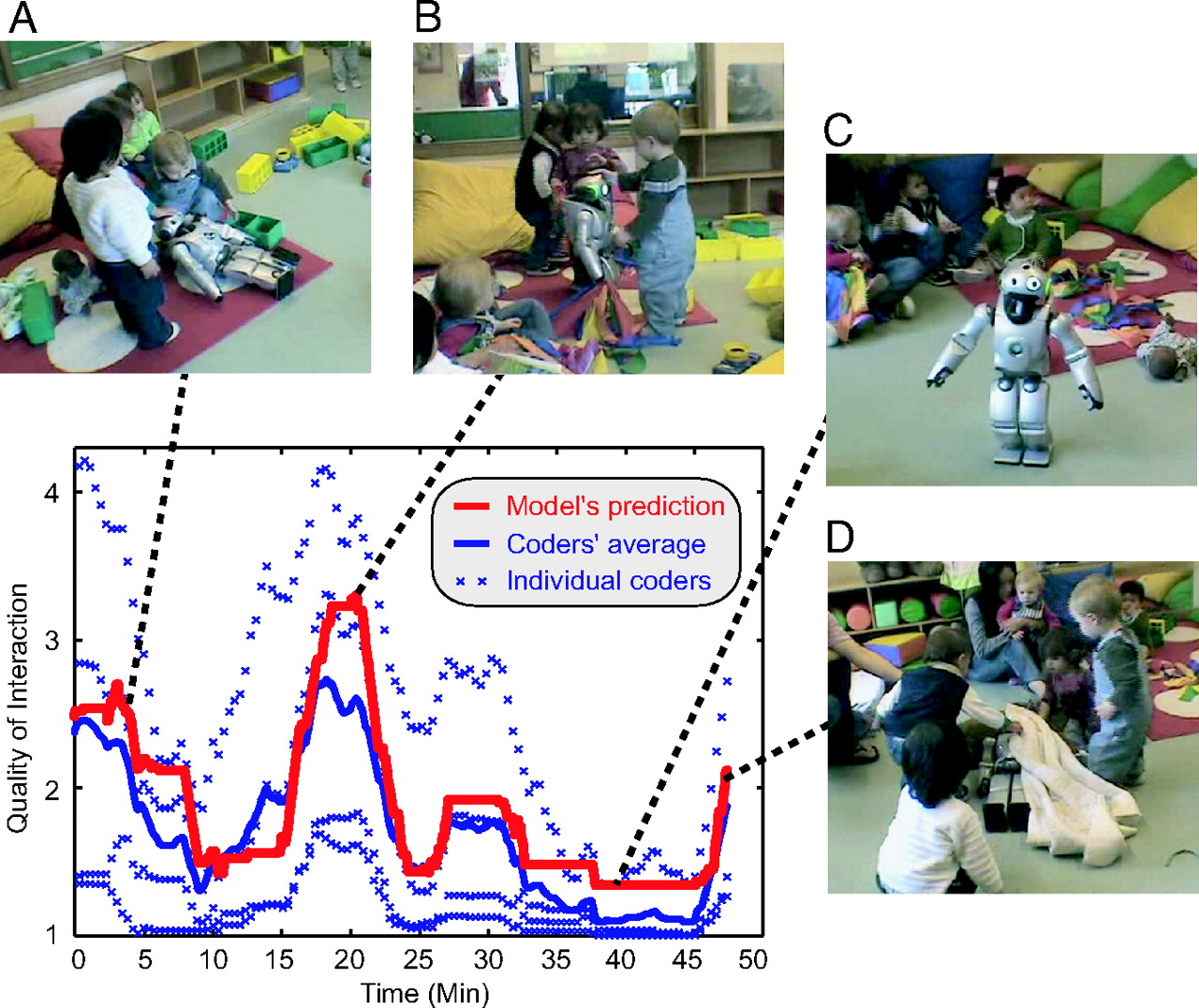
How's this for a (horrific) vision of the future! The abstract from Tanaka et al., followed by one figure from the paper:
A state-of-the-art social robot was immersed in a classroom of toddlers for >5 months. The quality of the interaction between children and robots improved steadily for 27 sessions, quickly deteriorated for 15 sessions when the robot was reprogrammed to behave in a predictable manner, and improved in the last three sessions when the robot displayed again its full behavioral repertoire. Initially, the children treated the robot very differently than the way they treated each other. By the last sessions, 5 months later, they treated the robot as a peer rather than as a toy. Results indicate that current robot technology is surprisingly close to achieving autonomous bonding and socialization with human toddlers for sustained periods of time and that it could have great potential in educational settings assisting teachers and enriching the classroom environment.


Figure - Predicting the quality of interaction. The red line indicates an automatic assessment of the quality of interaction between children and QRIO based on haptic (i.e. touching or physical contact) sensing. Blue lines indicate human assessment (by four independent coders) of the quality of interaction by using the continuous audience response method. (A) A session begins with QRIO waking up, attracting the children's interest. (B) During the music time in the classroom, children play with the robot. (C) Children are getting tired of the music time and losing interest in the robot. (D) Children put a blanket on the robot after it has laid down on the floor preparing for the end of a session.

Wednesday, November 14, 2007

This is Your Brain on Politics

Marco Iacoboni, whose work I have mentioned before, has together with several collaborators performed brain imaging experiments on 20 swing voters who indicate willingness to vote for a candidate from either party in the Nov. 2008 presidential elections. They summarize their findings in an Op-Ed piece in the Nov. 11 New York Times. There is a slide show you might like to watch. While insiders in the imaging business go apoplectic over simplistic interpretations of averaged data taken from a small number of subjects using ambiguous protocols with dubious controls, some correlations do emerge that "make sense." (See these comments on the article as 'junk science'.) For example: anterior cingulate (conflict resolution) associates with Hillary Clinton; or amygdala (anxiety) and insula (disgust) correlates with viewing the words "Democrat" or "Republican" but not "independent". One bit I found interesting: "Barack Obama and John McCain have work to do. The scans taken while subjects viewed the first set of photos and the videos of Mr. McCain and Mr. Obama indicated a notable lack of any powerful reactions, positive or negative."

Slide 2
Photos of Hillary Clinton elicited increased activity in the anterior cingulate cortex, a part of the brain that processes conflicting impulses, in swing voters who reported having an unfavorable opinion of her.

Tuesday, November 13, 2007

The brain in glorious color - "Brainbows"

Benedict Carey describes the work of Harvard researchers:
The scientists bred mice so their brain cells had genetic inserts containing genes for three colors of fluorescent protein, red, green and blue. They prompted each insert to randomly express one color, using a genetic trigger. Because there were multiple copies of the three-gene insert in each cell, the cell itself expressed a random mixture of the three colors, some 90 shades in all. What emerged was a kind of beaded rainbow belt of neurons, with the fluorescent glow radiating out through each cell’s neural branches. The researchers called the technique “Brainbow.”

Scientists can use this technique in animals, whose brain systems work in ways similar to those of humans, to see exactly where each cell begins and ends, both within the brain and out through the spine and the limbs — and what happens in between.

“I take a view that this is like the Hubble telescope,” said Dr. Jeff Lichtman, a professor of molecular and cellular biology at Harvard who is the paper’s senior author. “We’ve never been able to look at the brain this way before. Why not just start looking and see what we observe?”

Friday, October 26, 2007

The Outsourced Brain

I can't resist passing on this clever NY Times Op-Ed piece by David Brooks - on the subject of the dissolution of our individual intelligences into the mush of the infosphere.

Friday, October 19, 2007

Pogue’s Imponderables

Questions that N.Y. Times technical writer David Pogue doesn't have answers to. If you know the answers, fill him in at nytimes.com/pogue.
* Why is Wi-Fi free at cheap hotels, but $14 a night at expensive ones?

* What happens to software programs when their publishers go out of business?

* Would the record companies sell more music online if it weren't copy-protected?

* Do cellphones cause brain cancer?

* What's the real reason you have to turn off your laptop for takeoff?

* Why can't a digital S.L.R. camera record video?

* Wi-Fi on airplanes. What's taking so long?

* Who are the morons who respond to junk-mail offers, thereby keeping spammers in business?

* I'm told that they could make a shirt-pocket digital camera that takes pictures like an S.L.R., but it would cost a lot. So why don't they make one for people who can afford it?

* How come there are still no viruses for Mac OS X? If it has 6 percent of the market, shouldn't it have 6 percent of the viruses?

* Do shareware programmers pay taxes on all those $20 contributions?

* How are we going to preserve all of our digital photos and videos for future generations?

* Why are there no federal rebates or tax credits for solar power?

* Why do you have to take tape camcorders out of your carry-on at airport security, but not the tapeless kind? Couldn't you hide a bomb equally well in either one? (Actually, I have about 500 more logic questions about the rules at airport security, but I have a feeling they'll remain answerless for a very long time.)

* Laptops, cameras and cellphones have improved by a thousand percent in the last ten years. Why not their batteries?

* SmartDisplay, Spot Watch, U.M.P.C., Zune… when will Microsoft realize that it's not a hardware company?

* Why don't public sinks have foot pedals?

* Why don't all hotels have check-in kiosks like airlines do?

* Five billion dollars a year spent on ringtones? What the?

* How come cellphone signal-strength bars are so often wrong?

* Do P.R. people really expect anyone to believe that the standard, stilted, second-paragraph C.E.O. quote was really uttered by a human being?

* Why aren't there recycling bins for bottles and cans where they're most obviously needed, like food courts and cafeterias?

* Why doesn't someone start a cellphone company that bills you only for what you use? That model works O.K. for the electricity, gas and water companies —and people would beat a path to its door.

* Why doesn't everyone have lights that turn off automatically when the room is empty?

* What's the deal with Palm?

* Why are so many people rude on the Internet?

If you know the answers, by all means—fill us in at nytimes.com/pogue.

Thursday, October 11, 2007

Google's evil eye....

...thought I would link you to this interesting article.

See-through frog...

Just the thing for a budding young scientist's holiday stocking...From the Oct. 3 issue of Nature Magazine:
Japanese biologists have created what they call the world's first see-through creature with four legs. (Some fish are naturally transparent.) The frogs started out as ordinary Japanese brown frogs (Rana japonica ), but crossing animals with recessive genes for light-coloured skin led to transparency. Internal organs, eggs and other normally concealed innards are all on full display in the new amphibian (pictured). Its creator, Masayuki Sumida of Hiroshima University, plans to seek a patent, according to the AFP news agency.