 The last game of the baby boomers: Who wins is not who has the most toys, but who lives longest. Check out this great New Yorker article by Michael Kinsley. And, by the way, you might refer back to my May 2, 2007 post on Gawande's excellent article on aging.
Showing posts with label culture/politics. Show all posts
Showing posts with label culture/politics. Show all posts
Tuesday, April 22, 2008
Mine is longer than yours....
The last game of the baby boomers: Who wins is not who has the most toys, but who lives longest. Check out this great New Yorker article by Michael Kinsley. And, by the way, you might refer back to my May 2, 2007 post on Gawande's excellent article on aging.
Monday, April 07, 2008
The social cognitive neuroscience of business organizations
 Jumping on the bandwagon of getting cognitive neuroscience into business and marketing, there is a special issue of the Annals of the New York Academy of Sciences which offers one open access article by Klein and D'Desposito, "Neurocognitive Inefficacy of the Strategy Process." Their abstract (written in business-speak gobbledegook, but content can be extracted):
The most widely used (and taught) protocols for strategic analysis—Strengths, Weaknesses, Opportunities, and Threats (SWOT) and Porter's (1980) Five Force Framework for industry analysis—have been found to be insufficient as stimuli for strategy creation or even as a basis for further strategy development. We approach this problem from a neurocognitive perspective. We see profound incompatibilities between the cognitive process—deductive reasoning—channeled into the collective mind of strategists within the formal planning process through its tools of strategic analysis (i.e., rational technologies) and the essentially inductive reasoning process actually needed to address ill-defined, complex strategic situations. Thus, strategic analysis protocols that may appear to be and, indeed, are entirely rational and logical are not interpretable as such at the neuronal substrate level where thinking takes place. The analytical structure (or propositional representation) of these tools results in a mental dead end, the phenomenon known in cognitive psychology as functional fixedness. The difficulty lies with the inability of the brain to make out meaningful (i.e., strategy-provoking) stimuli from the mental images (or depictive representations) generated by strategic analysis tools. We propose decreasing dependence on these tools and conducting further research employing brain imaging technology to explore complex data handling protocols with richer mental representation and greater potential for strategy creation.
Sunday, March 30, 2008

Tuesday, March 25, 2008
Differing perception of facial expressions in the East and West
 Nagourney describes a study in the March issue of The Journal of Personality and Social Psychology reinforcing previous work showing that Westerners are more likely to see emotions as individual feelings while East Asians see them as inseparable from the feelings of the group. Many researchers have suggested that East Asians take a more holistic view of the world. Here is the abstract of the Masuda et al. article:
Two studies tested the hypothesis that in judging people's emotions from their facial expressions, Japanese, more than Westerners, incorporate information from the social context. In Study 1, participants viewed cartoons depicting a happy, sad, angry, or neutral person surrounded by other people expressing the same emotion as the central person or a different one. The surrounding people's emotions influenced Japanese but not Westerners' perceptions of the central person. These differences reflect differences in attention, as indicated by eye-tracking data (Study 2): Japanese looked at the surrounding people more than did Westerners. Previous findings on East-West differences in contextual sensitivity generalize to social contexts, suggesting that Westerners see emotions as individual feelings, whereas Japanese see them as inseparable from the feelings of the group.
Friday, March 21, 2008
Analogies between cultural and genetic evolution - the case of polynesian canoes
Rogers and Ehrlich, in an open access article, have made an important contribution to understanding cultural evolution. Here are some clips from an accompanying commentary by Stephen Shennan, followed by the article abstract. The link to the article takes you to pictures of the canoe features studied.
In the most general terms, parallel mechanisms for inheritance, mutation, selection, and drift act on culture as they do on genes...In the case of culture, the inheritance mechanism is social learning: People learn ways to think and act from others...natural selection can also act on cultural attributes, in the sense that those individuals who inherit or acquire certain cultural attributes may have a greater probability of surviving and/or reproducing than those who do not; as a result, those cultural attributes will become increasingly prevalent. For example, it is clear that, in many parts of the world, adopting an agricultural rather than a hunting-and-gathering way of life led to greater reproductive success; as a result, the cultural traits that characterize agriculture spread and, in some cases, subsequently influenced genetic evolution [e.g., the ability to digest lactose]...It is also important to look at things from what Dawkins called "the meme's eye-view," the perspective of the cultural attributes themselves...in the case of the canoe attributes analyzed by Rogers and Ehrlich, these culturally transmitted features are the data that archaeologists and anthropologists have available...What Rogers and Ehrlich have done is make progress in this area by showing that variation that is believed to be under selection is patterned differently from other variation that is believed not to be under selection, or at least not in the same way. It seems to be more conservative and, therefore, under negative selection. Perhaps more surprisingly, they find that there is no correlation at all in the similarities between island groups in terms of functional canoe variation and the similarities based on symbolic variation. One might have expected some correlation, either because both would be affected by the distance between the islands, or because the process of island colonization by groups in canoes would have brought both their functional and their symbolic attributes. The fact that selection appears to have been sufficiently powerful to overwhelm evidence of descent history is extremely interesting and confirms the importance of regarding cultures not as hermetically sealed entities, a bit like species, but as bundles of distinct packages of traits affected by different forcesThe Rogers and Ehrlich abstract:
It has been claimed that a meaningful theory of cultural evolution is not possible because human beliefs and behaviors do not follow predictable patterns. However, theoretical models of cultural transmission and observations of the development of societies suggest that patterns in cultural evolution do occur. Here, we analyze whether two sets of related cultural traits, one tested against the environment and the other not, evolve at different rates in the same populations. Using functional and symbolic design features for Polynesian canoes, we show that natural selection apparently slows the evolution of functional structures, whereas symbolic designs differentiate more rapidly. This finding indicates that cultural change, like genetic evolution, can follow theoretically derived patterns.
Thursday, March 20, 2008
A fiery piano performance...
This makes me cringe..... On March 8, pianist Yosuke Yamashita donned a fireproof suit and played a burning piano on a beach in Ishikawa prefecture. The improvised jazz performance went for about 10 minutes until the flames rendered the piano silent.
Tuesday, March 11, 2008
The age of American unreason
A Kakutani review of Susan's Jacoby's book with the title of this post is worth a look.
Monday, March 10, 2008
More on Brain Enhancement
 Have a look at Benedict Carey's article, "Brain Enhancement Is Wrong, Right?," in the NY Times Week in Review of 3/9/08. It continues the topic of using performance enhancing drugs, following up on a Nature article that I mentioned in my Feb. 1 post on the same subject. By the way, I have been meaning to point you to Chris Chatham's excellent post on how to use caffeine properly, obtaining effects on cognitive performance equivalent to those of modifanil. Here are some clips from the Carey article:
...two Cambridge University researchers reported that about a dozen of their colleagues had admitted to regular use of prescription drugs like Adderall, a stimulant, and Provigil, which promotes wakefulness, to improve their academic performance. The former is approved to treat attention deficit disorder, the latter narcolepsy, and both are considered more effective, and more widely available, than the drugs circulating in dorms a generation ago.
Francis Fukuyama raises the broader issue of performance enhancement: “The original purpose of medicine is to heal the sick, not turn healthy people into gods.” He and others point out that increased use of such drugs could raise the standard of what is considered “normal” performance and widen the gap between those who have access to the medications and those who don’t — and even erode the relationship between struggle and the building of character.
People already use legal performance enhancers, he said, from high-octane cafe Americanos to the beta-blockers taken by musicians to ease stage fright, to antidepressants to improve mood. “So the question with all of these things is, Is this enhancement, or a matter of removing the cloud over our better selves?”.
“You can imagine a scenario in the future, when you’re applying for a job, and the employer says, ‘Sure, you’ve got the talent for this, but we require you to take Adderall.’ Now, maybe you do start to care about the ethical implications.”
Moral Neuropolitics
Gary Olson, who is Chair of the Dept. of Political Science of Maravian College in Bethlehm, PA., sent me a latest draft of his article "From Mirror Neuron to Moral Neuropolitics." It does a nice job with the literature on mirror neurons and its implications, as well as political and cultural factors that enhance and inhibit moral behaviors. Gary is willing to pass on the draft article to blog readers for further comment (web version here; PDF download here).
My main comment was that the article might - in addition to covering cultural and political factors that work against moral behaviors between groups of distant people - add more data from evolutionary and developmental biology studies that also offer some evidence for factors working against morality and compassion. There is evidence for xenophobia and aggression between groups of animals (intra-group morality and cooperation, but also inter-group aggression and warfare), well documented in Chimps (cf. Feb. 19 Killer Instincts post), and other social animals (cf. March 8 post on Hyenas). Also, experiments show that that groups of children spontaneously invent not only language, but also in-groups and out-groups (cf. July 31 post) that can become competitive.
My main comment was that the article might - in addition to covering cultural and political factors that work against moral behaviors between groups of distant people - add more data from evolutionary and developmental biology studies that also offer some evidence for factors working against morality and compassion. There is evidence for xenophobia and aggression between groups of animals (intra-group morality and cooperation, but also inter-group aggression and warfare), well documented in Chimps (cf. Feb. 19 Killer Instincts post), and other social animals (cf. March 8 post on Hyenas). Also, experiments show that that groups of children spontaneously invent not only language, but also in-groups and out-groups (cf. July 31 post) that can become competitive.
Tuesday, March 04, 2008
Reasoning about our irrational ways
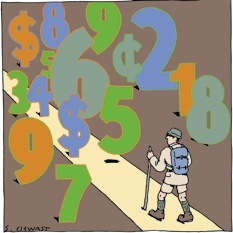 Elizabert Kolbert writes an interesting review in The New Yorker of several books on our irrational economic and political behaviors, the field of behavioral economics. It seems very likely that as politicians and governments become more knowledgeable about the patterns and emotional mechanisms governing our blunders, they will begin to nudge people towards more rational choices. The 'opt out' plans for increasing the numbers of people with health insurance plans or retirement savings are one example of this. Obama's campaign is making very good use of some basic neuro-economics and some of his people are aware of Westin's work (see my July 11 post), as well as Lakoff's (see Jan 31 post). Hillary doesn't seem to have a clue......
Tuesday, February 26, 2008
Life expectancy increases
Taken from an article by Kirkwood on a systems biology approach to longevity...

The graph shows the life expectancy in the then longest-living country. During the nineteenth and early twentieth centuries, the increase was driven mainly by improvements in sanitation, housing and education, causing a steady decline in early and mid-life mortality, which was chiefly due to infections. This trend continued with the development of vaccines and then antibiotics. By the latter half of the twentieth century, there was little room for further reduction in early and mid-life mortality. The continuing increase is due almost entirely to a new phenomenon: the decline in late-life mortality.

The graph shows the life expectancy in the then longest-living country. During the nineteenth and early twentieth centuries, the increase was driven mainly by improvements in sanitation, housing and education, causing a steady decline in early and mid-life mortality, which was chiefly due to infections. This trend continued with the development of vaccines and then antibiotics. By the latter half of the twentieth century, there was little room for further reduction in early and mid-life mortality. The continuing increase is due almost entirely to a new phenomenon: the decline in late-life mortality.
Monday, February 25, 2008
Love speed dating
 You may do better in relying on your impression after only 4 minutes of interaction with a potential partner than if you think about it a lot. Here is an engaging essay by Matt Kaplan.
Monday, February 18, 2008
Need something to worry about? Climate tipping points...
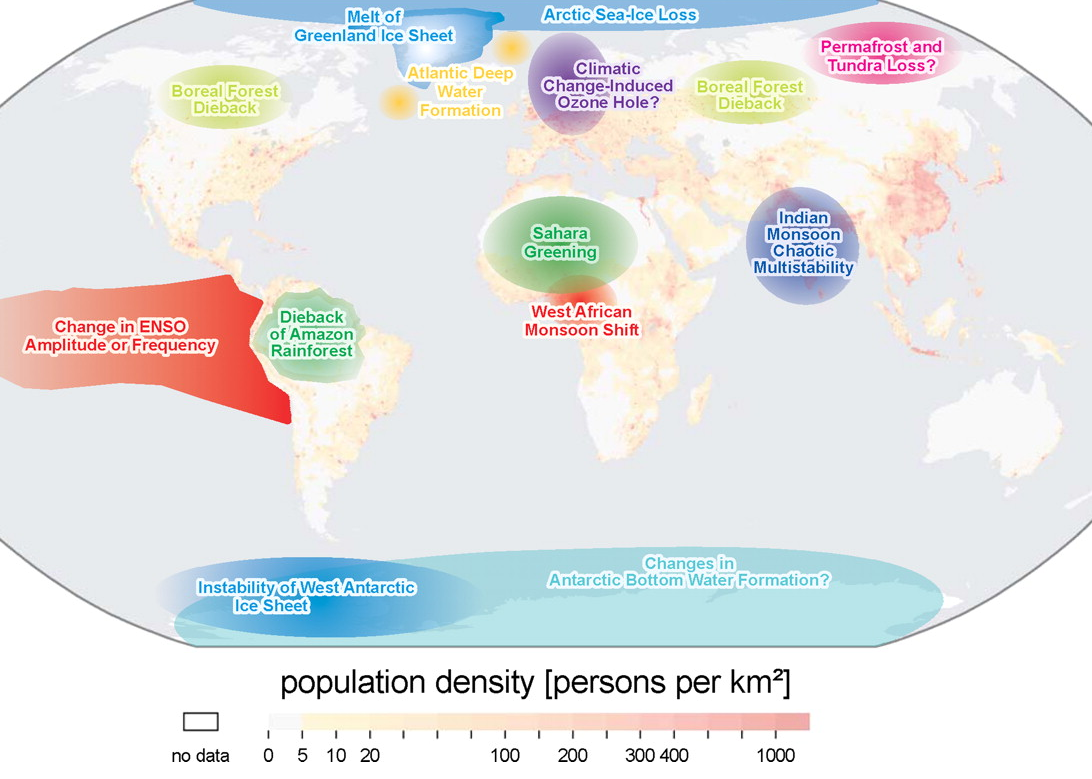 This graphic is from an open access article in PNAS by Lenton et al. on tipping elements in the earth's climate system. You probably need to click on the graphic to make it larger; the color indicating the population densities is hard to see. In the same issue of PNAS, there is an article on how when it get warm (as in the Paleocene – Eocene Thermal Maximum caused by a carbon dioxide increase about 55 million years ago), the insects chow down on the plants.
Legend for graphic - Map of potential policy-relevant tipping elements in the climate system, overlain on global population density. Subsystems indicated could exhibit threshold-type behavior in response to anthropogenic climate forcing, where a small perturbation at a critical point qualitatively alters the future fate of the system. They could be triggered this century and would undergo a qualitative change within this millennium. We exclude from the map systems in which any threshold appears inaccessible this century (e.g., East Antarctic Ice Sheet) or the qualitative change would appear beyond this millennium (e.g., marine methane hydrates). Question marks indicate systems whose status as tipping elements is particularly uncertain.
Wednesday, February 13, 2008
Are today's young people really more narcissistic?
A comment by Trzesniewski et al. on the idea that today's young people have inflated impressions of themselves compared with previous generations. They:
..investigated secular trends in narcissism and self-enhancement over the past three decades. Despite recent claims about the impact of the "self-esteem movement" on the current generation of young people, we found no evidence that college students' scores on the Narcissistic Personality Inventory increased from the 1980s through 2007 (N = 26,867), although we did find small changes in specific facets of narcissism. Similarly, we found no evidence that high school students' level of self-enhancement, defined by the discrepancy between their perceived intelligence and their actual academic achievements, increased from 1976 to 2006 (N = 410,527). These results cast doubt on the belief that today's young people have increasingly inflated impressions of themselves compared with previous generations.
Tuesday, February 12, 2008
Could a presidential debate on science backfire?
An interesting essay by David Goldston argues that a debate on science by presidential candidates might do more harm than good.
Monday, February 11, 2008
The incubator of suicide attacks - Fictive Kinship
 Anthropologist Scott Atran (Author of "In Gods We Trust") writes an essay laying out his change of mind about why people are willing to die for a cause. He has moved from thinking that individual cognition and personality, influences from broad socio-economic factors, and degree of devotion to religious or political ideology were determinant, to seeing friendship and others aspects of small group dynamics, especially acting together, trumping most everything else.
...people don't kill and die simply for a cause. They do it for friends — campmates, schoolmates, workmates, soccer buddies, body-building buddies, pin-ball buddies — who share a cause. Some die for dreams of jihad — of justice and glory — but nearly all in devotion to a family-like group of friends and mentors, of "fictive kin." (Atran gives a number of explicit examples of such groups)
... it is no accident that nearly all religious and political movements express allegiance through the idiom of the family — Brothers and Sisters, Children of God, Fatherland, Motherland, Homeland, and the like. Nearly all such movements require subordination, or at least assimilation, of any real family (genetic kinship) to the larger imagined community of "Brothers and Sisters." Indeed, the complete subordination of biological loyalty to ideological loyalty for the Ikhwan, the "Brotherhood" of the Prophet, is Islam's original meaning, "Submission."
...Social psychology tends to support the finding that "groupthink" often trumps individual volition and knowledge, whether in our society or any other. But for Americans bred on a constant diet of individualism the group is not where one generally looks for explanation.
Friday, February 08, 2008
Middle Age Misery
 Blanceflower and Oswald have done a fascinating study (PDF here) showing that across cultures, from Azerbaijan to Zimbabwe, we are happiest towards the beginning and end of our lives, leaving us most miserable in middle years between 40 and 50. For both men and women in the UK, the probability of depression peaked at around the age of 44. In the US, men were most likely to be unhappiest at 50, while for women the age was 40. The cause of the apparent U-shaped curve is not known. Quoting Oswald (the graphic is from his website):
...one possibility is that individuals learn to adapt to their strengths and weaknesses, and in mid-life quell their infeasible aspirations. Another possibility is that cheerful people live systematically longer...A third possibility is that older people might compare their lives with their peers'. Seeing their friends die could mean people value their remaining years more highly...It looks from the data like something happens deep inside humans. For the average person in the modern world, the dip in mental health and happiness comes on slowly, not suddenly in a single year...Only in their 50s do most people emerge from the low period. But encouragingly, by the time you are 70, if you are still physically fit then on average you are as happy and mentally healthy as a 20-year-old. Perhaps realising that such feelings are completely normal in mid-life might even help individuals survive this phase better.
Monday, February 04, 2008
The algorithms of love...
 John Tierney writes an interesting article on internet match finding services in the Jan 29 New York Times.
Online matchmaking has become a boom industry as rival scientists test their algorithms for finding love...The leading yenta is eHarmony, which pioneered the don’t-try-this-yourself approach eight years ago by refusing to let its online customers browse for their own dates. It requires them to answer a 258-question personality test and then picks potential partners...Another company, Perfectmatch.com, is using an algorithm designed by Pepper Schwartz, a sociologist at the University of Washington at Seattle. Match.com, which became the largest online dating service by letting people find their own partners, set up a new matchmaking service, Chemistry.com, using an algorithm created by Helen E. Fisher, an anthropologist at Rutgers who has studied the neural chemistry of people in love.On reading that Chemistry.com didn't discriminate against gay match making, I naturally decided to give it a spin and went through their series of questions (including one on the relative lengths of one's index and ringer finger). It included psychological profile questions and some interesting tests of susceptibility to visual illusions. Alas, the list of prospective mates for a 65 yr. old retired professor was rather lean, and I ended my experiment by withdrawing my chemistry.com profile after one day.
As the matchmakers compete for customers — and denigrate each other’s methodology — the battle has intrigued academic researchers who study the mating game. On the one hand, they are skeptical, because the algorithms and the results have not been published for peer review. But they also realize that these online companies give scientists a remarkable opportunity to gather enormous amounts of data and test their theories in the field. EHarmony says more than 19 million people have filled out its questionnaire...In the battle of the matchmakers, Chemistry.com has been running commercials faulting eHarmony for refusing to match gay couples (eHarmony says it can’t because its algorithm is based on data from heterosexuals), and eHarmony asked the Better Business Bureau to stop Chemistry.com from claiming its algorithm had been scientifically validated. The bureau concurred that there was not enough evidence, and Chemistry.com agreed to stop advertising that Dr. Fisher’s method was based on “the latest science of attraction.”
Dr. Fisher now says the ruling against her last year made sense because her algorithm at that time was still a work in progress as she correlated sociological and psychological measures, as well as indicators linked to chemical systems in the brain. But now, she said, she has the evidence from Chemistry.com users to validate the method, and she plans to publish it along with the details of the algorithm...“I believe in transparency,” she said, taking a dig at eHarmony. “I want to share my data so that I will get peer review.”
Sunday, February 03, 2008
Super Bowl preliminaries....the anthropoligist from Mars
The description in the header of this blog includes the phrase "and random curious stuff." Well....this post qualifies. I show you one of the videos used Sunday to warm patrons up for the super bowl orgy at my happy hour bar. "Macho Man", the Village People. Watching this did make me feel like Oliver Sacks' anthropologist from Mars.
Thursday, January 31, 2008
Why men are at the top.
 Helena Cronin presents an interesting idea about why men walk off with most of the top positions and prizes that sidesteps the usual assumption of average differences between men and women in innate talents, tastes and temperaments. She notes that there not only more Nobels, but also more dumbbells among men, and suggests that it is a fourth "T" that most decisively shapes the distinctive structure of male — female differences. Some clips from her essay:
That T is Tails — the tails of these statistical distributions. Females are much of a muchness, clustering round the mean. But, among males, the variance — the difference between the most and the least, the best and the worst — can be vast. So males are almost bound to be over-represented both at the bottom and at the top...Consider the mathematics sections in the USA's National Academy of Sciences: 95% male. Which contributes most to this predominance — higher means or larger variance? One calculation yields the following answer. If the sex difference between the means was obliterated but the variance was left intact, male membership would drop modestly to 91%. But if the means were left intact but the difference in the variance was obliterated, male membership would plummet to 64%. The overwhelming male predominance stems largely from greater variance...Similarly, consider the most intellectually gifted of the USA population, an elite 1%. The difference between their bottom and top quartiles is so wide that it encompasses one-third of the entire ability range in the American population, from IQs above 137 to IQs beyond 200. And who's overwhelmingly in the top quartile? Males. Look, for instance, at the boy:girl ratios among adolescents for scores in mathematical-reasoning tests: scores of at least 500, 2:1; scores of at least 600, 4:1; scores of at least 700, 13.1.
The legacy of natural selection is twofold: mean differences in the 3 Ts and males generally being more variable; these two features hold for most sex differences in our species and, as Darwin noted, greater male variance is ubiquitous across the entire animal kingdom...The upshot? When we're dealing with evolved sex differences, we should expect that the further out we go along the right curve, the more we will find men predominating. So there we are: whether or not there are more male dumbbells, there will certainly be — both figuratively and actually — more male Nobels.
Unfortunately, however, this is not the prevailing perspective in current debates, particularly where policy is concerned. On the contrary, discussions standardly zoom in on the means and blithely ignore the tails. So sex differences are judged to be small. And thus it seems that there's a gaping discrepancy: if women are as good on average as men, why are men overwhelmingly at the top? The answer must be systematic unfairness — bias and barriers. Therefore, so the argument runs, it is to bias and barriers that policy should be directed. And so the results of straightforward facts of statistical distribution get treated as political problems
Subscribe to:
Posts (Atom)